

Genentech-Led Study Reveals ESCRT-Mediated Membrane Repair as a Novel Mechanism of Tumor Immune Evasion, Opening Avenues for Next-Generation Cancer Therapies

Genentech
Pharmaceutical R&D Manufacturer

Howard Hughes Medical Institute
The Howard Hughes Medical Institute (HHMI) is a non-profit medical research institute in the United States. HHMI is also a scientific philanthropy organization dedicated to advancing basic biomedical research and science education for the benefit of humanity. We appoint scientists, provide research and educational grants, offer free classroom resources, and share scientific stories with a global audience. In all our endeavors, we encourage talented scientists, educators, and students to remain curious, pursue challenging scientific questions, and contribute to making science more inclusive.

Peter MacCallum Cancer Centre
Peter MacCallum Cancer Centre is a world-leading center for cancer research, education, and treatment, and it is the only public health service institution in Australia dedicated to caring for cancer patients. Peter MacCallum Cancer Centre employs 3,900 staff members, including more than 750 laboratory and clinical researchers, all of whom are focused on delivering better treatments, improved care, and potential cures for cancer.
In a new study, researchers from Genentech, the Howard Hughes Medical Institute, and the Peter MacCallum Cancer Centre have discovered that cancer cells can survive attacks by repairing small pores caused by a protein released from T cells in their membranes. The relevant findings were published in the April 22, 2022, issue of the journal *Science*, with the paper titled “ESCRT-mediated membrane repair protects tumor-derived cells against T cell attack”. In this paper, the authors describe how they used high-resolution imaging to understand what happens when cytotoxic T lymphocytes (CTLs), a type of T cell, attack cancer cells. Norma Andrews from the University of Maryland, College Park, published a Perspective article titled “Resisting attack by repairing the damage” in the same issue of *Science*, summarizing the research conducted by the team.
Previous studies have shown that CTLs kill cells infected by viruses or bacteria.InfectionThe method by which cells and cancer cells operate is by attaching to target cells and then releasing two protein toxins: perforin and granzyme. Perforin creates small pores in the membrane of the target cell. Subsequently, granzyme enters the target cell through these pores and triggers apoptosis, which is normal programmed cell death. In this new study, the authors gained insight into how cancer cells respond to such attacks.
Using high-resolution imaging and a strategy that allowed them to isolate cells during the early permeabilization process, the authors were able to observe cytotoxic T lymphocytes (CTLs) attaching to tumor cells and initiating an attack. They observed perforin successfully creating pores in the cancer cell membrane, followed by granzymes beginning to enter the cancer cells. However, they also noticed something else: the cancer cells started releasing proteins known as endosomal sorting complexes required for transport (ESCRT), which previous studies had shown are produced by cells as a means of repairing membrane damage. This blocked further entry of granzymes, thereby preventing apoptosis and allowing the cancer cells to survive.
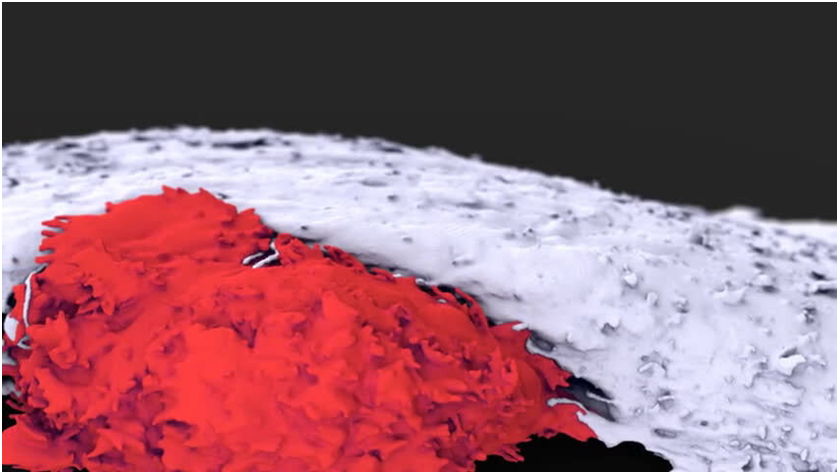
Image from Science, 2022, doi:10.1126/science.abl3855.
These authors then attempted two different methods — the first using CRISPR to inactivate a gene involved in ESCRT production, and the second genetically modifying cells to overexpress an enzyme involved in the process — to prevent cancer cells from releasing ESCRT. They found that both methods reduced the survival ability of cancer cells under CTL attack.BioValley Bioon.com)
References:
1. Alex T. Ritter et al. ESCRT-mediated membrane repair protects tumor-derived cells against T cell attack. Science, 2022, doi:10.1126/science.abl3855.
2. Norma Andrews. Resisting attack by repairing the damage. Science, 2022, doi:10.1126/science.abp8641.
3. Cancer cells found to repair their own membranes after attack by T cells
https://medicalxpress.com/news/2022-04-cancer-cells-membranes.html