

Medtronic's Harmony Transcatheter Pulmonary Valve Delivery System Recalled as Class I After One Year on Market

Medtronic
Chronic Disease Medical Device and Therapy Developer

FDA
U.S. Food and Drug Administration
On April 26, the FDA announced that Medtronic's Harmony Transcatheter Pulmonary Valve (TPV) catheter system was classified as a Class I recall, the most serious recall level, meaning the device may cause serious injury or death.
WeChat Video Preview
The Harmony Transcatheter Pulmonary Valve (TPV) System is the world's first self-expanding pulmonary valve, which was designated as a “Breakthrough Device” by the FDA, accelerating its approval. This device received FDA approval in March 2021.
However, just one year after its approval, on March 2, 2022, Medtronic initiated a voluntary recall of the Harmony Transcatheter Pulmonary Valve (TPV) delivery system. A total of 665 devices distributed in the United States between April 7, 2021, and January 26, 2022, were affected by this recall.
As of now, six clinical case complaints have been reported, with one injury and zero deaths related to device use.
Risk of Device Breakage
Will be suspended
Transcatheter Pulmonary Valve Replacement (TPVR), first introduced in 2000, is used to treat patients with right ventricular outflow tract dysfunction (including stenosis and regurgitation) following right ventricular outflow tract reconstruction. Similar to TAVR, minimally invasive implantation can delay open surgery and improve the long-term prognosis for these patients.
Although TPVR was the first to be introduced, its development has lagged relatively behind TAVR due to factors such as the size of the patient population, indications, durability, and promotional value.
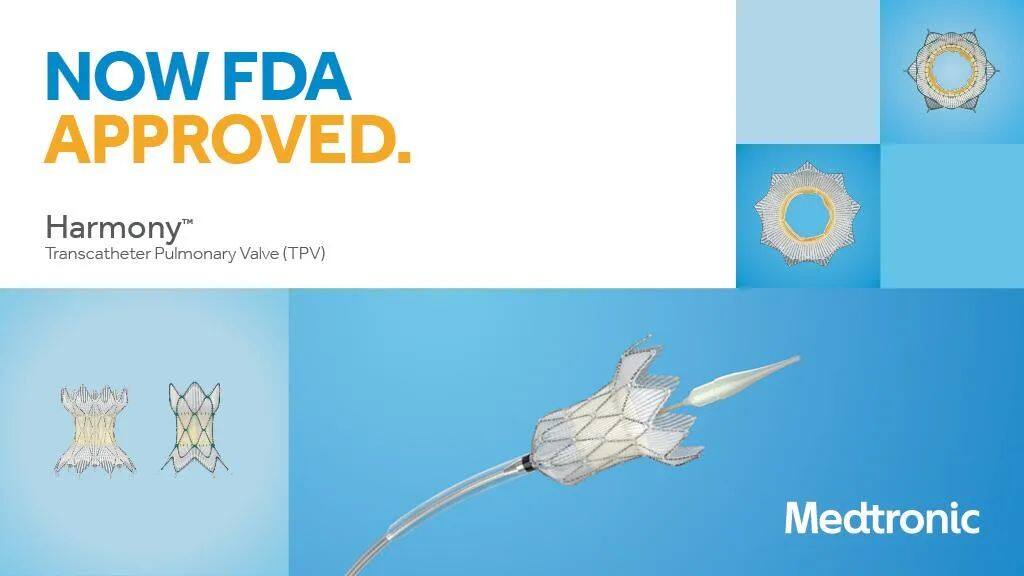
Harmony Transcatheter Pulmonary Valve (TPV) is the world's first self-expanding pulmonary valve. Previously marketed TPVR products were mainly balloon-expandable valves, such as Medtronic's Melody and Edwards' Sapien.
However, the smaller size of balloon-expandable valves is not suitable for the anatomical characteristics of RVOT aneurysmal dilation caused by long-term PR, further limiting the use of TPVR.
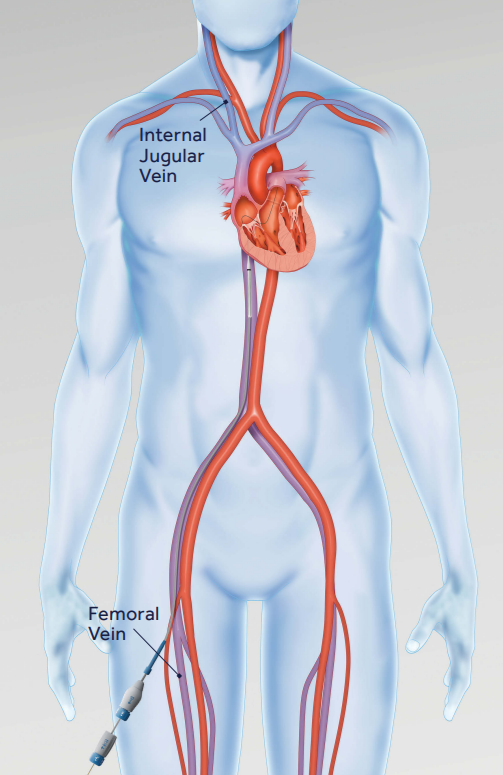
Harmony's approval not only resolved the issue of smaller-sized balloon-expandable valves but also enabled Medtronic to take the lead over Edwards in TPVR, whose product is still currently in clinical research.
However, just one year after this globally first approved product, on March 2, 2022, Medtronic initiated a recall of the Harmony catheter delivery system. The reason was that during the placement of the TPV, the adhesive securing the capsule to the end of the delivery catheter might break.
Fracture may lead to surgical delays or require additional surgeries. If a fracture occurs during the procedure, it could cause serious harm to the patient. These risks include: blocking blood flow and/or complete obstruction (embolism or occlusion), tearing and/or splitting (perforation or dissection), or other types of damage to the patient’s blood vessels.

Recalled Product Batch
According to reports, there are currently a total of 6 complaints from clinical cases, one injury, and no deaths related to the use of these devices.
The FDA-related recall page shows that the recall affects 665 devices distributed in the U.S. between April 7, 2021, and January 26, 2022.
Affected are:
1. Healthcare professionals planning to implant Harmony TPV in patients with severe pulmonary valve regurgitation
2. Candidates for Valve Replacement Using the Harmony TPV System
Medtronic also specifically noted that the recall applies only to the Harmony TPV delivery catheter, not the Harmony TPV itself. Patients who have successfully received the Harmony TPV implant do not need to take any action.
On April 6, 2022, Medtronic issued an urgent medical device recall notice to implanting physicians and customers, recommending the immediate suspension of use of the Harmony TPV delivery catheter.
Customer Notice Includes:
1. Remove the catheter from all unused products and return it to Medtronic.
2. Suspend new implant cases for the Harmony TPV system.
3. Customers are also required to fill out a form attached with a letter to confirm receipt of the recall and report the number of unused devices currently on hand.
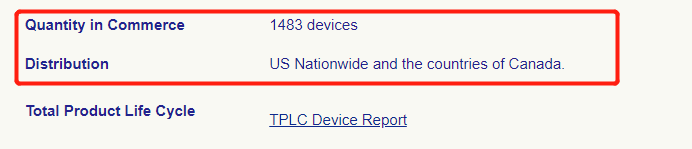
After checking the relevant FDA pages, it was found that a total of 1,483 Harmony TPV systems have been distributed in the United States and Canada. It is currently unclear whether the recall will be expanded to include all products, as well as those sold in Canada.
Medtronic Involved in Class I Recall
China Greatly Affected
Over the past two years, Medtronic has frequently been involved in Class I recall incidents, making it hard to tell whether these are old or new occurrences.
Death caused by stent fracture,DiabetesBusiness Plummets
According to the FDA database, Medtronic had 10 recalls classified as Class I in 2021.
Among them, the Valiant Navion thoracic stent graft system experienced an extremely rare clinical incident of "stent fracture." Three patients in the "Valiant Evo Global Clinical Trial" had stent fractures, two of whom experienced fiber tearing, leading to blood leakage into the aorta, and resulting in the death of one subject.
The MiniMed insulin pump is the core product of Medtronic's diabetes business, and the recall of this product has also caused significant trouble for Medtronic.
MiniMed 670G
In October 2021, Medtronic expanded the recall of the MiniMed 508, Paradigm pump remote controls, and MiniMed 600 series pumps. Both recalls were classified as Class I recalls, posing a risk of serious injury or death. This recall significantly impacted Medtronic's diabetes business.
In December 2021, Medtronic received a warning letter from the FDA, naming it for mishandling the recall of insulin pumps and remote controllers. To address the related issues, the approval of Medtronic's new insulin pump and CGM products was further delayed, dealing another heavy blow to its diabetes business, which immediately reflected in the market. Following the public release of the warning letter, Medtronic's stock price fell more than 11% in a few days to $99.53.
The recalls in 2021 also involved products made in China on multiple occasions.
In December 2021, the National Medical Products Administration announced that due to a manufacturing error, Medtronic's Covidien division had initiated a Class I recall of the Puritan Bennett 980 series ventilators.
On November 18, 2021, the National Medical Products Administration (NMPA) announced several recalls by Medtronic, including a Class I recall for the Insulin Pump and the Endurant II Stent Graft System.
"Life-Saving Device" Recalled at Level 1, Accounts for 50% in China
As the New Year of 2022 arrived, Medtronic's recall incident did not come to an end.
Only one month into the year, Medtronic has been involved in four Class I recalls, including:
Covidien's Puritan Bennett 980 Series Ventilator, Synergy Cranial, Stealth Station S7 Cranial Software, and HawkOne Directional Resection System
However, just when everyone was no longer surprised by the recall incidents, this Class I recall actually involved 50% of the products in China.
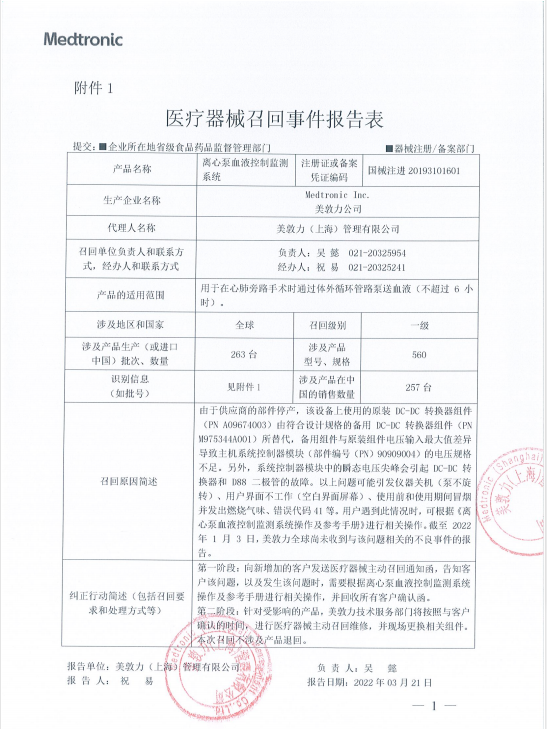
In March 2022, the NMPA announced that Medtronic decided to initiate a Level 1 recall of the Extracorporeal Blood Pumping Console, a centrifugal pump blood control monitoring system for ECMO.
The document shows that this failure may cause the instrument to shut down, including a blackened interface, smoke coming from the device, and a burning smell during use.
Industry insiders interpret that, for ECMO machines, a black screen or blood pump stoppage means the machine cannot properly simulate human blood circulation. Although the probability is low, the consequences are extremely severe.
The recall involves 263 units produced (imported) in China, while the current number of ECMO devices in China is only around 500. This recall by Medtronic involves nearly half of the devices. ECMO, known as Extracorporeal Membrane Oxygenation in Chinese, can not only temporarily replace the heart and lung functions of patients and reduce the burden on their heart and lungs, but also address conditions such as respiratory failure and cardiac arrest, thus earning it the nickname "life-saving device."
China's ECMO product deployment was already insufficient, and ECMO is a key medical device urgently needed for epidemic prevention and control. It can be said that this recall will greatly impact China's healthcare system.
Business growth slows down
Previously, Medtronic released its global financial report for the fiscal year 2021 (FY21 period from April 25, 2020, to April 30, 2021).
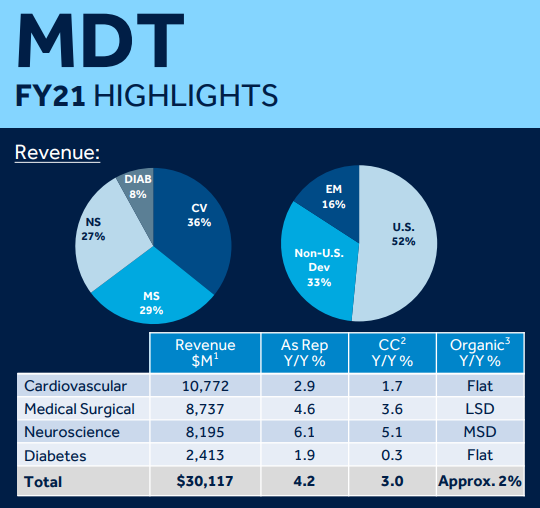
Data shows that in Medtronic's fiscal year 2021, the reported revenue was $30.17 billion, with a reported revenue increase of 4% and an organic growth rate of 2%.
Among them, the specific financial performance of the four major segments is as follows:
Cardiovascular business achieved revenue of $10.772 billion, a year-on-year increase of 2.9%. Surgical and critical care business achieved revenue of $8.737 billion, growing by 4.6%. Neuroscience business reached $8.195 billion, with a year-on-year increase of 6.1%. Diabetes business achieved $2.413 billion, increasing by 1.9% year-on-year.
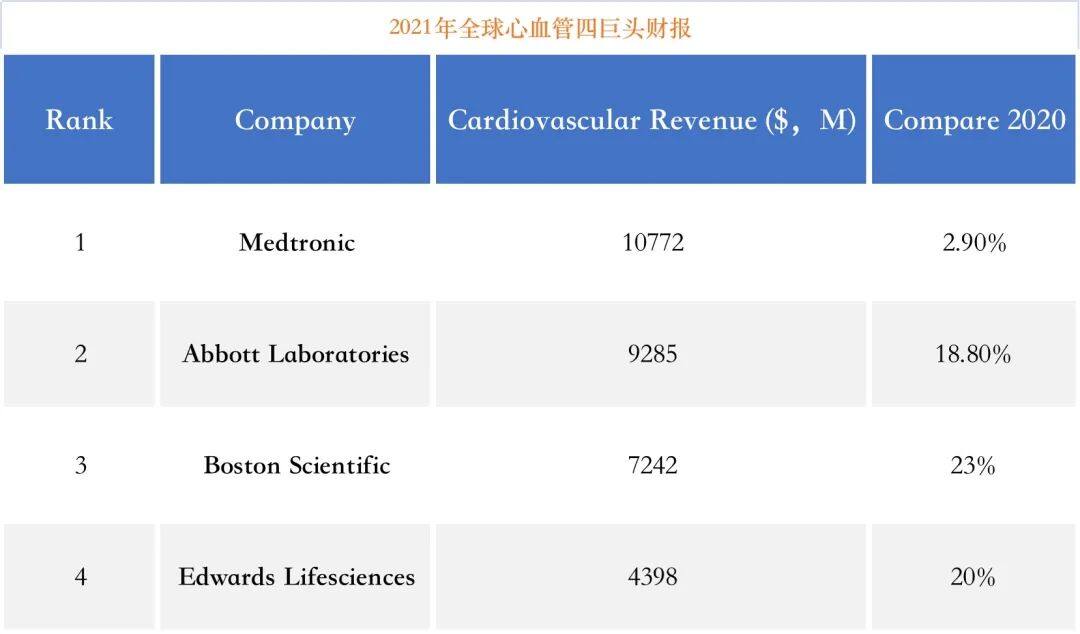
*Medtronic's fiscal year 2021 period ranges from April 28, 2020, to April 28, 2021.
Combined with the recent financial reports of other companies, the ranking of the global cardiovascular top four remains unchanged: Medtronic, plc. first, Abbott second, Boston Scientific third, and Edwards Lifesciences fourth.
Medtronic still ranks first in the cardiovascular field, but its growth has significantly slowed, with the lowest increase among the four companies.
Fiscal Year 2021 was also the first year for Geoff Martha as the global CEO of Medtronic. In the last quarter of FY2021, Medtronic restructured its cardiovascular business, including Cardiac Rhythm and Heart Failure, Structural Heart, Aortic, Coronary, and Peripheral Vascular, in pursuit of change.
Cardiovascular business is the earliest started and longest-operating business of Medtronic, and also the highest revenue-generating segment. In the fiscal year 2020, the revenue of this business segment declined by 9%, and this downward trend did not change in the fiscal year 2021.
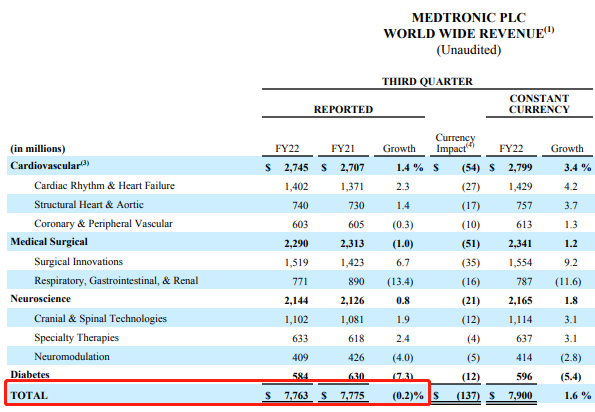
Screenshot from Medtronic's financial report
As a cautionary tale, impacted by the insulin pump recall incident, in the first three quarters of the fiscal year 2022 (ending January 28, 2022), Medtronic's diabetes business revenue reached $1.741 billion, marking a year-on-year decrease of 1.4%. This is the only business segment of Medtronic that experienced a decline.
The recall of the Harmony transcatheter pulmonary valve (TPV) catheter system once again sounded the alarm for Medtronic's cardiovascular sector. However, as the world's first self-expanding pulmonary valve, its innovative value remains commendable.
In previous clinical studies, the Harmony Transcatheter Pulmonary Valve (TPV) has also demonstrated excellent safety (no mortality) and effectiveness.
In a prospective, non-randomized, multi-center clinical study, 70 patients were implanted with Harmony. All patients were scheduled for follow-up at the start of the study, during the implant procedure, at discharge, and at one month, six months, and five years post-implant.
Within 30 days after Harmony implantation, the primary safety endpoint was no surgery- or device-related deaths, which was achieved by 100% of patients. At 6 months, there were no significant reinterventions, reoperations, or endocarditis. Meanwhile, among patients with evaluable echocardiograms, 89.2% reached the primary efficacy endpoint.
Following the approval of Harmony, this study has been extended to 10 years in order to provide long-term durability, safety, and effectiveness data for Harmony.
Medical devices are directly related to human safety, so their innovation process and market entry are particularly difficult. Will the impact of this recall incident expand further in the future? Med Device House will continue to follow up.