

Lilly's Tirzepatide Achieves Landmark Success in First Phase III Obesity Trial: Up to 24 kg Weight Loss at 72 Weeks

Eli Lilly
Global Pharmaceutical R&D and Production Company
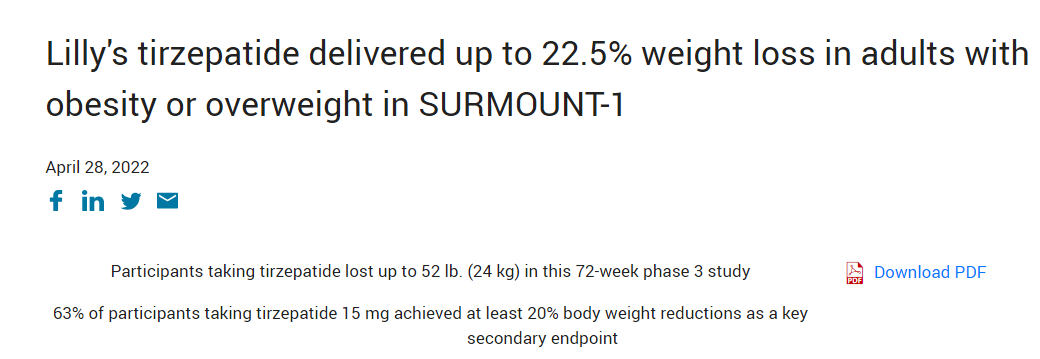
On April 28, Eli Lilly announced the key results of the Phase III SURMOUNT-1 study of GLP1R/GIP dual agonist tirzepatide for the treatment of obesity patients without diabetes. Compared with placebo, the weight loss effect of tirzepatide (5 mg, 10 mg, 15 mg) treatment groups at week 72 was significantly better than that of the placebo control group, with an average weight loss of up to 22.5% (24kg). Moreover, 63% of patients in the 15mg high-dose group achieved a weight loss of more than 20%.
SURMOUNT-1 Study is the first global Phase III registration study of tirzepatide conducted in obese patients. It enrolled 2,539 obese or overweight patients with at least one condition (hypertension, dyslipidemia, obstructive sleep apnea syndrome, or cardiovascular disease, but without diabetes). The study evaluated the differences in weight loss efficacy and safety of adding tirzepatide versus placebo on the basis of a low-calorie diet and increased exercise.
Subjects were randomized in a 1:1:1:1 ratio, with tirzepatide treatment starting at a once-weekly dose of 2.5mg, followed by dose escalation in 2.5mg increments every four weeks until reaching target doses of 5mg, 10mg, and 15mg, which were maintained through 72 weeks. The study’s co-primary endpoints were the percentage reduction in body weight at Week 72 and the proportion of patients achieving at least 5% weight loss, comparing the tirzepatide 10mg and 15mg groups to the placebo control group.
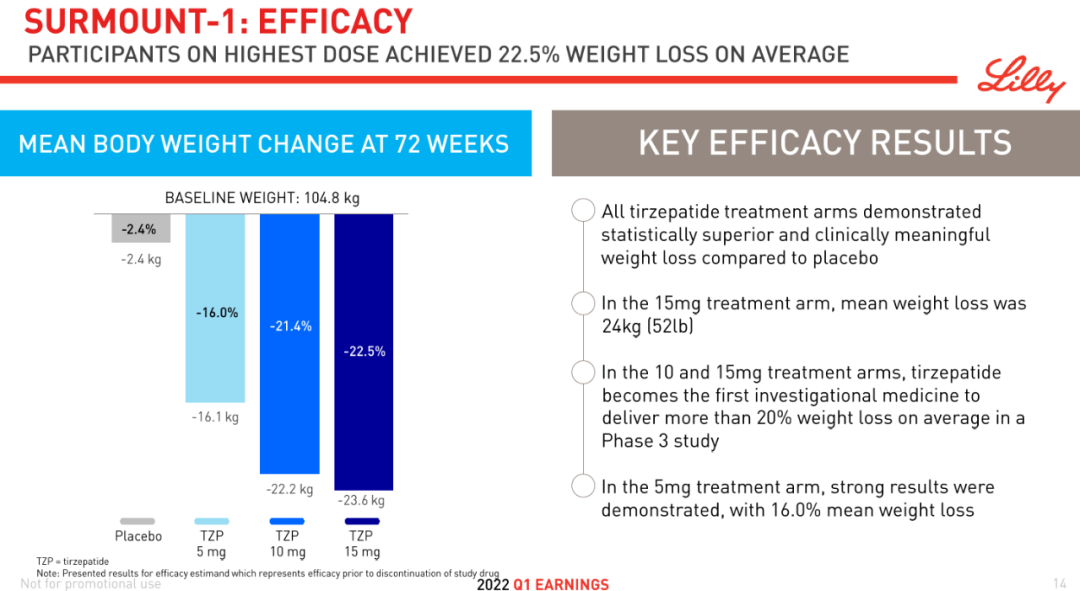
The results showed that after 72 weeks of treatment with tirzepatide 5mg, 10mg, 15mg, and placebo, the participants' weight decreased by an average of 16.0% (16.1kg), 21.4% (22.2kg), 22.5% (23.6kg), and 2.4% (2.4kg) from baseline, respectively. The proportion of patients who lost more than 5% of their body weight was 89.4%, 96.2%, 96.3%, and 28%, respectively.
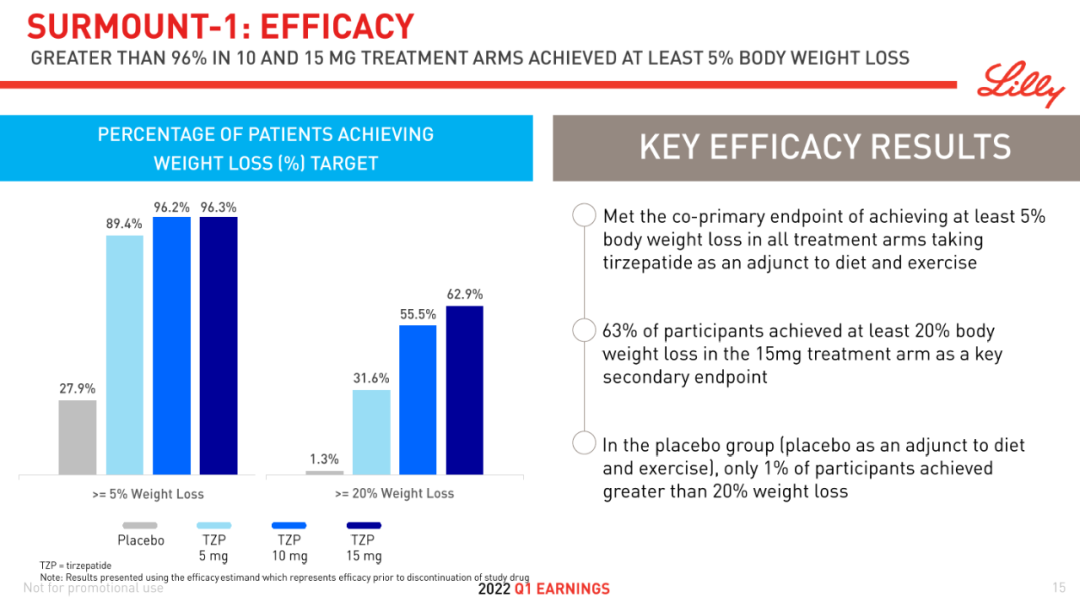
For the key secondary endpoint, the proportion of patients who lost more than 20% of their body weight in the tirzepatide 10mg, 15mg, and placebo groups was 55.5%, 62.9%, and 1.3%, respectively.
In terms of safety, the most commonly reported adverse events were gastrointestinal-related, generally occurring during the dose-escalation period, with mild to moderate severity. Compared with placebo, patients receiving tirzepatide (5mg, 10mg, and 15mg) experienced nausea (24.6%, 33.3%, 31.0%), diarrhea (18.7%, 21.2%, 23.0%), vomiting (8.3%, 10.7%, 12.2%), and constipation (16.8%, 17.1%, 11.7%) more frequently. These symptoms occurred in the placebo group at rates of 9.5%, 7.3%, 1.7%, and 5.8%, respectively.
The treatment discontinuation rates due to adverse events were 4.3% (5mg), 7.1% (10mg), 6.2% (15mg), and 2.6% (placebo), respectively. The overall treatment discontinuation rates were 14.3% (5mg), 16.4% (10mg), 15.1% (15mg), and 26.4% (placebo), respectively.
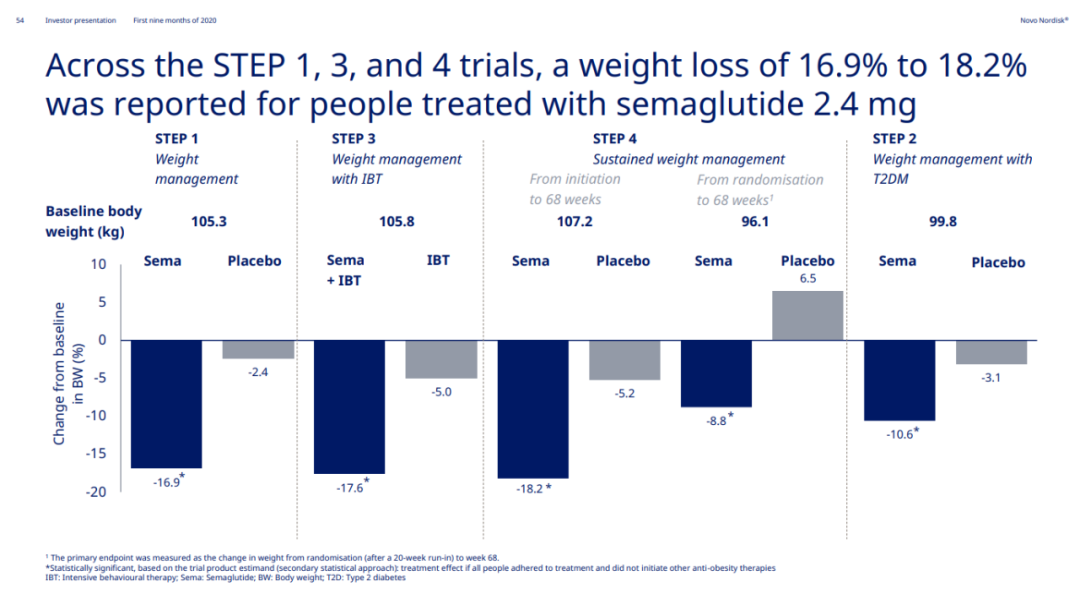
Novo Nordisk's GLP-1R agonist semaglutide was approved by the FDA in June 2021 for a new indication for obesity, mainly based on data from four Phase IIIa clinical trials in the STEP clinical development program. Administered once weekly via subcutaneous injection at a dose of 2.5mg, it achieved weight loss of 16.9% to 18.2%.
Tirzepatide is a novel once-weekly subcutaneous injection GLP-1R/GIPR dual agonist. In October 2021, a new drug application for the treatment of type 2 diabetes was submitted to the U.S. FDA and the European EMA. A priority review voucher was also submitted along with the NDA to the FDA in the hope of expediting its approval. The obesity indication represents the second battleground for Tirzepatide to continue its head-to-head competition with semaglutide.
The SURMOUNT clinical development program, which was initiated at the end of 2019, includes six studies and has already enrolled more than 5,000 patients who are overweight or obese. The results of the SURMOUNT-2, -3, and -4 studies will be announced in 2023.