

Neurointerventional Sector Surges with Up to 517% Revenue Growth: How Domestic Players Achieved a Market Breakthrough

HeartCare
Neurointerventional Medical Device Developer

Zylox-Tonbridge
Innovative R&D, Production, and Sales of Medical Devices in the Vascular Intervention Field
Peijia Medical
Developer of Cardiac and Cerebrovascular Interventional Medical Devices
2021 is a turning point in the field of neurointervention.
In the first half of the year, neurointervention was still a hot favorite in the eyes of investors, receiving much attention. However, by the second half of the year, neurointervention had become largely overlooked.
Now, as listed companies engaged in neurointervention businesses successively release their annual reports, investors who once bet on the neurointervention field can smile with relief:Although the number of investment and financing events in the industry has sharply decreased, the neurointervention businesses of various companies have grown rapidly.。
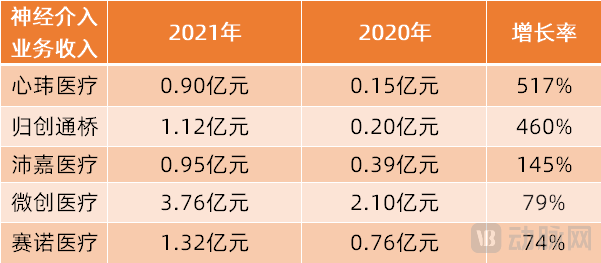
In 2021, HeartCare's neurointervention business revenue reached 0.9 billion yuan, a significant year-on-year increase of 517%. Meanwhile, the neurointervention businesses of Zylox-Tonbridge, Peijia Medical, Minimally Invasive Brain Science, and Sino Medical also achieved year-on-year growth of 460%, 145%, 79%, and 74%, respectively.
How did neurointervention break into the market from the start of commercialization to a surge in revenue? How will companies respond to the shift from "fierce competition" to "centralized procurement"? With a long road ahead, how are companies planning for the future? To address these questions, VCBeat conducted an in-depth analysis of the annual reports of listed companies operating in the neurointervention sector.
In 2021, it was not only a year for neurointerventional companies to go public, but also a year when the neurointerventional field fell from the pedestal of the capital market. Similarly, it was also a year for neurointerventional companies to work hard and develop their businesses.
In 2021, with substantial R&D funding support, companies made smooth progress in product development and registration. For example, HeartCare invested approximately 76.3 million yuan in R&D in 2021, a year-on-year increase of 49%. By the end of 2021, it had received NMPA approval for 11 neurointerventional devices. Zylox-Tonbridge invested about 168 million yuan in R&D in 2021, representing a 133.3% increase over 2020. By the end of 2021, it had obtained Class III registration certificates for nine neurointerventional devices.
After numerous products have been approved for marketing, various enterprises have transitioned from the product development stage to the commercialization stage. So, how are they entering the market?
After reviewing the annual reports of various companies, we found that: first,Neurointerventional companies provide comprehensive product solutions in the market.For example, Zylox-Tonbridge has launched a complete three-piece solution in the field of ischemic stroke, including the蛟龙 intracranial thrombectomy stent, balloon guiding catheter, and intracranial thrombus aspiration catheter, while advocating the BADDASS technique to support the promotion of the three-piece solution. HeartCare has introduced a product suite for stent thrombectomy, comprising a thrombectomy stent, distal access catheter, microcatheter, and occlusion balloon catheter.
Secondly, in addition to comprehensive product solutions, companies also place great emphasis on market sales channels.Among them, HeartCare's sales and marketing team has exceeded 100 people, and a distribution network consisting of more than 100 distributors has been established, covering over 1,400 hospitals in China.
Peijia Medical's sales and marketing team, which focuses on neuro-interventional business, consists of 55 people. Its distribution network, composed of 143 distributors, has covered more than 1,700 hospitals across China. Minimally Invasive Brain Science (Suzhou) Co., Ltd., on the other hand, covers approximately 2,200 hospitals in China, including all of the top 100 hospitals ranked monthly by the National Stroke Center of China.
Finally, based on extensive marketing networks, products from various companies have successfully entered numerous hospitals. However, in order to promote neurointerventional surgery, companiesA large amount of funds has been spent on market promotion.。For example, Zylox-Tonbridge conducted extensive marketing and product training activities, with sales and distribution costs amounting to 95.27 million yuan; Peijia Medical spent 15.22 million yuan on conferences and incurred expenses of 39.77 million yuan in sales and distribution for its neurointervention business; HeartCare's sales and distribution expenditures reached 51.13 million yuan.
InFull-set solutions, sales channels, marketing activities, product training events, conference promotionsWith support from multiple aspects, the revenue of neurointervention businesses of various companies surged significantly. For instance, MicroPort NeuroScience's neurointervention business revenue in 2021 was approximately 376 million yuan, Zylox-Tonbridge’s was 112 million yuan, Peijia Medical’s was 95 million yuan, and HeartCare’s was 90 million yuan.
However, the sources of revenue growth for each company are different.For example, the neurointervention business of Minimally Invasive Brain Science (Suzhou) Co., Ltd. surged by 79.3%, mainly benefiting from its flow diverter, coil embolization system, vertebral artery rapamycin-targeted eluting stent system, intracranial support catheter system, and intracranial artery stent system, covering four细分fields: hemorrhagic stroke, cerebral arteriosclerosis stenosis, ischemic stroke, and vascular access.
Zylox-Tonbridge's sales revenue from thrombectomy stents and intracranial support catheters increased by 441.5% year-on-year in 2021. Its intracranial aneurysm embolization coils and intracranial PTA balloon dilation catheters accounted for 15.8% of the total revenue in 2021. Among these, the ischemic stroke and vascular access segments related to thrombectomy stents and intracranial support catheters showed significant growth.
Peijia Medical's revenue growth mainly comes from hemorrhagic stroke, ischemic stroke, and vascular access products. Among them, the revenue from hemorrhagic products increased by 52.3% year-on-year, accounting for 54.2% of the total neurointervention business revenue; the revenue from ischemic products increased by 596.2% year-on-year, accounting for 20.6% of the total neurointervention revenue; the revenue from vascular access products increased by 1094.3% year-on-year, accounting for 24.9% of the total neurointervention revenue.
HeartCare's revenue growth in 2021 was driven by the "thrombectomy device quartet" – thrombectomy devices, distal access catheters, intracranial balloon dilation catheters, carotid artery balloon dilation catheters – as well as intracranial arterial stenosis treatment devices.
Overall, the hemorrhagic stroke segment grew steadily in 2021, while the ischemic stroke and vascular access segments showed explosive growth trends.。
In 2021, in addition to these listed companies accelerating market promotion, unlisted innovative companies such as Jian Shi Medical, Wallaby Medical, Zhongtian Medical, HeartCare Medical, Libai Technology, and MicroNova also joined the market competition.
On the one hand, the participation of many enterprises in market promotion has rapidly popularized neurointerventional surgeries, significantly increasing the market size; on the other hand, the entry of multiple enterprises has led to a situation of "fierce competition" in the neurointerventional market.
In addition to fierce market competition, the neurointerventional market also faces centralized procurement. In September 2021, the Zhejiang Provincial Drug and Medical Consumables Centralized Volume Procurement Office released the "Second Batch of Medical Consumables Centralized Volume Procurement Catalog for Public Medical Institutions in Zhejiang Province (Draft for Solicitation of Comments)," planning volume-based procurement of specialized microcatheters for neurointervention. In November 2021, Hebei Province announced notices regarding centralized volume procurement of hernia patches, dural patches, and coil embolization devices.
As neuro-interventional dedicated microcatheters and coils are included in the centralized procurement, and with an increasing number of products being approved for marketing, it is expected that more products in the neuro-intervention industry will be incorporated into the centralized procurement.
How will companies respond to fierce market competition and centralized procurement?
According to the annual report, we found that these companies all plan to enhance market competitiveness through platform-based layouts and a rich product portfolio. Meanwhile, each company is planning to increase revenue sources by innovating medical devices and expanding markets.
In terms of a rich product portfolioTaking Zylox-Tonbridge as an example, it not only launched a three-part solution in the field of ischemic stroke but also strengthened its R&D efforts. By the end of 2021, it had obtained Class III registration certificates for 9 neurointerventional products and expects to receive approval for an additional 16 neurointerventional products by the end of 2025.
Zylox-Tonbridge first opened the market and captured a certain market share with its "three-piece solution," earning a good reputation. Subsequently, Zylox-Tonbridge could leverage its commercial capabilities to quickly promote new products into hospitals and seize the market. In the event of fierce market competition, on one hand, Zylox-Tonbridge could reduce the price of similar single products for sales, and on the other hand, it could increase revenue by selling complementary devices.
At the same time, its sales team sells a full range of products, which not only reduces marketing costs but also facilitates hospital procurement and lowers the surgical risks associated with switching between different brands of instruments—a win-win situation. In this way, Zylox-Tonbridge can leverage its comprehensive solutions with a rich product portfolio to gain a competitive edge over single-product companies and enhance its market competitiveness.
In response to centralized procurement, the logic is the same. After the centralized procurement of a single product, Zylox-Tonbridge can push its complementary products into hospitals more quickly and achieve profitability through these complementary devices.
In terms of device innovation,Minimally Invasive Brain Science (Suzhou) Co., Ltd. launched the world's first and only intracranial covered stent system for treating cerebrovascular diseases, adopting a differentiated promotion strategy focused on personalized and unique treatment approaches.
HeartCare has innovatively developed an aspiration pump, and its aspiration catheter is currently undergoing registration review. So far, there is only one domestically produced neurointerventional thrombus aspiration system available in China. Once HeartCare's innovative product is launched, it will provide new options for patients in China.
Zylox-Tonbridge further developed vacuum suction devices and radial artery access vascular sheaths, and after the launch of the Jiaolong stent, began developing the next-generation technology product: a fully visible thrombectomy stent.
In terms of market development,Companies are working together to "expand the pie." For instance, MicroPort has launched the " Divine Eagle and Flying Swallow Project" targeting the grassroots healthcare market. The project aims to educate doctors in primary healthcare institutions about neurointervention, conduct training for neurointerventional surgeries, and provide follow-up consultations and regular guidance for local doctors and patients. To date, the initiative has reached approximately 80 lower-tier cities and counties.
It can be seen that through the "Shendiao Flying Swallow Plan," Minimally Invasive Medical not only extended medical resources to grassroots levels, opening up a new market in primary healthcare, but also brought hope to patients suffering from hemorrhagic stroke, who are under strict time constraints.
Overall, companies are using platform-based product layouts to undercut single-product enterprises, enhancing market competitiveness; through device innovation, they are meeting unmet clinical needs and creating differentiated advantages; by providing multi-faceted training to allocate medical resources to lower-tier markets, they are expanding grassroots markets and growing the pie. With the synergy of various strategies, the neurointerventional market is maintaining healthy growth.。
In fact, in addition to the aforementioned measures, companies are also avoiding risks and exploring new revenue growth points by exporting medical devices.
For example, the coil embolization system independently developed by MicroPort has successively obtained the EU CE certification, approval from South Korea's Ministry of Food and Drug Safety, and U.S. FDA market approval, and has achieved overseas implantation in Chile. At the same time, MicroPort has strategically partnered with Israeli company Rapid Medical to create a "dual stent" product portfolio featuring the Neurohawk intracranial thrombectomy stent and the world’s first fully visible adjustable stent. Additionally, both parties will leverage each other's sales channels to promote the application of neurovascular disease solutions in the global market.
As of now, MicroPort has established local sales teams in Brazil, Japan, and the UK to expand its global sales network. It plans to build local R&D and production facilities in the United States in the future, creating global supply capabilities.
Minimally Invasive Medical's annual report shows that its total revenue in 2021 was $7.786 billion, of which overseas revenue (non-China region) reached $4.216 billion, accounting for approximately 54.15%. This indicates that Minimally Invasive Medical's overseas business is becoming one of the core drivers of its revenue growth, and its strategy of expanding medical device exports has yielded substantial returns.
Zylox-Tonbridge stated in its annual report: "The overseas market is crucial to our development strategy, and we will continue to invest to enhance our competitiveness."
In overseas markets, Zylox-Tonbridge has initiated clinical trial designs for key products such as the second-generation drug-eluting PTA balloon dilation catheter, intravascular lithotripsy system, and flow diverter, and has launched registration plans for more products like intracranial aneurysm embolization coils.
At the same time, Zylox-Tonbridge is planning to establish a local team in Europe to assist in launching new products and brand building; it intends to seek geographic expansion in selected markets based on different product needs and adopt a customized strategy to commercialize products in different target jurisdictions, including collaborative development, granting commercial rights to third parties, and cooperating with distributors.
To enhance the overseas brand awareness, Zylox-Tonbridge also plans to regularly and continuously participate in the Leipzig Interventional Course (LINC), attend more renowned international medical conferences such as the World Conference of Interventional Neuroradiology (WCIN), and join industry exhibitions as well as conferences organized by the European Stroke Organisation (ESO) and the World Stroke Organization (WSO).
It can be seen that Minimally Invasive Medical has achieved scaled revenue in overseas markets and is strengthening the construction of sales channels and R&D production capabilities. On the other hand, Zylox-Tonbridge is in the early stages of entering international markets, with plans to expand its channels and enhance brand building.
A review of the annual reports of various companies reveals another commonality: all enterprises are currently expanding their product lines and venturing into other fields.
Why is this so? We estimate that this is a move by companies to reduce risks and increase sources of profit.
HeartCare's annual report shows that, in addition to building a complete neurointervention product line, the company alsoPlans to build a complete solution in cardiac intervention, including left atrial appendage occluders, electrophysiology, and coronary intervention robots, covering multiple fields with significant clinical demand such as atrial fibrillation treatment, stroke prevention, structural heart disease, and heart failure.At the same time, HeartCare also plans to continuously advance the research and development of multiple innovative device pipelines in the fields of pulmonary intervention and computer-assisted technology.
Zylox-Tonbridge stated: "We plan not only to continuously improve the product portfolio in existing treatment areas but also to leverage our current products and advantages.Extend to other fields", fully leveraging our R&D capabilities." In addition to independent research and development, Zylox-Tonbridge also plans to expand its product line by establishing strategic alliances, partnerships, and other methods.
For example, in November 2021, Zylox-Tonbridge entered into a cooperation with Hangzhou Tianlu Medical, obtaining the exclusive license to certain proprietary technologies of its intravascular lithotripsy system. The intravascular lithotripsy system is used for treating peripheral vascular diseases and will expand Zylox-Tonbridge's...Lower Extremity Arterial Disease Solutions。
In January 2022, Zylox-Tonbridge focused on development.Pan-Vascular Surgical RobotMicroVast Medical. At the same time of the investment, Zylox-Tonbridge and MicroVast Medical entered into a strategic cooperation agreement, which grants Zylox-Tonbridge the exclusive agency sales rights to preferentially obtain products developed by MicroVast Medical in specific regions where commercialization advantages have been established.
Peijia Medical plans to maintain its sales growth momentum in the neurointervention field by further increasing the penetration rate of existing products and commercializing new products. Meanwhile, Peijia Medical also intends to strengthen its product pipeline, including transcatheter mitral valve intervention devices, transcatheter tricuspid valve intervention devices, and other transcatheter valve treatment products. Additionally, Peijia Medical will continue to enhance its internal R&D capabilities and seek deeper collaborations and strategic partnerships worldwide.
Overall, these companies are no longer solely focused on the neurointervention field but have started to extend their reach into other areas. Among them, vascular interventional surgical robots have gained significant recognition and attention from such enterprises.
In fact, the field of vascular intervention includes three major areas: cardiovascular intervention, peripheral intervention, and neurointervention. The products in these three areas have a certain degree of commonality, which provides the prerequisite for companies to extend their business into related fields.
As a future product that investors, clinical doctors, and industry insiders all highly anticipate, vascular interventional surgical robots are also closely related to the products of various companies. It is only natural that these enterprises focus heavily on this field.