

AbbVie’s JAK Inhibitor Rinvoq Receives Fourth FDA Approval in Five Months for Ankylosing Spondylitis

AbbVie
Innovative Drug Developer
FDA
U.S. Food and Drug Administration
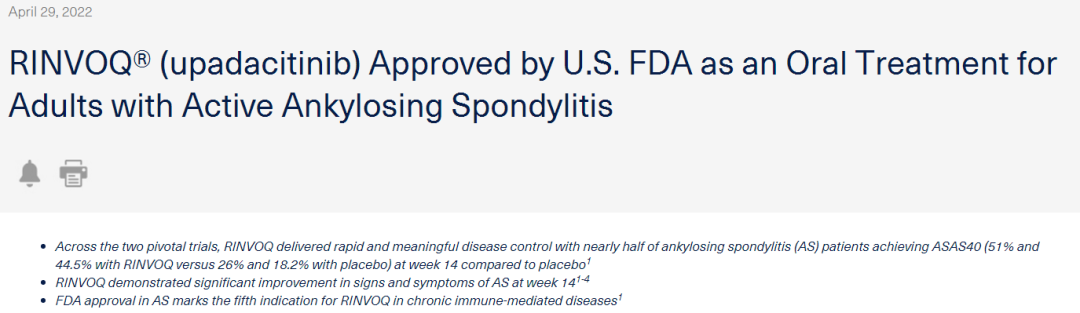
On April 29, AbbVie announced that the U.S. FDA approved Rinvoq (upadacitinib) for the treatment of adult patients with active ankylosing spondylitis (AS) who have had an inadequate response or intolerance to one or more tumor necrosis factor (TNF) blockers. This marks the fourth FDA approval for the drug within five months.
AS is a chronic inflammatory musculoskeletal disease that primarily affects the spine. It is estimated that in the United States, one in every 200 adults (approximately 1.1 million people) is affected. For patients whose pain symptoms persist after treatment with TNF receptor blockers, current treatment options are very limited.
This approval is based on the efficacy and safety data from the Phase III SELECT-AXIS 2 clinical trial (Study 1) and the Phase II/III SELECT-AXIS 1 trial. The SELECT-AXIS 2 trial evaluated the efficacy and safety of Rinvoq in patients with inadequate response or intolerance to one or two biologic disease-modifying antirheumatic drugs (bDMARDs). The SELECT-AXIS 1 trial assessed the efficacy and safety of Rinvoq in patients who had not received bDMARDs and had an inadequate response or intolerance to at least two nonsteroidal anti-inflammatory drugs (NSAIDs).
In the SELECT-AXIS 1 and SELECT-AXIS 2 clinical trials, the proportion of patients receiving Rinvoq 15 mg who achieved an ASAS40 response (a composite index measuring disease activity, primary endpoint) at week 14 (51% and 44.5%, respectively) was significantly higher than that of patients receiving placebo (26% and 18.2%, respectively).
This approval marks the fourth for the drug, following its previous approvals in December of last year for psoriatic arthritis, in January this year for atopic dermatitis, and in March for ulcerative colitis. Rinvoq was initially approved in 2019 for the treatment of rheumatoid arthritis. According to AbbVie's Q1 report, Rinvoq generated $465 million in revenue, representing a 57% increase compared to the same period last year.
AbbVie is banking on Rinvoq and Skyrizi to fill the gap after Humira loses patent protection in 2023. The company forecasts that Rinvoq's sales will reach $8 billion by 2025. An $8 billion revenue seems achievable if Rinvoq can continue to expand its indications and avoid recent safety concerns associated with the JAK inhibitor class of drugs.
Last year, a post-marketing study of Pfizer's JAK inhibitor Xeljanz found that the drug was associated with an increased risk of heart-related side effects and cancer. This prompted the FDA to update the black box warnings for all three oral JAK inhibitors (including Eli Lilly's Olumiant) and recommend TNF blockers as an alternative (for details, see: FDA Requires JAK Inhibitors to Add "Black Box Warning" for Risk of Serious Heart Events).