

Breakthrough in China's Venous Intervention Market: Product Portfolio Strategy vs. Single-product Focus

Venmedtech
Peripheral Vascular Field Product R&D and Manufacturer
In recent years, vascular interventional devices have developed rapidly. In terms of the progress of localization in China, the localization in the field of coronary intervention has been relatively mature, with coronary stents achieving a transition from technological catch-up to localized substitution. Neurointervention follows closely behind, but...Peripheral intervention is still in the growth stage, especially in venous intervention, where only the vena cava filter can currently compete with foreign products.。
The current state of development of venous interventional devices is closely related to the characteristics of peripheral venous diseases themselves, the clinical development of vascular surgery, and the public's awareness of venous diseases, among other factors.
Peripheral venous disease has a slow onset and relatively low rates of mortality and disability, so the current clinical treatment rate is not high. According to statistical analysis by Industrial Securities, only 0.2% of patients with peripheral arterial disease receive revascularization treatment, and the treatment rate for venous diseases is even lower. In 2021, the number of percutaneous coronary intervention (PCI) procedures in China exceeded one million cases, while the number of peripheral venous interventional procedures lagged far behind.
With the increasing degree of aging population in China and the continuous improvement of residents' living standards, people's concepts of disease treatment are also changing. Health awareness and the demand for comfort are constantly rising, shifting from treating fatal diseases to improving quality of life and reducing suffering.
Some peripheral venous diseases, such as varicose veins and iliac vein compression syndrome, although not highly lethal, cause distress in patients' daily lives, leading to pain and mobility issues. If left untreated, they may result in severe conditions like amputation or pulmonary embolism (PE). With the aim of improving patients' quality of life and reducing the risk of complications, clinical attention towards peripheral venous diseases is continuously increasing.
Currently, the number of doctors engaged in venous interventional treatment is increasing year by year, and the medical theory of venous surgery is also developing rapidly, with relevant treatment guidelines and consensuses emerging endlessly. At the same time, the surgical treatment methods for peripheral venous diseases have shifted from highly invasive approaches to minimally invasive interventions, significantly reducing the learning curve for doctors and the risk of surgical complications. All these factors are driving the continuous expansion of China's venous intervention market.
Clinical demand exists, and the market has space. Can domestic companies seize the opportunity in the billion-dollar market supported by over 100 million patients with peripheral venous diseases?
Peripheral Venous Disease refers to a syndrome characterized by a series of symptoms and signs caused by structural or functional abnormalities of the veins, which result in poor venous blood return and excessively high venous pressure. Peripheral venous disease accounts for approximately 60% of peripheral vascular diseases, mainly including three major conditions: varicose veins, deep vein thrombosis, and iliac vein compression syndrome.
From the patient base, the prevalence of lower extremity venous disease in China accounts for 8.9% of the total population, with over 100 million patients, several times the number of patients with other cardiovascular and cerebrovascular diseases.
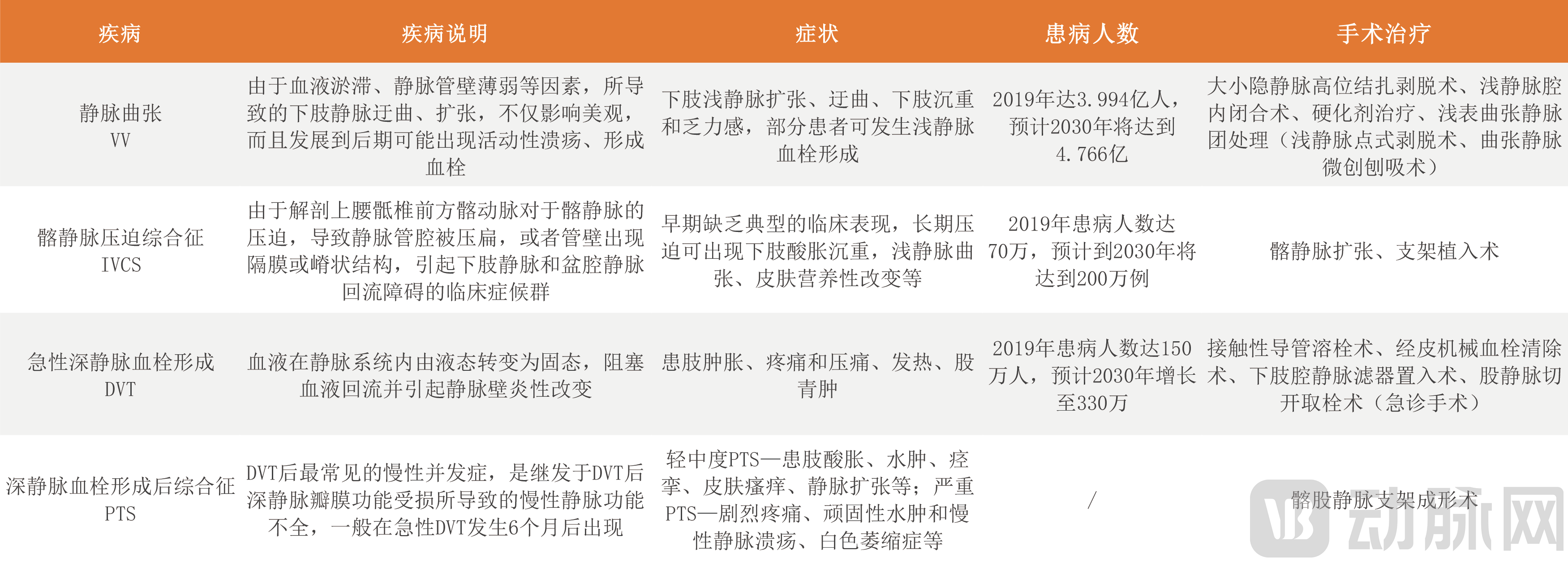
Main Peripheral Venous Diseases Source: "Standard for Diagnosis and Treatment of Common Venous Diseases (2022 Edition)"
Peripheral Venous Disease: Although the Disability and Mortality Rates Are Low, It Can Impact Patients' Quality of Life and Pose Life-Threatening Risks in Severe Cases
Compared with other cardiovascular and cerebrovascular interventional procedures, peripheral interventions are relatively simple to perform, have a shorter learning curve for doctors, and can be widely implemented in grassroots hospitals, enabling localized treatment. On the other hand, complex procedures such as neurointervention and coronary intervention generally need to be performed in top-tier tertiary hospitals at the provincial level, leading patients to concentrate in large hospitals. This results in an uneven distribution of doctors and patients, and an overload on tertiary hospitals.Interventional Treatment of Venous Diseases: An Opportunity for the Development of Grassroots Hospitals in Response to China's Tiered Medical Care Policy
In recent years, the discipline construction of vascular surgery in China has accelerated. More than 2,400 hospitals across China have established vascular surgery departments or teams, with a large number of doctors and beds dedicated to vascular surgery treatments, enabling more patients to receive treatment for venous diseases. With the continuous updating of treatment guidelines for venous diseases, treatment procedures have become increasingly standardized, allowing more patients to be screened and treated earlier and more systematically.
At the same time, China is currently vigorously promoting the comprehensive prevention and treatment of VTE.In 2021, the National Health Commission of China issued the "2021 National Medical Quality and Safety Improvement Goals," with the fifth goal explicitly stating the need to increase the standardized prevention rate of venous thromboembolism.It was mentioned that medical institutions should establish a system for the prevention and treatment of VTE within the hospital.
Venous Thromboembolism (VTE) is mainly caused by slow venous blood flow, venous vascular injury, and increased blood coagulability, leading to abnormal blood clotting within the veins, complete or partial blockage of venous vessels, and even thrombus formation. It commonly manifests as deep vein thrombosis (DVT) in the lower limbs and pulmonary embolism (PE), making it the third most common cardiovascular disease after ischemic heart disease and stroke. VTE is one of the leading causes of unexpected patient deaths, posing a serious threat to patient safety.
Clinically, due to the insidious onset and lack of obvious symptoms of VTE, it is prone to misdiagnosis and missed diagnosis. According to the "Guidelines for Diagnosis, Treatment, and Prevention of Pulmonary Thromboembolism (2018 Edition)," in six major countries of the EU, the number of symptomatic VTE cases exceeds 1 million annually, with 34% of patients presenting with sudden fatal PTE, 59% of patients remaining undiagnosed until death, and only 7% of patients receiving a clear diagnosis before death. Therefore, effective prevention and standardized treatment can significantly reduce the incidence, disability rate, and mortality of VTE.
Since the launch of the VTE project in China, more than 1,000 hospitals have registered to participate in its development. From April 2019 to September 2021, a total of 224 institutions were successfully certified as VTE Prevention and Treatment Centers.The implementation of VTE prevention and treatment promotes the standardization of VTE therapy, with an increase in treatment penetration rate, which also provides more opportunities for venous intervention-related companies to develop venous intervention treatment products.
Despite the rapid development of peripheral venous intervention disciplines and clinical practices in China,The prevention and treatment work in the early stage of the disease is not yet in place, the joint prevention and treatment model for VTE needs further improvement, and the VTE prevention and treatment system in secondary hospitals in China is insufficient. Meanwhile, the treatment methods for venous diseases need to be improved, and the existing interventional therapies still lack venous-specific devices.
To address the clinical pain points in the treatment of venous diseases, the cooperation of multiple parties such as hospitals, governments, and enterprises is essential, with enterprises being a crucial link.
In terms of treatment methods, companies develop intravenous-specific products based on clinical needs to fill the clinical gap; in terms of treatment penetration, companies actively engage in clinical education and market promotion, collaborating with clinics to standardize venous interventional diagnosis and treatment. Additionally, companies play an important role in patient management, academic promotion, and industry standard formulation.
Standing at the forefront of the development of peripheral venous disease treatment, China's peripheral venous intervention market is growing rapidly.
In China's peripheral venous interventional device market, the main therapeutic products include vena cava filters, iliac vein stents, and thrombus aspiration systems. Currently, only the vena cava filter sector has seen significant participation from domestic companies. With the approval of China's first domestically produced iliac vein stent and thrombus aspiration system by the NMPA, domestic enterprises are expected to achieve comprehensive deployment with their breakthrough technologies and products.
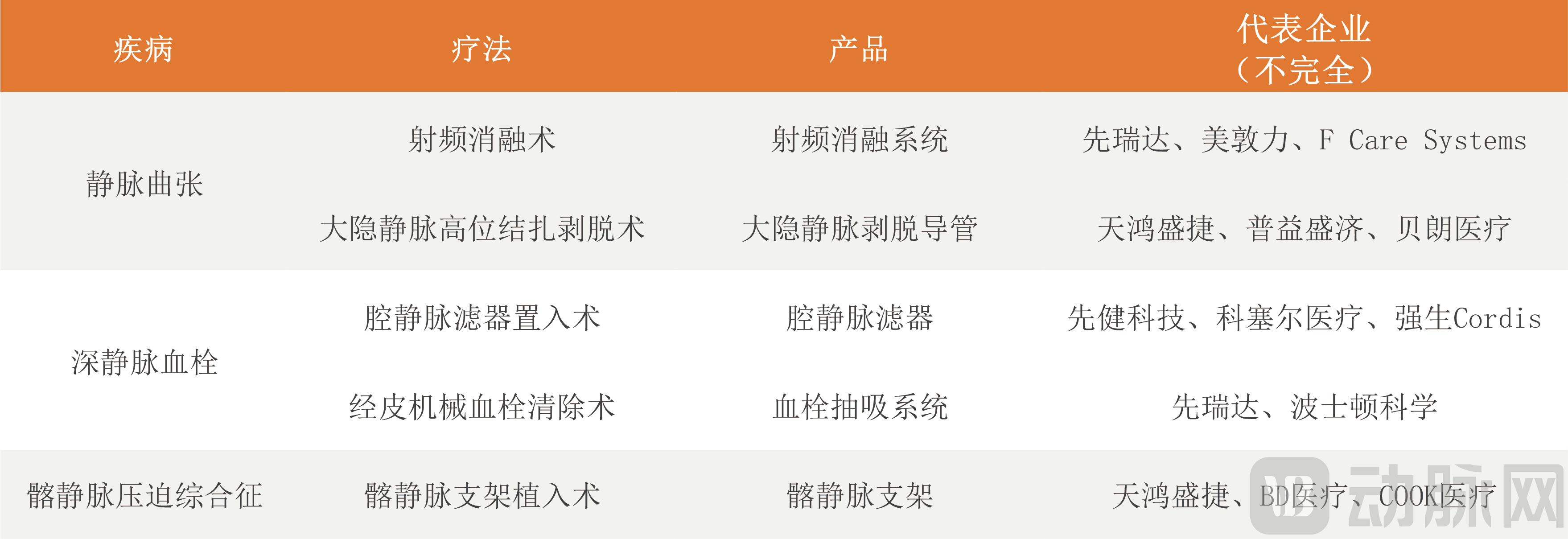
Main Products of Peripheral Venous Intervention Source: Public Information
China's Peripheral Venous Intervention Market: Small Size, Rapid Growth. In 2013, the market size of venous intervention devices in China was only 370 million yuan, reaching 890 million yuan in 2017. This rapid growth trend is expected to accelerate with the increasing application of venous intervention surgeries in clinical practice. By 2022, the market size of venous intervention devices in China is projected to reach 3.1 billion yuan, with a compound annual growth rate (CAGR) of 28.4% from 2017 to 2022.
AndAccording to CIB Securities, the market value of China's venous intervention device market, which mainly treats common venous diseases such as varicose veins, deep vein thrombosis, and iliac vein compression syndrome, is approximately 19.46 billion yuan.
In the entire cardiovascular intervention field, only the venous intervention device market currently has a low degree of monopoly, with some areas having only one or two products approved, or even none at all. Moreover, although a group of companies have begun to enter the blue ocean of venous intervention, no single monopolistic player has yet emerged among the existing market participants.In fields such as iliac vein stents and thrombus aspiration systems, companies within and outside China are almost at the same starting line.
At the same time, there has been a lack of dedicated devices for venous treatment in clinical practice, and peripheral artery products are often used off-label for the treatment of venous diseases. Due to the differences in anatomical and pathological factors between human peripheral arteries and veins, venous blood flow is slower and the vessel diameter is larger, thus requiring different product characteristics.
As the treatment of peripheral venous diseases continues to advance and clinical exploration deepens, there is an increasing demand for more specialized venous intervention products, providing venous intervention companies with greater room for development. Chinese companies have the opportunity to build on past medical research, compare the efficacy of arteriovenous products, and develop dedicated devices that meet the specific needs of venous treatments.
Overall, in the blue ocean of peripheral venous intervention, there are opportunities for domestically produced alternatives and conditions for domestic companies. However, domestic substitution is not just a slogan; the premise is to achieve better localization while ensuring good efficacy, meeting local needs in terms of price, product line layout, sales model, and medical-enterprise interaction. Simply engaging in price wars or producing me-too products is no longer the breakthrough point in the current market.
Moreover, the current opportunity for domestic enterprises to achieve domestic substitution is global. A globalization strategy is not a forced choice made by domestic companies due to external pressures such as centralized procurement and competition, but rather a spontaneous action driven by confidence in original technology to expand overseas.
Currently, the peripheral venous intervention market includes cardiovascular giants such as Boston Scientific, Medtronic, and BD, as well as listed companies like Zonare Medical and Creganna Medical, with an increasing number of companies entering the field. However,The current venous intervention market has problems such as scattered industrial layout and lack of coherence in enterprise product lines. Some domestic and foreign companies treat venous intervention as a business branch, only developing one or two popular single products in the market. As a result, these companies lack overall competitiveness in the field of venous intervention and have insufficient promotional strength in grassroots areas.
In contrast, overseas giants such as Medtronic, BD Medical, and Boston Scientific have all approached the market from the perspective of the entire treatment chain for venous diseases, leveraging self-research and acquisitions to establish their presence in the venous intervention space. Previously, BD's core product in venous intervention was the Venovo iliac vein stent. By the end of 2021, the company expanded its radiofrequency ablation product line by acquiring Venclose, thereby strengthening its treatment capabilities for chronic venous insufficiency (CVI).
Therefore, whether China's venous intervention market can eventually reach a scale of tens of billions depends on whether domestic companies can achieve technological innovation and build a comprehensive product portfolio.
One-stop Solution for Venous Diseases: More Than Just a Slogan.
The correlation between peripheral venous diseases is driving companies to move along the treatment chain and propose comprehensive solutions. For instance, for patients with varicose veins, as diagnosis and treatment become more standardized, the focus is no longer solely on treating the morphological changes of varicose veins but also on exploring their pathogenesis, such as examining the degree of iliac vein stenosis in patients, to address the root cause of the problem.
For instance, in the treatment of patients with deep vein thrombosis, current clinical practices often involve comprehensive treatment methods such as targeted thrombolysis, mechanical thrombectomy, or aspiration thrombectomy. It is necessary to fully consider the patient's age and adjust the dosage of thrombolytic drugs accordingly.
Only by developing products in accordance with the fundamental logic of clinical treatment can enterprises truly meet clinical needs, while enhancing their own core competitiveness, strengthening the therapeutic relevance among products, and achieving the aggregation and spillover effects of the enterprise's product chain.
Suzhou Venmed Technology Co., Ltd. (Venmedtech), the company that previously launched the first domestically produced iliac vein stent in China, is one such representative.Venmedtech is China's first company dedicated to the treatment of peripheral venous diseases. The company focuses on diseases such as peripheral venous obstruction, stenosis, thrombosis, and reflux, continuously improving its industrial layout and moving towards becoming a one-stop product platform for venous disease treatment in China.
Venmedtech's product development logic starts from the clinical perspective. The company collaborates with many top clinical experts in China, and based on a profound understanding of clinical needs, it independently develops interventional treatment products along the treatment pathways for peripheral venous diseases.
Currently, the company has obtained 5 NMPA product registration certificates, including iliac vein stent systems, peripheral balloon dilation catheters, intravascular foreign body retrieval devices, great saphenous vein stripping catheters, and balloon inflation devices, all of which are proprietary intellectual property.
In addition to excellent clinical understanding, efficient execution has also driven Venmedtech to expand its territory in the venous intervention field.Venastent®, independently developed by the company, is the first iliac vein stent in China to pass the special review process for innovative medical devices, and has completed clinical enrollment ahead of others. As the first domestically produced iliac vein stent approved for marketing in China, the launch of this product is expected to promote the clinical adoption of dedicated venous stents and improve the accessibility of treatment for iliac vein compression syndrome.
In the large market of venous intervention, Venmedtech plans to achieve a full industry chain layout in steps, aiming to build a platform enterprise for venous intervention.
Next, Venmedtech will continue to improve its venous intervention product line focusing on diseases such as venous obstruction, stenosis, thrombosis, and reflux. Meanwhile,The company's industrial layout will also extend to the peripheral artery and peripheral vascular fields, and its product types will shift from access products to drug-device combination and functional products.. In addition,Venmedtech will also start from treatment, gradually covering the entire process of screening, diagnosis, treatment, and prognosis, providing a comprehensive one-stop solution for peripheral intervention.。
Company founder Wang Yonggang mentioned: "The underlying logic of medical treatment has changed now, from saving lives to reducing suffering. Nowadays, when people take medicine for treatment, it’s mostly not to save their lives but to alleviate pain. In the past, people were just focused on staying alive; now, they want to live with quality, with dignity. Health awareness and comfort demands have significantly increased. From the past 50 years, 100 years, to today, the number of diseases we know has grown rapidly because detection methods are increasing, and our standards for health are becoming higher."
"In the past, the treatment of diseases was primarily about saving lives, but now it has shifted towards improving the quality, dignity, and vitality of life—enabling people to enjoy a higher quality of life and experience the beauty of living. This theory effectively explains why many chronic diseases are increasingly being given more attention, reflecting a fundamental shift in underlying logic. Therefore, Venmedtech’s mission and vision must align with these changes. Our goal is clear: to restore the beauty of life!"
Reference: "Efficacy Observation of One-stop Treatment for Acute Left Lower Limb Deep Vein Thrombosis Combined with Left Iliac Vein Compression Syndrome" — Journal of Jining Medical University
"Standard for Diagnosis and Treatment of Common Venous Diseases (2022 Edition)" —— Chinese Journal of Vascular Surgery
"Peripheral Vascular Intervention Market Depth: Market in Early Stage, Chinese Enterprises Poised for Growth" — Industrial Securities