

Hansoh Pharma out-licenses flagship drug Almonertinib to India’s Glenmark, seeking fresh growth in emerging markets
Hansoh Pharma
Pharmaceutical Research, Production, and Sales
A blockbuster Chinese innovative drug with annual sales over RMB 3 billion has secured a new international partner.
On the evening of December 16, Hansoh Pharma announced that it has entered into an exclusive license, collaboration, and distribution agreement with Glenmark Specialty S.A. for Almonertinib. Almonertinib is China's first original third-generation Epidermal Growth Factor Receptor Tyrosine Kinase Inhibitor (EGFR-TKI) and has been approved for four indications in the treatment of non-small cell lung cancer (NSCLC), covering patient populations for advanced second-line therapy, first-line therapy, locally advanced maintenance therapy, and postoperative adjuvant therapy.

Under the license agreement, Hansoh Pharma will grant Glenmark an exclusive license to develop and commercialize Almonertinib in the licensed territories (the Middle East and Africa, Southeast and South Asia, Australia, New Zealand, Russia and other CIS countries, as well as several specific Caribbean countries covered by the agreement). Hansoh Pharma will receive an upfront payment, potential future regulatory and commercial milestone payments cumulatively exceeding one billion USD, and tiered royalties on net sales within the licensed territories.
Analysts have pointed out that the collaboration between Hansoh Pharma and Glenmark represents a pragmatic and focused regional breakthrough for the globalization strategy of its core product, Almonertinib. Compared to its earlier partnership with the US biopharmaceutical company EQRx, Inc., the strategic rationale behind this collaboration demonstrates more pronounced differentiation and targeted execution.
A Setback in the First Global Foray
Lung cancer, one of the most common malignancies globally and in China, is a critical therapeutic area for pharmaceutical companies worldwide. In 2024, there were approximately 2.6 million new cases globally, with about 1.15 million occurring in China. Among all lung cancer cases, non‑small cell lung cancer (NSCLC) accounts for about 85%, and EGFR mutation is the most common driver genetic alteration, particularly in Asian populations where up to 50% of patients carry this mutation.
Targeting the EGFR mutation—a "golden" therapeutic target—numerous pharmaceutical companies have worked to advance EGFR‑TKI development through three generations of evolution, significantly extending the survival of relevant patients. In March 2020, Hansoh Pharma's Almonertinib was approved as China's first original EGFR‑TKI, breaking the long‑term dominance of imported originator drugs in the EGFR‑TKI landscape. It has steadily expanded its indications to cover advanced second‑line and first‑line therapy, locally advanced maintenance therapy, and postoperative adjuvant therapy, achieving comprehensive penetration across early‑, intermediate‑, and advanced‑stage treatment settings.
According to statistics from PharmCube's PharmaBI® IPM database, sales of EGFR‑TKIs in the Chinese market reached RMB 18.1 billion in 2024. Among them, Hansoh Pharma's Almonertinib contributed RMB 3.6 billion, securing a 20% market share and ranking first among domestic drugs in China. For this flagship product, Hansoh Pharma has been planning its global expansion early on.
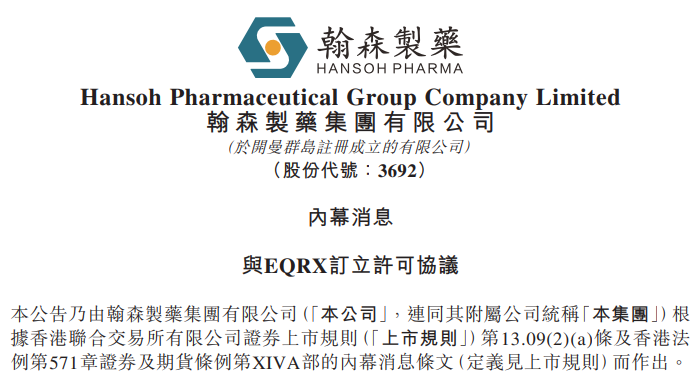
In July 2020, Hansoh Pharma entered into a strategic collaboration and license agreement with EQRx, granting the latter an exclusive license to research, develop, manufacture, and commercialize Almonertinib (and any product containing or consisting of Almonertinib) outside Greater China in the fields of cancer, cancer‑related, and immunoinflammatory diseases. Under the agreement, Hansoh Pharma was entitled to receive an upfront payment and registration and development milestone payments totaling approximately USD 100 million (excluding other potential commercial milestone payments and tiered royalties based on net sales).
Founded in early 2020, EQRx was a US biopharmaceutical company focused on reducing the price of innovative drugs. In the context of high drug pricing in the United States, it sought to acquire high-quality, lower-cost me-too drugs from around the world, aiming to capture market share through its pricing advantage. Utilizing a license-in model, EQRx rapidly expanded its pipeline to over ten assets within just three years. Among these, four assets were sourced from China, originating from Hansoh Pharma, CStone Pharmaceuticals, and Lynk Pharmaceuticals.
A turning point occurred in August 2023, when Revolution Medicines entered into an agreement with EQRx to acquire the latter through an all-stock transaction. Notably, unlike most mergers and acquisitions driven by the target's pipeline assets, Revolution Medicines was primarily interested in EQRx's substantial cash reserves. For the pipeline assets already established by EQRx, Revolution Medicines did not intend to adopt them wholesale but rather planned to utilize EQRx's cash to sustain its own original drug development programs.
Subsequently, Hansoh Pharma received written notice from EQRx terminating their collaboration, thereby regaining the rights to Almonertinib in overseas markets. Industry observers widely believe that the synergy between EQRx's commercialization pathway in mature Western markets and Hansoh Pharma's internationalization expectations for Almonertinib formed the basis for the original collaboration. However, EQRx's commercialization strategy also faced multiple challenges, including complex local reimbursement policies and competitive market dynamics, which ultimately contributed to the early conclusion of the partnership.
Transition to Regional Markets
However, the overseas EGFR-TKI market holds far greater development potential and broader possibilities. For example, osimertinib, a third-generation EGFR-TKI developed by AstraZeneca, achieved global sales of USD 6.58 billion in 2024. Confronted with the vast potential of the global market, Hansoh Pharma has taken over the groundwork laid by EQRx and continued to advance the internationalization of Almonertinib.
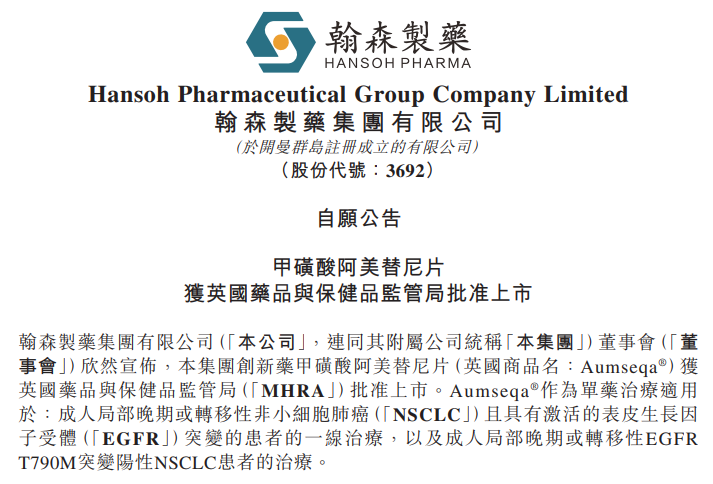
In June of this year, Hansoh Pharma announced that Almonertinib received marketing approval from the UK Medicines and Healthcare Products Regulatory Agency (MHRA). The drug is indicated as monotherapy for the first-line treatment of adult patients with locally advanced or metastatic NSCLC with activating EGFR mutations, as well as for the treatment of adult patients with locally advanced or metastatic EGFR T790M mutation-positive NSCLC. This milestone makes Almonertinib the first innovative drug from Hansoh Pharma approved for overseas markets and the first China-originated EGFR-TKI to achieve market authorization outside China.
Notably, as early as June 2022, the MHRA had accepted the marketing authorization application for the above-mentioned indications of Almonertinib, which was submitted at the time by EQRx. It took approximately three years to finally secure approval for the UK market, which may have underscored for Hansoh Pharma the importance of identifying a more suitable partner.
This time, Hansoh Pharma has partnered with Glenmark Specialty S.A., a wholly-owned subsidiary of Glenmark Pharmaceuticals. Glenmark is a research-led global pharmaceutical company headquartered in Mumbai, India, with operations spanning innovative drugs, generics, and OTC products, and a focus on therapeutic areas such as respiratory, dermatology, and oncology. Glenmark reportedly operates 11 world-class manufacturing facilities across four continents and its business reaches over 80 countries. According to the Scrip 100 ranking, Glenmark was listed among the top 100 biopharmaceutical companies by pharmaceutical sales in 2023.
In September this year, Hengrui Pharmaceuticals also announced an exclusive licensing agreement with Glenmark for the HER2 ADC innovative drug, trastuzumab rezetecan (SHR-A1811). Under the agreement, Hengrui granted Glenmark exclusive global rights to develop and commercialize trastuzumab rezetecan outside of Greater China, the United States, Canada, Europe, Japan, Russia, Armenia, Azerbaijan, Belarus, Kazakhstan, Kyrgyzstan, Moldova, Tajikistan, Turkmenistan, and Uzbekistan. Hengrui will receive an upfront payment of USD 18 million, potential regulatory and sales milestone payments of up to USD 1.093 billion, and corresponding sales royalties.
By choosing to collaborate with the Indian pharmaceutical company Glenmark, Hansoh Pharma—like Hengrui—clearly values Glenmark's established, localized commercial network, mature channel management expertise, and deep understanding of local healthcare systems and patient needs in emerging markets, particularly in South Asia, Southeast Asia, and parts of Africa.
The industry widely views this "region-focused" partnership strategy as enabling Almonertinib to reach target patient populations more rapidly and reduce market access barriers. Furthermore, Glenmark's established brand presence in therapeutic areas such as respiratory and dermatology may also bring potential synergies in indication expansion or physician education for Almonertinib, facilitating a more efficient transition from "product export" to "market cultivation."
There is no doubt that the Chinese EGFR-TKI market has become a "high-dimensional competition" arena dominated by mature therapies, characterized by slowing growth yet accelerating technological iteration. The renewed overseas push for Hansoh Pharma's Almonertinib epitomizes how Chinese pharmaceutical companies are navigating this landscape—breaking out of the Chinese red ocean and seeking a global footprint. Faced with growth ceilings and intense pricing competition in China, expanding into emerging markets is a rational strategy for incremental growth. The aligned choices of Hansoh Pharma and Hengrui Pharmaceuticals are likely to serve as a reference for other companies.