

Holy Haid AI-Driven Drug Discovery Platform Files IPO Prospectus, Aiming to Eliminate Clinical Uncertainty in Hepatitis B Treatment

Holy Haid
AI Drug Discovery Company
With the development of big data and artificial intelligence technology, the AI pharmaceuticals industry has been booming in recent years. Not only have several listed AI pharmaceutical companies emerged, such as Schrödinger and Relay, but international giants like Johnson & Johnson and Merck have also entered the field.
The热度 of China's AI pharmaceuticals market is no less impressive. Multiple AI pharmaceutical companies, represented by Insilico Medicine, have successively advanced their AI-driven drug development pipelines into clinical stages. According to incomplete statistics from VCBeat, in 2021, there were 34 financing events in China’s AI pharmaceuticals sector, involving a total financing amount of approximately 8.3 billion yuan, with an average single-round financing amount of about 250 million yuan.
How can startups gain a foothold and stand out in the current AI pharmaceuticals boom?
As the world's first integrated AI-driven new drug R&D incubation platform, Holy Haid (hereinafter referred to as Holy Haid) has pioneered an end-to-end drug R&D model under the concept of "repurposing old drugs," which combines "AI big data screening + retrospective data research + clinical big data validation," making it a standout presence in China’s AI pharmaceuticals field.
Holy Haid was co-founded in 2019 by Wang Shi, the founder of China Vanke Co., Ltd., Chen Mingjian, the founder of Oriental Gaosheng, and Roger Kornberg, a Nobel Prize winner.
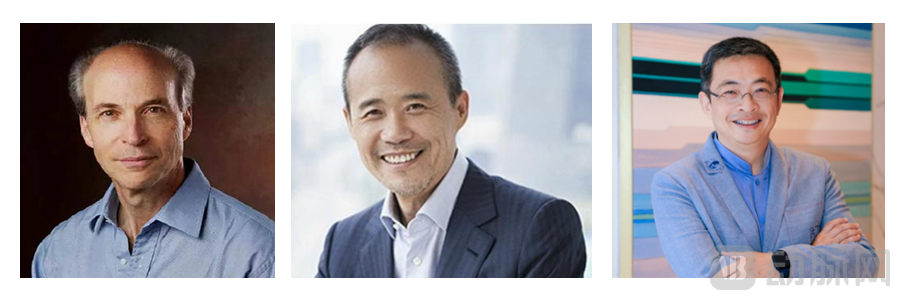
From left to right are Professor Roger, Wang Shi, and Chen Mingjian (Source: Holy Haid Official Website)
Out of interest in the innovative factors of Israel and the Jewish people, Wang Shi and Chen Mingjian respectively went to Israel for academic visits in 2018 and 2019, conducting research related to Jewish culture and education at the Hebrew University. In 2019, the two, together with Roger Kornberg, Nobel Prize winner, American biochemist, and professor of structural biology at Stanford University, co-founded Holy Haid (中以海德) in Israel.

Holy Haid Logo
The logo of Holy Haid emphasizes "AI + Big Data" in blue, which represents the innovative factor of Holy Haid. HAID stands for "HBV + AI + DATA". Holy Haid aims to leverage the powerful intellect of Chinese and Israeli scientists, combining data such as human genes and gut microbiota, and utilizing artificial intelligence to efficiently and rapidly find a cure for hepatitis B.
Holy Haid not only boasts a founding team comprising "scientists, investors, and entrepreneurs," but has also assembled a top-tier team of scientists.
In order to maintain a good atmosphere for innovation and the driving force, Holy Haid established Haid Lab in Israel during its early stage of establishment. The lab is led by Avraham Schroeder, a professor at the Technion-Israel Institute of Technology, serving as the CEO.Bringing together more than twenty top scientists from China, the United States, and Israel, dedicated to "transplanting" Israel's "from 0 to 1" innovation system;And in areas such as artificial intelligence, intellectual property, biological research, and clinical trials, Holy Haid has corresponding excellent talent.
Currently, Holy Haid has applied for more than 60 patents and software copyrights, covering dimensions such as drugs, research and development methods, and AI algorithms, striving to build a drug R&D system with independent intellectual property rights for source innovation.
Facing the long-term pressures of "long cycles, high investment, and high risk" in the biopharmaceutical industry, AI-driven drug discovery has demonstrated significant advantages. By enabling machines to autonomously learn from data, mine data, and uncover drug discovery patterns beyond expert experience, AI facilitates the optimization of each stage in the drug discovery process, enhances R&D efficiency, and reduces costs and trial-and-error expenses.
However, AI pharmaceuticals are also subject to significant clinical uncertainty. Currently, most AI-developed drugs still follow the traditional drug development model, which starts with identifying disease targets and proceeds through steps such as screening and optimizing lead compounds, selecting candidate drugs, and conducting preclinical research before advancing to clinical studies. Most AI pharmaceutical companies in China primarily focus on target discovery and molecular design, mainly providing services to pharmaceutical companies, with certain deficiencies in the subsequent safety and efficacy studies of the drugs. Additionally, since no AI-developed drug has successfully reached the market yet, there remains uncertainty in the industry regarding the realization of ultimate commercial value.
In response to such industry pain points, Holy Haid has taken the path of independently developing drugs, covering the entire process from initial drug screening to clinical trials. Based on the concept of "repurposing old drugs," it has pioneered an end-to-end drug development model that integrates "AI big data screening + retrospective data research + clinical big data validation," striving to reduce the uncertainty of clinical drug trials to zero.
Based on this set of drug development logic, Holy Haid has set the functional cure of hepatitis B as its initial goal.
Hepatitis B is a potentially life-threatening liver infection caused by the hepatitis B virus (HBV), which is widely distributed around the world. The disease often has a prolonged course and can easily develop into chronic hepatitis, cirrhosis, and liver cancer.
Holy Haid's First Target: Functional Cure for Hepatitis B
To advance the research and development of hepatitis B drugs, Holy Haid has built a proprietary precision drug discovery platform — the Thunder AI System — which integrates intelligent and precise disease targeting, pathway identification, and drug screening. This system is based on nearly a hundred multi-source heterogeneous databases from fields such as medicine, pharmacy, chemistry, and bioinformatics, utilizing algorithms like deep learning and machine learning to construct a high-dimensional medical knowledge fusion graph for drug discovery.
On March 8 this year, the first patient was enrolled in the clinical trial of HDM-8421034, a hepatitis B drug independently developed by Holy Haid, at Beijing Tsinghua Changgung Hospital.It is reported that this clinical trial is the first clinical paradigm in China for an AI and big data-driven drug aimed at the functional cure of hepatitis B to be approved for clinical trials.This clinical trial is a prospective, randomized controlled clinical study exploring the inhibitory effect of HDM-8421034 combined with nucleos(t)ide analogs on hepatitis B surface antigen in nucleos(t)ide analog-treated patients with chronic hepatitis B.
"If the drug HDM-8421034 can be successfully developed, it will become the first small-molecule drug targeting the cure of hepatitis B, which is a groundbreaking innovation from 0 to 1 for the field of hepatitis B treatment," said the chief scientist of Holy Haid. If this clinical trial yields optimistic data, Holy Haid's end-to-end drug development model of 'AI big data screening + retrospective data research + clinical big data validation' will be scientifically validated. From preclinical to filing for new drug marketing after completing clinical research, Holy Haid is expected to control the time within about 2 years. In the future, Holy Haid will also replicate this drug development logic to other disease areas to address unmet clinical needs.
It is reported that since its establishment in 2019, Holy Haid has been wholly incubated by Oriental Gaosheng. In order to accelerate the progress of the existing hepatitis B drug pipeline and expand new indications, Holy Haid will initiate angel round financing in the follow-up.
Looking forward to Holy Haid bringing new hope to hepatitis B treatment. Perhaps in the near future, Holy Haid will be able to expand its end-to-end drug development model of "AI big data screening + retrospective data research + clinical big data validation" to more indications that currently have no treatment options, offering patients more hope for life.