

Beyond the deal: Harbour BioMed’s $1.1B+ BMS pact for next-gen multi-specific antibodies

Harbour BioMed
Antibody Drug Developer

AstraZeneca
Pharmaceutical Technology Research and Development Provider
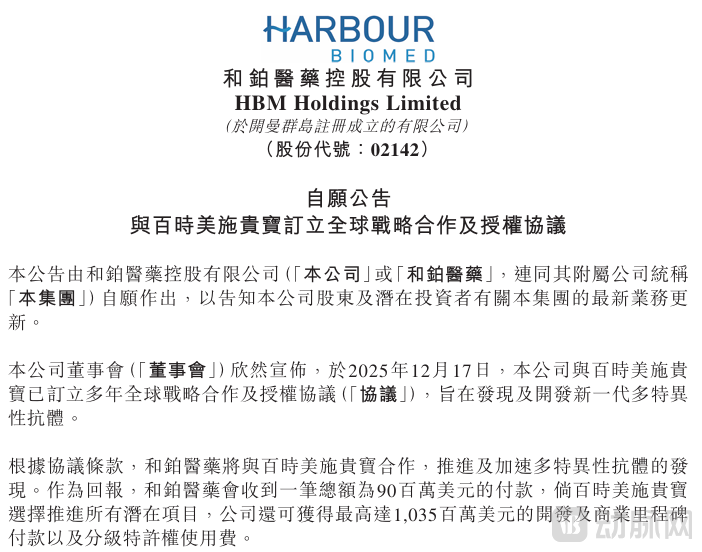
On December 7, 2025, Harbour BioMed (HKEX: 02142), a global biopharmaceutical company, announced today that it has entered into a global strategic collaboration and license agreement with Bristol Myers Squibb (BMS) to co-develop next-generation multi-specific antibodies.
Under the terms of the agreement, Harbour BioMed will receive an upfront cash payment of $90 million, along with potential development and commercial milestone payments totaling up to $1.035 billion. The collaboration will focus on "next-generation multi-specific antibodies"—an advanced class of antibody therapies designed to enhance therapeutic efficacy and reduce toxicity by simultaneously targeting multiple signaling pathways.
Notably, this is not Harbour BioMed's first high-value deal this year. In March, Harbour BioMed entered into a strategic collaboration with AstraZeneca with a total potential value exceeding $4.5 billion (including a $175 million investment and a multi-specific antibody license). In June, Harbour BioMed further partnered with Otsuka Pharmaceutical on a BCMA×CD3 bispecific T cell engager for autoimmune diseases, receiving an upfront payment of $47 million and additional milestones of up to $623 million.
This sustained series of high-value international collaborations has established Harbour BioMed as a prominent representative of China's innovative drug companies expanding globally.
Harbour BioMed: Powered by HCAb Dual Platform, Reports Profitability for Two Consecutive Years
The foundation of this series of high-value collaborations lies in the proven capabilities and clinical translation value of its internally developed HCAb technology platform in the field of multi-specific antibodies.
Traditional bispecific antibodies have long faced challenges in development, including complex structures, insufficient stability, and limitations in manufacturing controllability. The engineering difficulty becomes particularly pronounced when simultaneously balancing efficacy and safety, which is significantly higher than that of monoclonal antibodies. As a result, early bispecific antibody products were largely confined to a few structural paradigms, with few platforms truly offering reproducible capabilities. It is precisely for this reason that the current competition in multi-specific antibodies has evolved beyond merely developing bispecifics; it has advanced to the ability to systematically expand the combinatorial space of multiple targets through foundational antibody structural design. Harbour BioMed entered this field precisely from this perspective.
Founded in 2016, Harbour BioMed has focused its technological core on the engineering capabilities of fully human antibody structures. Its Harbour Mice® fully human antibody platform can generate both conventional two-heavy-chain, two-light-chain (H2L2) antibodies and fully human heavy chain-only antibodies (HCAb). Compared to traditional architectures, the HCAb molecule features a simpler structure, providing greater controllability for the stable expression and large-scale manufacturing of multi-specific antibodies.
Building on this, Harbour BioMed further developed its HBICE® bispecific antibody platform and HBICA bispecific antibody antagonist technology. This technological approach directly addresses the core engineering bottlenecks in bispecific antibody development and also reserves space for extension into higher-order multi-specific antibodies.
Guided by this platform strategy, Harbour BioMed's pipeline is not merely a collection of projects but is strategically designed to address complex disease scenarios in immunology and oncology.
In immunology, Harbour BioMed has demonstrated the safety and feasibility of HCAb in the clinic with its anti-FcRn antibody, HBM9161. This program has advanced into clinical studies for various IgG-mediated autoimmune diseases.
In the multi-specific antibody domain, Harbour BioMed focuses on next-generation molecular formats such as immune cell engagers. A prime example is HBM7020, a BCMA×CD3 bispecific T cell engager for autoimmune diseases. Unlike the strongly activating T-cell bispecific designs used in oncology, HBM7020 incorporates molecular-level fine-tuning of CD3 signaling, aiming to maintain targeted cell clearance while potentially reducing the risk of cytokine release syndrome (CRS).
In oncology, Harbour BioMed is concurrently advancing strategies such as antibody-drug conjugates (ADCs). HBM9033 is an ADC targeting human mesothelin (MSLN) for advanced solid tumors. In 2023, Harbour BioMed's subsidiary, Nona Biosciences, granted Pfizer an exclusive global license for this program.
Financially, Harbour BioMed has demonstrated steady growth. For the full year ending December 31, 2024, the company reported total revenue of approximately RMB 274 million (USD 38.1 million) and a profit of approximately RMB 19.41 million (USD 2.70 million), marking its second consecutive year of profitability.
From structural engineering to the systematic delivery of multi-specific antibodies — this constitutes the core narrative of Harbour BioMed in the current industry cycle and lays a clear technological foundation for its collaborations with multinational pharmaceutical companies such as Bristol Myers Squibb.
Bristol-Myers Squibb (BMS): Continuously Doubling Down on Multi-Antibody Therapies to Overcome Patent Expiration Pressure
Bristol Myers Squibb (BMS) is a leading global multinational pharmaceutical company headquartered in the United States, with core operations spanning oncology, cardiovascular diseases, hematology, and immunology, among other areas. According to its 2024 financial report, BMS achieved revenue of $48.3 billion, a year-on-year increase of 7%, while its R&D investment reached $11.159 billion, reflecting a 20% growth compared to the previous year. Among its key products, the anticoagulant apixaban (Eliquis) generated revenue of $13.333 billion, and the PD-1 inhibitor nivolumab (Opdivo) contributed $9.304 billion in revenue.
Concurrently, as patents for drugs such as lenalidomide (Revlimid) have expired, BMS has actively focused on enhancing its new product pipeline and identifying next-generation therapies. BMS primarily targets five key therapeutic areas—oncology, cardiovascular, hematology, immunology, and neuroscience—and categorizes its products into growth and mature segments, aiming to sustain performance growth through innovation-driven strategies.
In terms of technology pathways and collaborations, BMS emphasizes a diversified approach. BMS lists multi-specific antibodies as one of its key focus areas on its official website. In June 2025, BMS entered into a collaboration with BioNTech to jointly develop the PD-L1×VEGF bispecific antibody BNT327 (for multiple solid tumors), with a total deal value of approximately $11.1 billion. Additionally, BMS continues to advance its internal R&D projects, such as the TYK2 inhibitor deucravacitinib, which is undergoing multiple clinical studies in rheumatology and immunology. Overall, BMS addresses growth pressures resulting from patent expirations of core products by maintaining substantial internal R&D investments while actively pursuing external partnerships.
The Bispecific Antibody Market Grew 33% Year-on-Year, Making Multi-Targeting a Core Area for Collaboration
The collaboration between Harbour BioMed and Bristol Myers Squibb (BMS) is, in essence, a classic case of technological complementarity and strategic synergy. Harbour BioMed leverages its fully human antibody platforms—comprising HCAb and HBICE®—to excel in the discovery and engineering of next-generation multi-specific antibodies. Meanwhile, BMS brings its established global R&D system, extensive clinical development experience, and industrial-scale manufacturing network. Through this partnership, BMS gains early-stage access to potentially differentiated multi-specific antibody assets, while Harbour BioMed amplifies the global development and commercial value of its candidate molecules by leveraging the multinational pharmaceutical company's platform.
This collaboration also reflects an increasingly clear industry trend in recent years. As analyzed by Blue Stones Consulting, the number of partnerships between Chinese biotechnology companies and multinational pharmaceutical enterprises surged significantly in the first half of 2025, underpinned by the continuous enhancement of fundamental R&D capabilities and platform development among Chinese innovative biopharma firms. According to statistics from Pharmcube, China completed 11 licensing deals valued at over $1 billion in the first quarter of 2025, accounting for nearly half of such transactions globally. Among these, Harbour BioMed stood out as one of the most active players in China-overseas pharmaceutical deals, thanks to multiple high-value collaborations. In 2025 alone, Harbour BioMed has secured several key partnerships covering various molecular formats, including multi-specific antibodies and antibody-drug conjugates (ADCs).
From a broader industrial perspective, next-generation multi-specific antibodies are accelerating their transition from the forefront of research to commercial validation. Data from VCBeat indicates that the global bispecific antibody market reached approximately $13 billion in the first three quarters of 2025, a year-on-year increase of 33%, with full-year projections exceeding $17 billion. This growth is driven by the combined advantages of multi-specific antibodies in therapeutic synergy and safety optimization. Representative products such as Roche's hemophilia bispecific Hemlibra and ophthalmology bispecific Vabysmo have achieved multi-billion-dollar sales across multiple therapeutic areas, validating not only the clinical value of bispecifics but also providing a realistic foundation for the commercial exploration of higher-order multi-specific antibodies. Simultaneously, tri-specific and other higher-order multi-specific antibodies are being viewed as the next frontier of technological advancement. Continued investments from multinational pharmaceutical giants such as Roche, Amgen, and Johnson & Johnson indicate the formation of a stable market expectation, with a projected scale of tens of billions of dollars.
Against this backdrop, the collaboration between Harbour BioMed and BMS represents a convergence point of technological maturation in multi-specific antibodies and industrial capital reallocation. Looking ahead, multi-specific antibodies are poised to expand their applications in oncology, immunology, and other complex disease areas. Together with technological pathways such as ADCs and cell therapies, they are set to form an integral part of global innovative drug development.