

Novel CD19-Targeted STAR-OX40-T Cell Therapy Demonstrates High Efficacy and Safety in Relapsed/Refractory B-ALL: First-in-Human Phase I Trial Results Published in American Journal of Hematology

BriSTAR Immunotech
Cellular Immunotherapy Product Developer
Beijing, May 18, 2022 /PRNewswire/ -- On May 1, 2022, the team of Professor Lu Peihua from Lu Daopei Hospital and the team of Professor Lin Xin from Tsinghua University School of Medicine collaborated to publish in a prestigious American hematology journal.American Journal of Hematology(IF=10.047) Published a research paper on the novel CD19-targeted STAR-T cell therapy for R/R B-ALL. The preclinical and clinical studies of STAR-T and STAR-OX40-T cells were developed and manufactured by Tsinghua University (School of Medicine) and Huaxia Yingtai (Beijing) Biotechnology Co., Ltd. The first-in-human Phase I clinical study was conducted at Daopei Lu Hospital.
Research Background
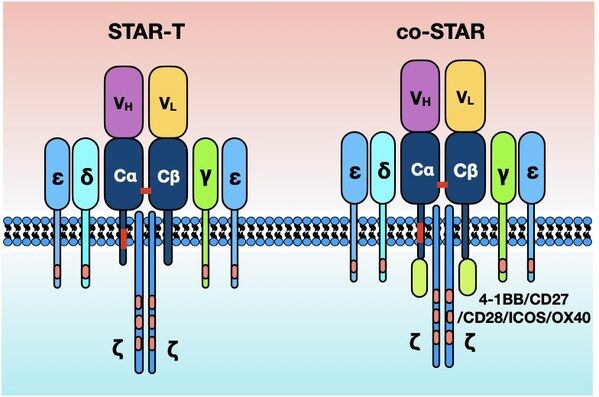
CAR-T cell therapy has demonstrated high response rates in patients with B-cell malignancies, but the durability of remission and safety still need improvement. Researchers have developed a novel dual-chain chimeric receptor—STAR—composed of two protein modules. Each module contains either the variable region of an antibody light chain or heavy chain, fused with the constant regions of T-cell receptor (TCR) alpha and beta chains, combined with an OX40 co-stimulatory domain. The two modules are linked by a self-cleaving furin-P2A sequence, allowing proteolytic separation and recombination of the modules. This article reports the preclinical studies of STAR-T cell therapy and the Phase I clinical trial results of CD19 STAR-OX40-T cell therapy for refractory/relapsed (R/R) acute B-cell lymphoblastic leukemia (B-ALL).https://clinicaltrials.gov, NCT03953599)。
Research Methods
Peripheral blood (PB) mononuclear cells were obtained from healthy donors and patients for preclinical and clinical studies; lentiviral vectors were used to transduce the STAR structure into T cells to generate STAR-T cells, and a leukemia xenograft mouse model was utilized to evaluate the anti-tumor function of STAR-T cells. From December 2019 to June 2020, the trial enrolled a total of 18 CD19+ R/R B-ALL patients (male-to-female ratio of 10:8), with a median age of 22.5 years. Prior to the infusion of STAR-OX40-T cells, patients received a 3-day intravenous administration of fludarabine (25mg/m²).2·d) and cyclophosphamide (250mg/m2·d) Pre-treatment. After the patient achieves complete remission (CR), a decision can be made on whether to proceed with consolidative allogeneic hematopoietic stem cell transplantation (allo-HSCT).
Research Results
Preclinical Study Results
In preclinical cell-level studies, it was found thatCD19 STAR-TUnder the stimulation of target cells, the cells exhibit faster activation time, higher cytokine secretion, and better tumor-killing effects, significantly outperforming conventional CAR-T cells (BBz-CAR). In a leukemia xenograft mouse model, under different doses of T-cell therapy, STAR-T cells demonstrated stronger tumor clearance than BBz-CAR-T cells without significant tissue damage. Subsequently, different co-stimulatory molecules were further coupled to the STAR structure for optimization to enhance the proliferation ability of STAR-T cells. Results at the cellular level showed that after STAR was coupled with OX40 (STAR-OX40), it significantly increased IL-2 secretion and proliferation levels under the stimulation of target cells. This structure was significantly superior to other structures (e.g., STAR-4-1BB, STAR-CD28, STAR-CD27, STAR-ICOS). Additionally, in a co-culture system of target cells and peripheral blood cells, it secreted lower levels of cytokines associated with cytokine release syndrome (CRS). Results from different leukemia xenograft mouse models also showed that STAR-OX40-T cells had better tumor clearance and proliferation effects and could effectively inhibit tumor recurrence. Based on studies at both the cellular and animal levels, the STAR-OX40 structure has been approved for Phase I clinical trials.
Clinical Research Results
In this Phase I clinical trial, the median follow-up time was 507 days (range: 63-665 days). The median pre-treatment bone marrow blast level was 15.3% (range 0.5% - 90.5%), including one patient with post-transplant relapse and two patients with central nervous system leukemia (CNSL). All 18 patients received a median dose of 1×10.6/kg of STAR-OX40-T cells in a single infusion: low-dose group (5×10⁵ / kg,n = 3), medium-dose group (1×10⁶ / kg,n = 8) and high-dose group (2~2.5×10⁶/kg, n = 7). The median time from collection to infusion of STAR-OX40-T cells was 9 days (7-13 days). The median transfection efficiency was 57.4%. Evaluation two weeks after STAR-OX40-T cell infusion showed 100% (n=18) achieved complete remission (CR) with minimal residual disease (MRD) negativity. At the 30-day evaluation, the CR rate was 100%, with one patient showing MRD positivity at 0.09% blasts. At a median of 57.5 days (range: 40-67 days) after STAR-OX40-T cell infusion, 16/18 (88.9%) CR patients (15 MRD-negative and 1 MRD-positive) opted for consolidative allo-HSCT. After a median follow-up of 549 days (range: 433-665 days), 11 patients remained MRD-negative in CR, one turned MRD-positive at day 477, three others relapsed at day 211, day 305, and day 345 respectively, and one died at day 210. After allo-HSCT, seven patients developed acute GVHD (four grade I, one grade II, one grade III, and one grade IV), and three patients experienced mild chronic GVHD limited to the skin or lungs. Among the two patients who did not receive consolidative allo-HSCT, one relapsed at day 58 and died at day 63. This patient had a pre-treatment BM blast level of 90%, was BCR-ABL1 (P210) positive, and had CNSL. The other relapsed at day 186 and died from relapse at day 378. Overall, six patients relapsed after receiving STAR-OX40-T cell therapy. At the time of relapse, four patients were CD19+, and two patients were CD19-.
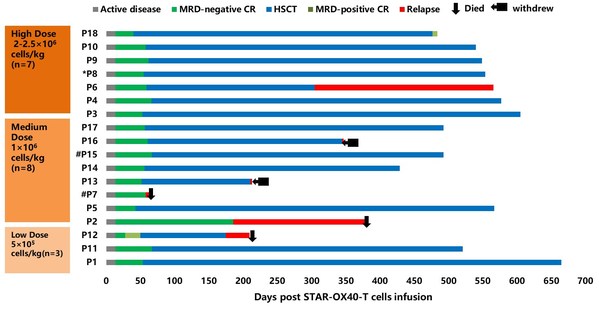
#CNSL *relapsed after allo-HSCT before STAR-OX40-T cells
Regarding adverse reactions, only 55.6% (n=10) of patients developed grade 1-2 mild cytokine release syndrome (CRS), with 8 cases being grade 1 CRS and 2 cases being grade 2 CRS. Additionally, 2 patients experienced grade 3 neurotoxicity.
After infusion of STAR-T cells, CD19 STAR-OX40-T cells in peripheral blood were monitored by qPCR and flow cytometry. Regardless of the infusion dose, STAR-OX40-T cells demonstrated high in vivo expansion and persistence. qPCR showed that the median time to reach peak levels was 8.5 days (range: 4-10 days), with a median fold expansion of 4.9×10.4copies/μ peripheral blood genomic DNA. Flow cytometry results showed that the median STAR-OX40-T /CD3 peak was 13.87% (range: 1.42%-88.1%), and STAR-OX40-T cell levels could still be detected in some patients 6 months after infusion.
Research Conclusion
This preclinical study demonstrated that STAR-T cells are superior to conventional CAR-T cells in terms of T-cell activation capacity, cytokine production ability, and anti-tumor efficacy in preclinical studies and animal models. The first-in-human phase I clinical trial proved the technical feasibility, clinical safety, and efficacy of STAR-OX40-T in treating CD19+ R/R B-ALL. A high CR rate can be achieved after infusion with low toxicity. However, long-term observation of these patients is still required, along with larger patient studies.
Original link:
Jiasheng Wang*,Xian Zhang*,Zhixiao Zhou*,Yue Liu,Li Yu,Lemei Jia,Junfang Yang MD,Jingjing Li,Hanyang Yu, Wenzhong Li,Guangna Liu,Wei Rui,Hongli Zheng,Xueqiang Zhao,Xin Lin#,Peihua Lu#, A Novel Adoptive Synthetic TCR and Antigen Receptor (STAR) T-Cell Therapy for B-Cell Acute Lymphoblastic Leukemia. Am J Hematol. 2022 May 1. doi: 10.1002/ajh.26586. Epub ahead of print. PMID: 35491511.