

Human Ventricular Progenitor Cell Therapy for Cardiac Regeneration Following Myocardial Infarction

AstraZeneca
Biopharmaceutical Manufacturer

German Centre for Cardiovascular Research
The German Centre for Cardiovascular Research (DZHK) is a cardiovascular disease research institution that creates space for such research projects. It provides a framework that enables researchers to collaborate and translate their research ideas into clinical practice more effectively and rapidly. The primary goal of the DZHK is to make new research findings available to all patients in Germany as soon as possible, thereby advancing not only the treatment but also the diagnosis and prevention of cardiovascular diseases.

Technical University of Munich
Technical University of Munich (TUM) is one of the best universities in Europe, with 15 faculties, 41,375 students, and 566 professors. Third-party research funding amounts to €331 million. The university has 17 Nobel laureates.
Karolinska Institute
Karolinska Institute, also known as Karolinska College, Karolinska Medical College, or the Karolinska Institute of Medicine, was formerly named the Royal Caroline Institute ("Caroline" in honor of the army of Swedish King Charles XII). It is a renowned medical school in Sweden and one of the top medical institutions globally. Established in 1810, the Karolinska Institute is the third oldest higher education institution in Sweden, preceded only by Uppsala University and Lund University. Located in Stockholm, the capital of Sweden, at the confluence of the Baltic Sea and Lake Mälaren, the Karolinska Institute is among the largest and finest single-discipline medical schools in the world. Ranked among the top ten medical schools worldwide, it conducts 43% of Sweden’s medical academic research and operates an affiliated hospital, the Karolinska University Hospital. The Institute is globally renowned for housing the Nobel Committee, which is responsible for evaluating and awarding the Nobel Prize in Physiology or Medicine each year.Historically, many revolutionary breakthroughs in human medicine have originated here, including the discovery of the erythrocyte sedimentation rate (ESR), the invention of the Gamma Knife, pioneering research on mitochondrial diseases, and the first discovery of prostaglandins. Furthermore, five laureates of the Nobel Prize in Physiology or Medicine are affiliated with the Karolinska Institute.In the 2017/2018 QS World University Rankings, the Karolinska Institute ranked 7th globally in the broad field of Life Sciences and Medicine, with its specific disciplines ranking highly: 6th in Medicine, 7th in Dentistry, and 10th in Pharmacy and Pharmacology. In the 2017/18 Times Higher Education World University Rankings, the Karolinska Institute was ranked 38th globally overall and 10th worldwide in Clinical and Health subjects. It stands as a world-class leading institution in the field of medicine.
After a heart attack, the human body is unable to repair lost cardiac tissue because the heart cannot generate new myocardium. However, treatment with cardiac progenitor cells may form functional cardiac cells at the site of injury.
In a new study, researchers from Germany HeartBlood VesselResearchers from the Research Center, Technical University of Munich, Karolinska Institute in Sweden, and AstraZeneca introduced this new treatment method. Their goal is to begin clinical studies within the next two years. The relevant research findings were published in the May 2022 issue of Nature Cell Biology, with the paper titled "Migratory and anti-fibrotic programmes define the regenerative potential of human cardiac progenitors".
How to Restore Heart Function After a Heart Attack? According to estimates by the World Health Organization (WHO), 18 million people die from cardiovascular diseases globally each year, which is a subject of research worldwide. One possible answer is using abundant human pluripotentStem CellsHuman Pluripotent Stem Cell Derived Ventricular Progenitor (HVP) for treatment.
Many heart diseases lead to the death of cardiac muscle cells and blood vessels. They are replaced by fibrotic scar tissue, which further leads to the deterioration of heart function. Some animals, especially amphibians and fish, can repair this kind of damage --- adults almost completely lack this ability in the heart. An experimental method to restore lost heart tissue is stem cell therapy. Previous studies have included the use of stem cells to produce heart cells, especially cardiomyocytes. However, this often results in side effects such as irregular heartbeats and fatal outcomes.Arrhythmia。
Cardiac progenitor cells rather than differentiated cardiac cells
In contrast, these authors are studying HVP. These cells play a crucial role in the formation of the heart during development. Over time, they differentiate into various cell types within the heart, including cardiomyocytes. They have successfully utilized human embryonic pluripotent stem cells to produce HVP in large quantities. "This represents the culmination of two decades of research efforts to find the ideal cells for rebuilding the heart," said Kenneth R. Chien, co-corresponding author of the paper and professor of cardiovascular research at Karolinska Institutet.
Complex molecular mechanisms
Through these cells, the authors studied the complex molecular processes involved in repairing damaged areas of the myocardium. "In laboratory studies, we were able to show how HVP can, in a sense, track the damaged areas in the heart, migrate to the site of injury, and mature into functioning heart cells," said Karl-Ludwig Laugwitz, professor of cardiology at the Technical University of Munich and co-corresponding author of the paper. "They also actively prevent the formation of scar tissue by communicating with fibroblasts."
Successful Treatment of Pig Heart
As a next step, these authors studied the effects of HVP treatment on damaged hearts in pigs. Physiologically, the pig's heart is very similar to the human heart. Therefore, experiments are often conducted on pigs just before starting research on human patients. Their results showed that even in large animals, heart damage could be reliably repaired, and no serious side effects were observed. "The therapy successfully demonstrated the formation of new heart tissue, and importantly, improved heart function while reducing scar tissue formation," said Dr. Regina Fritsche-Danielson, co-corresponding author of the paper and Head of Research and Early Development at AstraZeneca.
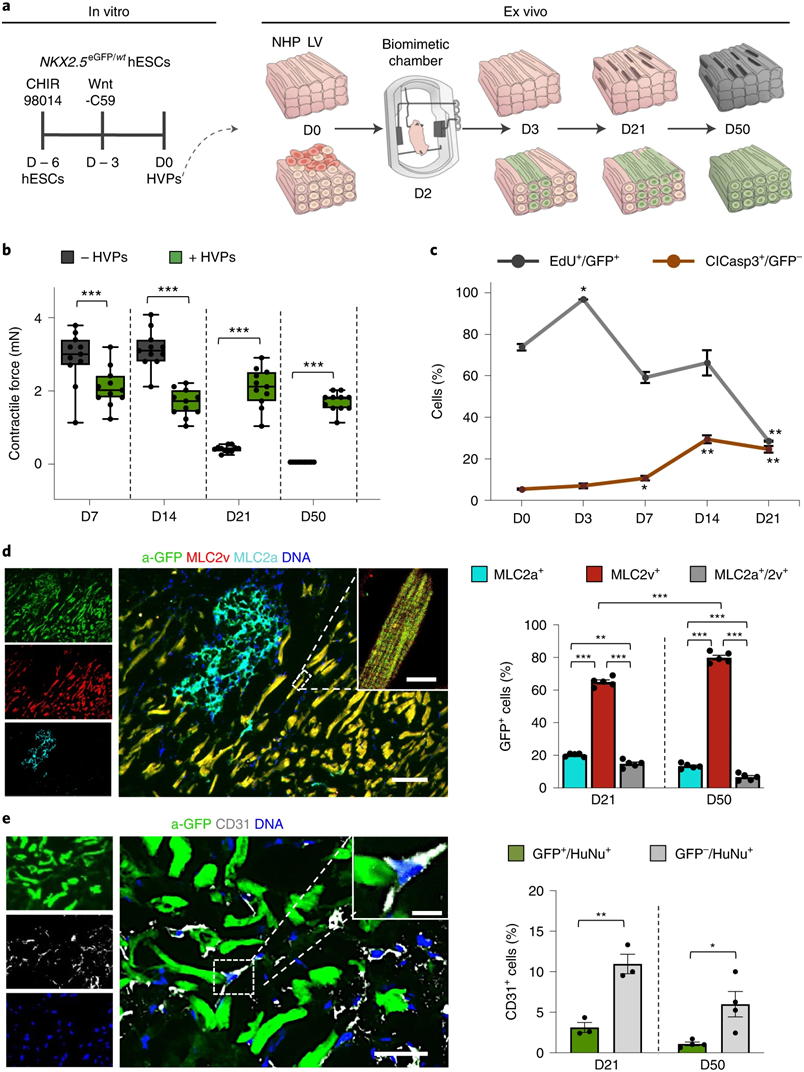
HVP expands, regenerates, and functionally matures in an in vitro 3D non-human primate heart model. Image from Nature Cell Biology, 2022, doi:10.1038/s41556-022-00899-8.
The goal is to start clinical research within the next two years.
In the coming months and years, these authors plan to translate their current research findings into treatments for heart disease patients. An important intermediate step is the development of lowImmunityThe original HVP cell line. Currently, it is necessary to inactivate the recipient's immune system to prevent it from destroying HVP cell therapy. Low immunogenicity HVP cells will eliminate the need for this step as they will not be recognized as foreign by the recipient. Further research will be conducted on low immunogenicity HVP cells and possible side effects. These authors aim to begin clinical studies on the therapeutic use of HVP within the next two years.
Professor Laugwitz said, "New insights into the therapeutic uses of HVP represent a treatment for a variety of serious...Heart Failure"A milestone for patients. Especially for elderly patients with coexisting diseases, for whom major heart surgery would be excessively stressful, they will benefit from HVP cell therapy."BioValley Bioon.com)
References:
1. Christine M. Poch et al. Migratory and anti-fibrotic programmes define the regenerative potential of human cardiac progenitors. Nature Cell Biology, 2022, doi:10.1038/s41556-022-00899-8.
2. Cardiac progenitor cells generate healthy tissue after a heart attack
https://medicalxpress.com/news/2022-05-cardiac-progenitor-cells-healthy-tissue.html