

Leading Edge MedValley Targets Chronic Pain Management with Innovative Wireless Implantable Neuromodulation Products

Leadinno Medical Valley
Developer of Medical Devices and Consumables in the Field of Pain and Neuromodulation
The World Health Organization revised the International Classification of Diseases (ICD-11) in 2018, marking the first time that pain was independently coded and systematically classified as a standalone disease. In the medical community, the view that "chronic pain is a disease in itself" has become a consensus.
Age is an important factor affecting chronic pain, and the incidence of chronic pain shows an upward trend with the increase of age. According to the Report on the Development of Pain Medicine in China (2020), the number of patients with chronic pain in China exceeds 300 million, and it is growing rapidly at a rate of 10 to 20 million people per year.
Studies show that pain is an independent risk factor for suicide, premature death, Alzheimer's disease, depression, anxiety, and other events. However, since pain does not directly threaten life like other diseases, it remains outside the public's attention, and patients' awareness of pain relief is lagging. Moreover, the complex causes and pathogenesis of chronic pain result in unsatisfactory outcomes for many treatment methods.
In recent years, spinal cord stimulation (SCS), as a safe "green therapy," has increasingly gained clinical attention. It involves the use of interventional techniques to implant electrodes into the epidural space of a patient’s vertebral canal. Once the position is confirmed, pulsed electrical currents are used to stimulate specific segments of the spinal cord nerves, blocking and interfering with the transmission of pain signals. This method can effectively alleviate chronic intractable pain caused by various reasons.
Leadinno Medical Valley (hereinafter referred to as "Leadinno Medical Valley"),A company focusing on the research and development of neuromodulation innovative technologies and the construction and development of pain departments in Chinese hospitals. Leadinno Medical Valley, starting with SCS, is independently developing the first wireless-powered implantable neurostimulation product in China.。
This product is able to overcome the clinical application limitations of traditional active implantable neuroelectric stimulation products and is expected to "disrupt" the existing market. To further understand this technology and product, VCBeat interviewed Mr. Xu Tianrui, founder of Leadinno Medical Valley. According to his revelation,Leadinno Medical Valley's wireless implant product is about to enter the clinical trial stage.。
The application of modern neuromodulation technology began around the 1960s. Following the pain gate control theory, SCS was gradually used for pain treatment. Later, therapeutic techniques such as deep brain stimulation (DBS), peripheral nerve stimulation (PNS), vagus nerve stimulation (VNS), and sacral nerve stimulation (SNS) emerged successively.
To date, neuromodulation technology has been applied to the treatment of a variety of diseases, such as pain, epilepsy, Parkinson's disease, psychiatric disorders, angina, and irritable bowel syndrome. From transcutaneous electrical stimulation products to active implantable electrical stimulation products, most of the global neuromodulation market is already dominated by multinational giants like Medtronic, Abbott, and Boston Scientific.
However, the vast majority of products currently available are traditional active (IPG) designs. This product form, to a certain extent, restricts the application and market growth of neuromodulation technology due to the level of surgical trauma and postoperative comfort issues for patients.Take the SCS system as an example, which includes an implantable pulse generator (IPG), electrodes, extension leads, test stimulators, patient controllers, patient charging devices, and external control systems.In the specific treatment process, the patient needs to undergo two surgeries:
The first surgery requires implanting a trial electrode into the target position in the patient's vertebral canal, then connecting it to an external temporary stimulator via a wire for testing treatment. If the patient’s test results are satisfactory, a second surgery can be performed to implant the IPG; otherwise, the electrode will be surgically removed. The second surgery, after passing the test, involves replacing the trial electrode with a permanent one and implanting the IPG subcutaneously. The electrode and IPG are then connected through a subcutaneous tunnel with a wire.
Regarding active design, the shortcomings of existing products are:
First, the second surgery, the surgical procedure is relatively complex.For patients, the two surgeries take approximately 5 to 6 hours, and restricted movement during the testing period can easily discourage their willingness to undergo treatment. For doctors, the learning curve for the surgery is relatively long, which limits the dissemination of the treatment technology, making it difficult for grassroots-level patients to access this treatment.
Secondly, there are comfort issues after IPG product implantation.Such as causing wound pain, triggering infections, electrode displacement, and leading to MRI incompatibility issues.
Thirdly, the battery's shortcoming is its expensive price.On the one hand, the battery load of traditional IPG products is limited by power capacity. If high-frequency electrical stimulation and burst stimulation, which offer better therapeutic effects, are performed, their endurance will face significant challenges. Although rechargeable IPG products have already appeared on the market, their charging efficiency still has limitations. On the other hand, the cost increase caused by rechargeable IPGs further raises the product price.
Currently, the implantable parts of products on the market are moving towards miniaturization and microminiaturization to enhance patients' willingness and experience with treatment. In the product iterations, IPG implanted neurostimulators are evolving into wireless charging IPG neurostimulators and wireless power-carrying implantable neurostimulators.
Leadinno Medical Valley, based on years of industry experience, has identified four key requirements in response to clinical needs and the limitations of IPG-type products: "simplified surgery, miniature implants, sufficient energy, and low cost." They have chosen to make a breakthrough with innovative wireless power-carrying neurostimulation technology.
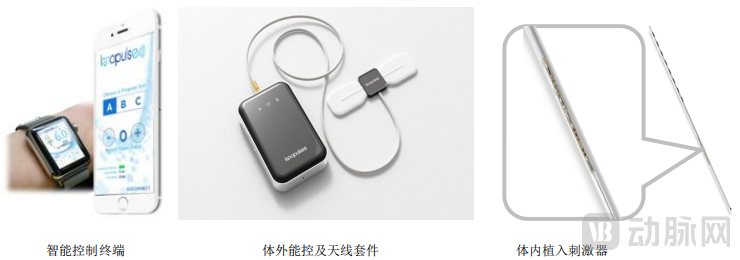
Specifically,Leadinno Medical Valley's wireless SCS product InnoPulse includes a smart control terminal, external energy control and antenna kit, and an implantable stimulator.。
Source: Leadinno Medical Valley
During the treatment with wireless SCS, patients only need to undergo a minimally invasive surgery for the implantation of the stimulation electrode. After the surgery, doctors adjust the stimulation parameters through a smart control terminal. During the treatment, the product is powered by the battery in the external energy controller, and the external antenna transmits energy to the internal antenna via wireless radio frequency; then, the chip in the implanted stimulator modulates and demodulates the radio frequency energy into electrical energy, which is conducted to the front-end stimulation electrode to form the stimulation waveform, thereby completing the treatment.
Compared with IPG products, wireless SCS productsFirst, the complexity of the surgical procedure was resolved., patients only need to undergo one surgery.Second, the product's energy is supplied from outside the body.。With unlimited power supply, it can well support high-frequency electrical stimulation and burst electrical stimulation; meanwhile, it also reduces issues such as electrode displacement.Third, the independent research and development of RF power transmission and in-body chip systems can significantly reduce costs.Lower costs leading to lower end-user prices are expected to enable more patients to afford this green and effective treatment method.
Xu Tianrui stated, "With the aging process in China, the number of patients with chronic pain will increase significantly. This large patient population will drive a surge in demand for SCS products. Only by controlling product costs can we align with China's medical insurance policies and future centralized procurement requirements, truly serving the patients."
In the field of neuromodulation, SCS undoubtedly has the greatest market potential. According to data from a Grand View Research report, the compound annual growth rate of the global neurostimulation market will reach 10%, with an expected scale of $8.8 billion by 2025. Among this, SCS represents the largest segment in terms of market size, accounting for approximately 55%.
In China, there are over 300 million patients with chronic pain and approximately 90 million patients with neuropathic pain. Among them, about 1.8 million patients have clear indications for SCS. However, these populations are spread across cities and villages in various provinces of the country, and currently, the number of people truly receiving SCS treatment remains limited.
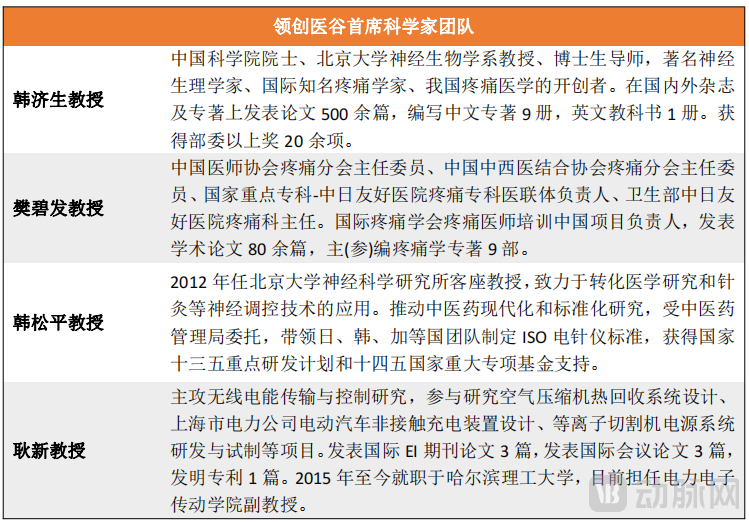
Leadinno Medical Valley was founded based on unmet clinical and market needs. Xu Tianrui, who graduated from the Basic Medicine program at Peking University Health Science Center, worked for 10 years in Pfizer's pain management product line before starting his entrepreneurial journey. A decade of understanding China’s pain market led Leadinno Medical Valley to enter the Chinese pain management market with SCS products. Since its establishment, Leadinno Medical Valley has built a comprehensive research system and assembled a strong team of chief scientists.
Source: Leadinno Medical Valley
In the application of wireless implants, the international market took an earlier step. As early as 2015, a wireless power-carrying implantable neurostimulation product appeared and received FDA and CE approvals. While avoiding the technical patents of international competitors, Leadinno Medical Valley has formed its own intellectual property rights. Currently, it has applied for dozens of invention patents, utility model patents, and design patents centered on wireless power-carrying communication technology.
Backed by strong R&D capabilities and a wireless implantation platform technology, Leadinno Medical Valley aims to cover the entire field of neuromodulation applications. From the SCS domain to the PNS domain with consistent underlying technology, this is the first map they intend to illuminate in the field of neuromodulation.Within the next 2-3 years, Leadinno Medical Valley aims to complete the registration and certification of SCS and PNS products; at the same time, it will gradually expand its coverage into the DBS and VNS fields, completing the product layout across the entire neuromodulation sector.
In addition, we found thatLeadinnoLeadinno Medical Valley has developed a foraminoscope business in addition to its neuromodulation operations.The product line of the foraminoscope includes a foraminoscope and accompanying surgical instruments, mainly used for the surgical treatment of lumbar disc herniation. Its related products have been approved last year and have started sales.
Speaking of this, Xu Tianrui introduced: "The spinal endoscope product line has a relatively clear purpose for us. First, the company relies on the spinal endoscope to have a self-sustaining capability, but more importantly, the significance lies inThe target departments for percutaneous endoscopic lumbar discectomy highly align with the neuromodulation product line.." Thus, the Leadinno Medical Valley's percutaneous endoscope product line and neuromodulation product line maintain high consistency in the dealer channel.Lays the foundation for the rapid commercialization of future neuromodulation products。
Currently, Leadinno Medical Valley is undergoing Series A financing to rapidly advance its product plans.。In the future, whether wireless-powered implantable neuroelectric stimulation products can make a big splash in the field of neuromodulation and achieve a "disruption" of existing products remains to be anticipated.