

Glofitamab Achieves 39.4% Complete Response Rate in Relapsed/Refractory DLBCL: Pivotal Phase II Data Submitted for Regulatory Review

Roche
Oncology Drug Research, Development, and Manufacturing
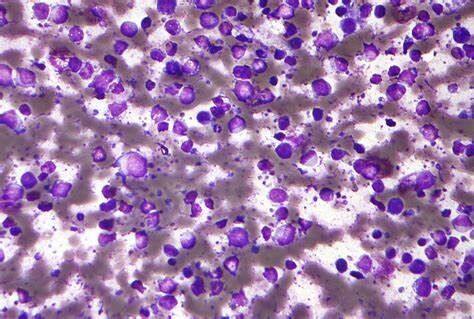
News on May 30, 2022 /BioValleyBIOON/ -- Roche recently announcedCD20xCD3 T-cell engaging bispecific antibody glofitamab (formerly known as CD20-TCB)Treatment of Relapsed or Refractory (R/R) Diffuse Large B-CellLymphomaLatest Data on Patients with DLBCL. The latest results from the pivotal Phase 2 NP30179 extension study (NCT03075696) show that, with a median follow-up of over 12 months, glofitamab fixed-duration treatment (12 cycles, 21 days/cycle) induced durable complete responses (CR) in heavily pre-treated R/R DLBCL patients who had previously received a median of three prior lines of therapy.
This extension study enrolled heavily pretreated and highly refractory DLBCL patients, with 58.3% of patients being non-responsive to their initial treatment and approximately one-third (33.1%) having previously receivedCAR-TCell Therapy. According to the assessment by the Independent Review Committee (IRC),With a median follow-up of 12.6 months, 39.4% of patients (61/155) achieved CR (primary efficacy endpoint), and half of the patients (51.6%; 80/155) achieved overall response (the proportion of patients with partial response [PR] + complete response [CR]; secondary efficacy endpoint).Patients whose condition reached CR showed durable remission, with the majority (77.6%) remaining in sustained remission at 12 months; the median duration of response (DOR) has not yet been reached (not evaluable [16.8 months, not evaluable]).
In terms of safety, cytokine release syndrome (CRS) was the most common adverse event, occurring in 63.0% of patients. CRS events were predictable and generally low-grade (mainly Grade 1 [47.4%] or Grade 2 [11.7%]), occurring at the initial dose, with only one patient discontinuing glofitamab treatment due to CRS. The incidence of Grade 3 or higher CRS was low (3.9%), with no Grade 5 events.
Data from the NP30179 study have been submitted to the European Medicines Agency.ManagementThe European Medicines Agency (EMA) is being approached by Roche for the approval of glofitamab. Roche plans to submit the study data to regulatory authorities around the world, including in the United States, later this year.FDA。
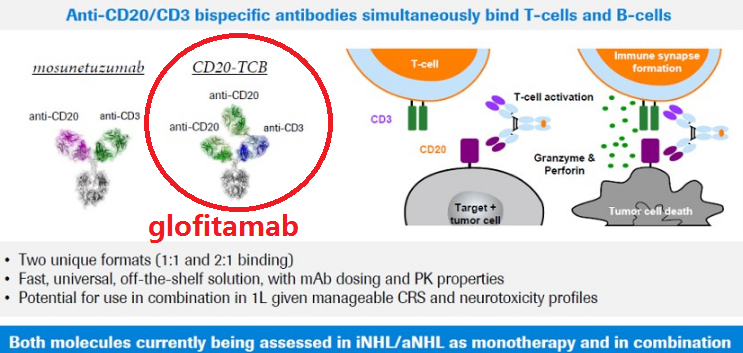
Currently, Roche is also developingAnother CD20xCD3 bispecific antibody, mosunetuzumab. In April this year, the EMA's Committee for Medicinal Products for Human Use (CHMP) issued a positive opinion, recommending the approval of mosunetuzumab for the treatment of patients who have previously received two therapies.Relapsed or Refractory Follicular Lymphoma (R/R FL)Patient. Results from the phase 1/2 GO29781 study showed that mosunetuzumab treatment achieved a high complete response rate (CR), with most CR patients maintaining remission for at least 18 months. Specific data: median follow-up of 18.3 months,The complete remission rate was 60% (n=54/90), and the objective response rate (ORR) was 80%.(n=72/90), with a median progression-free survival (PFS) of 17.9 months. In patients with a response, the median duration of response (DOR) was 22.8 months (95% CI: 9.7–not estimable [NE]).
Mosunetuzumab and Glofitamab are both CD20xCD3 bispecific antibodies that function by simultaneously binding to two different targets on two different cells (CD20 on the surface of malignant B-cells and CD3 on the surface of T-cells). This dual targeting action activates and redirects the patient’s existing endogenous T-cells, binding to and eliminating these malignant B-cells by releasing toxic proteins into the target B-cells. This dual-targeting therapy provides an innovative treatment approach for hematologic cancers, including non-Hodgkin lymphoma (NHL) and multiple myeloma (MM).
Mosunetuzumab and glofitamab differ in structure. Mosunetuzumab is structurally similar to natural human antibodies but contains two Fab regions, one targeting CD20 and the other targeting CD3. Glofitamab features a novel "2:1" structural pattern, with two Fab regions targeting CD20 and one Fab region targeting CD3.
Currently, Roche is further researching the subcutaneous formulations of mosunetuzumab and glofitamab, and expanding its understanding of their impact in earlier treatment through other Phase 3 studies, aiming to provide robust and durable treatment outcomes for patients with different types of lymphoma. (Bioon.com)
Source of Original Text:New Pivotal Data Demonstrate Clinical Benefit of Genentech’s Glofitamab, a Potential First-in-Class Bispecific Antibody for People with Aggressive Lymphoma