

AstraZeneca's BTK Inhibitor Calquence Shows 90% Five-Year Survival in First-Line CLL Treatment, Per ELEVATE-TN Trial

AstraZeneca
Biopharmaceutical Manufacturer
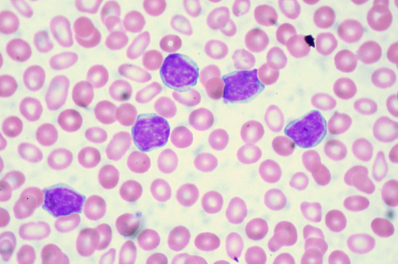
Chronic LymphocyticLeukemia(CLL, Image Source: dxline.info)
News on June 9, 2022 /BioValleyBIOON/ -- AstraZeneca recently at the 2022 American Society of Clinical Oncology (ASCO) The latest results of the ELEVATE-TN Phase III trial of the targeted anticancer drug BTK inhibitor Calquence (acalabrutinib) for the first-line treatment of chronic lymphocytic leukemia (CLL) were announced at the annual meeting. The study was conducted in previously untreated (treatment-naive) adult patients with CLL, evaluating Calquence monotherapy, Calquence + obinutuzumab combination therapy, and standard chemotherapy.ImmunityEfficacy and Safety of Chlorambucil + Obinutuzumab Regimen.
Data shows,With a median follow-up of approximately 5 years, compared to the standard chemo-immunotherapy regimen of chlorambucil + obinutuzumab, both Calquence monotherapy and Calquence + obinutuzumab combination therapy maintained...StatisticsStatistically significant progression-free survival (PFS) advantage, the safety and tolerability were consistent with the known profile of Calquence. The results also showed that, compared with the chlorambucil + obinutuzumab regimen, the Calquence + obinutuzumab combination therapyWith a longer overall survival (OS)。
CLL is the most common type of leukemia in adults, and Calquence is a BTK inhibitor. Data presented at the ASCO Annual Meeting show that,With a median follow-up of 58.2 months, compared to the chlorambucil + obinutuzumab regimen, the combination therapy of Calquence + obinutuzumab significantly reduced the risk of disease progression or death by 89% (HR=0.11; 95% CI: 0.07-0.16), while Calquence monotherapy reduced it by 79% (HR=0.21; 95% CI: 0.15-0.30).。
OS data are not yet mature, and the median OS has not been reached in any group.Compared with the bendamustine + obinutuzumab regimen group, the Calquence + obinutuzumab treatment group reduced the risk of death by 45%.(HR=0.55;95%CI:0.30-0.99)。CThe 5-year survival rate of the Alquence+Obinutuzumab treatment group is approximately 90%.,The Calquence monotherapy group was 84%, and the chlorambucil + obinutuzumab treatment group was 82%.
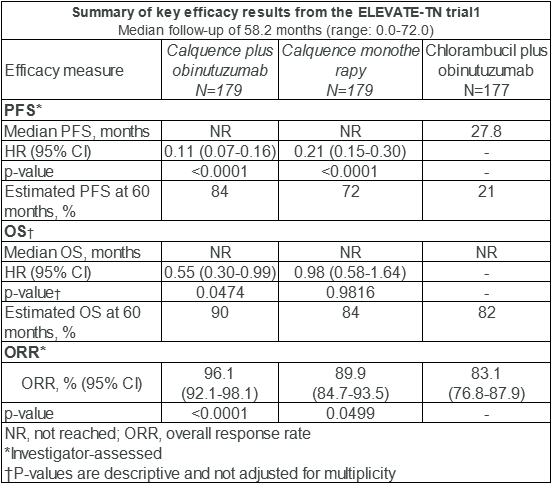
ELEVATE-TN Phase 3 Trial: 5-Year Follow-Up Data
The 4-year follow-up data from the ASCEND Phase 3 trial were also presented at the ASCO Annual Meeting. The results showed,In adult patients with relapsed or refractory chronic lymphocytic leukemia (R/R CLL), compared with the investigator-selected regimens of rituximab + idelalisib (IdR) or rituximab + bendamustine (BR),Calquence Shows Sustained PFS Benefit Over 4-Year Treatment Period。At 42 months, an estimated 62% of patients in the Calquence treatment group were alive and progression-free, compared to 19% in the IdR/BR treatment group.The median follow-up time was 46.5 months in the Calquence treatment group and 45.3 months in the IdR/BR treatment group.
The safety and tolerability of Calquence in the ELEVATE-TN and ASCEND trials were consistent with earlier findings, with no new safety signals identified.
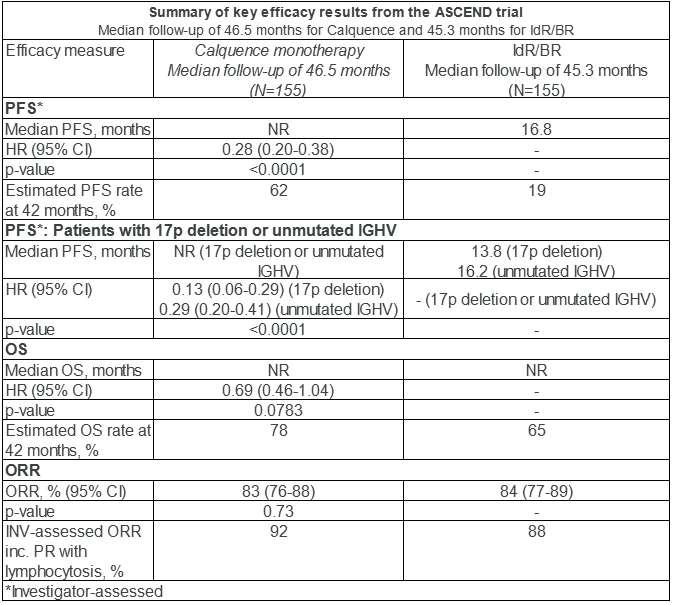
ASCEND Phase 3 Trial: 4-Year Follow-Up Data
Calquence was approved by the United States in October 2017.FDAApproved for marketing, indications include: (1) for patients with relapsed or refractory mantle cell lymphoma who have previously received at least one therapy.Lymphoma(MCL) adult patients; (2) for the treatment of chronic lymphocytic leukemia (CLL) or small lymphocytic lymphoma (SLL) adult patients.
The active pharmaceutical ingredient in Calquence is acalabrutinib, a next-generation, highly selective, potent, covalent Bruton's tyrosine kinase (BTK) inhibitor that works by permanently binding to and inhibiting BTK. BTK is a key regulator of the B-cell receptor (BCR) signaling pathway, widely expressed in various types of hematologic malignancies, and is involved in the proliferation, trafficking, chemotaxis, and adhesion of B cells, making it an important target for treating hematologic malignancies. In preclinical studies, acalabrutinib demonstrated minimal off-target effects.
Currently, Calquence is being developed for various B-cell blood cancers, including CLL, MCL, diffuse large B-cell lymphoma (DLBCL), Waldenstrom macroglobulinemia (WM), follicular lymphoma (FL), multiple myeloma, and other hematologic malignancies.
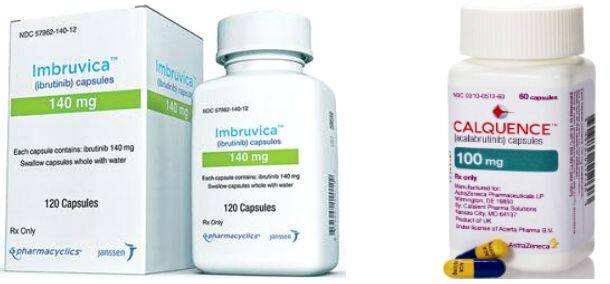
Calquence has the same mechanism of action as AbbVie/Johnson & Johnson's blockbuster blood cancer drug Imbruvica (ibrutinib), which is the world's first approved BTK inhibitor.Since its initial approval in November 2013, Imbruvica has been approved for up to 11 treatment indications across six disease areas, with global sales steadily increasing. (Bioon.com)
Source of the original text:Calquence plus obinutuzumab demonstrated sustained survival benefit in 1st-line chronic lymphocytic leukaemia with 90% of patients surviving five years in ELEVATE-TN trial