

Yuyao Biopharma Files for IPO: Pioneering AI-Driven Super Molecular Glue Platform Targeting Over 10 First-in-Class Oncology and Disease Targets
YU YAO BIOTECH
Small Molecule Drug Developer
On March 3, 2022, YU YAO BIOTECH received its first clinical approval. YY001, the company's self-developed next-generation EP4 receptor small molecule antagonist, has officially entered the clinical stage.
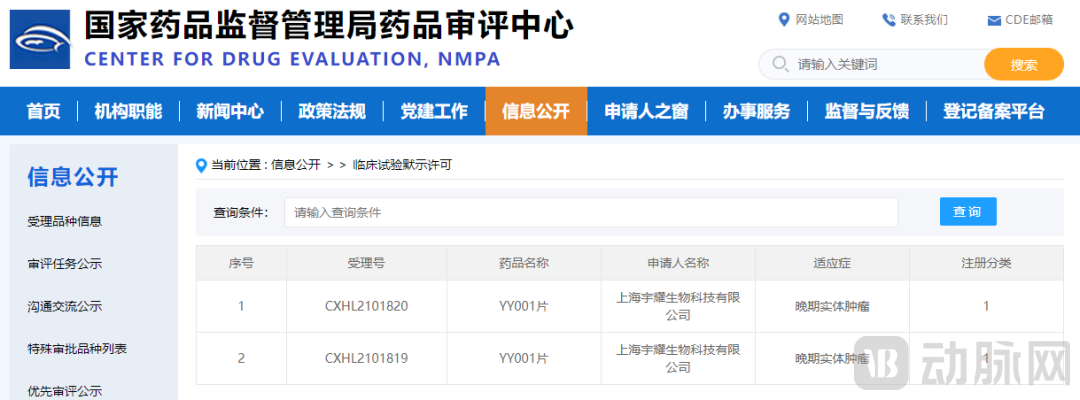 YU YAO BIOTECH“YY001"Tablet" Receives Clinical Trial Implied Permission
Dr. Wenbo Zhou, founder of YU YAO BIOTECH, stated that the preclinical study data of YY001 shows,Target activity increased 5-10 times, oral bioavailability improved 2 times, and in vivo drug concentration rose 4 times.; In addition, YY001 demonstrated significant anti-tumor effects in advanced solid tumors such as colorectal cancer, gastric cancer, and prostate cancer, and significantly enhanced therapeutic efficacy when used in combination with PD-1 antibodies., which is expected to transform PD-1 antibody treatment-insensitive "cold" tumors into sensitive "hot" tumors, providing a new strategy for the treatment of advanced solid tumors.
Currently, there are no similar drugs targeting EP4 available globally, and YY001 is YU YAO BIOTECH's first heavy-hitting new drug aimed at becoming a First-in-Class breakthrough.
Including YY001, YU YAO BIOTECH's current product pipeline covers more than 10 First-in-Class targets such as EP4, STAT3, and Pan-Ras. After witnessing the intense competition, YU YAO BIOTECH’s choice represents the conceptual upgrade of a new generation of pharmaceutical professionals from "me-too" to "first-in-class."
Dr. Wenbo Zhou, the founder of YU YAO BIOTECH, is a Ph.D. in Medicinal Chemistry from East China Normal University. During his Ph.D. studies, he led his team to advance two new drugs from the initial target selection to the PCC stage (Preclinical Candidate Compound), one of which is YY001, which has just been approved for IND.
"We hope to transform scientific research results into products that are beneficial to society and can be practically used; at the same time, we don’t want to follow others but aim to develop more First-in-Class original innovative drugs." With such a vision, Zhou Wenbo co-founded YU YAO BIOTECH with his mentor. Under his leadership, the company has successively won several honors including the Gold Award at the 7th "Create Youth" China Youth Innovation and Entrepreneurship Competition (the only one from Shanghai), the Gold Award at the 6th "Internet+" College Students Innovation and Entrepreneurship Competition, the Gold Award at the First National Postdoctoral Innovation and Entrepreneurship Competition, the Gold Award at the 2021 "Lingang Cup" Create Youth Shanghai Youth Innovation and Entrepreneurship Competition, and the Excellence Award in the Global Finals of the 2021 "Haiju Yingcai" Innovation and Entrepreneurship Competition.
He has consistently been committed to scientific research and new drug development. As the project leader, he guided two First-in-Class projects of YU YAO BIOTECH into Phase I clinical trials, and published multiple first-author papers in top journals of medicinal chemistry such as JMC and EJMC. He has received talent awards such as Shanghai Youth Entrepreneurship Talent and Minhang District Entrepreneurship Talent.
After more than two years of dedicated development, YU YAO BIOTECH's core R&D team consists of over 30 employees with doctoral and master’s degrees. The team has extensive experience in molecular and cellular biology, cancer mechanism research, drug metabolism and safety evaluation, drug design and synthesis, and AI + biomedicine interdisciplinary fields. The company has applied for more than 13 invention patents and 4 PCT patents, some of which extend to countries and regions such as Europe, the United States, Japan, Australia, and Canada, laying a foundation for future global expansion.
Nowadays, YU YAO BIOTECH has officially moved into the Temperature Science Park in Wujing Town, Minhang District, the southern science and innovation center of Shanghai, with more than 5,000 square meters of office and R&D laboratory space.
According to the latest global cancer burden data for 2020 released by the International Agency for Research on Cancer (IARC) of the World Health Organization, China ranks first in the world for both new cases and deaths, making it a veritable "cancer giant."
Cancer treatment is imminent, and pharmaceutical companies in China have long been involved in this field. According to a research report published in the Chinese Journal of Oncology, in 2020, a total of 722 clinical trials for cancer drugs were registered in China, with an annual growth rate of 52.3%, accounting for 28.3% of all drug clinical trials during the same period. Among them, 603 trials (83.5%) were initiated by domestic pharmaceutical companies, 105 trials (14.5%) were international multicenter trials, and Phase I clinical trials accounted for the highest proportion (44.5%).
But behind the prosperity of anti-tumor drug development, there also lies the current situation in China where cancer clinical trials are overcrowded and products have a high degree of repetition.
Dr. Zhou Wenbo believes that behind the "involution" is actually the clustering around popular targets. Due to the high difficulty, large investment, and high risk involved in researching new targets, many companies are either unwilling or unable to pursue new targets. As a result, they concentrate on a few popular targets with high certainty, leading to a waste of resources.
"We have always adhered to innovation from the source, seeking new targets, and developing truly original drugs," said Dr. Zhou Wenbo. The differentiation of YU YAO BIOTECH lies in its ability to discover new targets. Over the past decade, the founding team has been committed to the mechanistic and translational research between new targets and diseases. Many of the targets and endogenous ligands were even discovered and named by scientists within the team. This has provided the initial foundation for YU YAO BIOTECH’s systematic drug development targeting these targets.
In addition to tumors, YU YAO BIOTECH is also actively expanding the range of indications, covering disease areas such as metabolic diseases, autoimmune diseases, and neurodegenerative diseases.
Leveraging the R&D strength of its scientist-backed team and its pursuit of original targets, YU YAO BIOTECH, with its two major technology platforms, has developed a product pipeline covering more than 10 global first-in-class targets, including EP4, STAT3, and Pan-Ras.
Super Molecular Glue Technology Platform
The occurrence and development of most diseases are related to the abnormal expression or aggregation of proteins. Traditional drug development approaches for such pathological mechanisms involve developing various small molecule or protein inhibitors that occupy and block the active sites of target proteins, thereby inhibiting their functional activity. This type of strategy requires target proteins to have well-defined "druggable" active pockets or binding sites. However, approximately 80% of proteins lack these active binding regions and are therefore considered "undruggable."
Molecular glues are a class of small molecule compounds that can induce or stabilize protein-protein interactions, mediating target protein degradation through the ubiquitin-proteasome pathway, offering new opportunities for targeting proteins traditionally considered undruggable.
Among the already approved drugs, immunomodulatory agents (IMiDs) such as thalidomide, lenalidomide, and pomalidomide are typical molecular glues. Notably, thalidomide, which was marketed in 1954, was initially widely used as a sedative for pregnant women but was later withdrawn from the market due to causing severe birth defects in newborns. It wasn't until 2010 that scientists clarified the specific mechanism of action of thalidomide, discovering that it binds to the CRBN protein and forms an E3 ubiquitin ligase complex with DDB1, Cul4A, and ROC1, inducing target protein degradation.
However, the binding of thalidomide to CRBN protein also competes with the binding between MEIS2 and the DDB1-CRBN complex, leading to an extended half-life of MEIS2. As a transcription factor, MEIS2 plays a crucial role in human development, which also explains the reason why thalidomide causes birth defects in newborns.
YU YAO BIOTECH, learning from historical lessons, has developed a super molecular glue platform, focusing on "non-CRBN" degrader molecular glues, achieving differentiation from existing molecular glue drugs.
FirstDrugs developed based on the super molecular glue platform are not limited by traditional E3 ligase restrictions. By using molecular glue to form ternary complexes through protein-protein interactions, they can be applied to any difficult-to-drug target.Secondly,Super molecular glue mainly inhibits the undruggable surface of target sites by recruiting chaperone proteins, scaffold proteins, etc. This inhibition effect is more comprehensive, efficient, and less prone to drug resistance.FinallyFrom the perspective of molecular design, YU YAO BIOTECH modularly designs super molecular glue, which is organically composed of two modules: one part for binding to the target protein and the other part for binding to the chaperone protein.
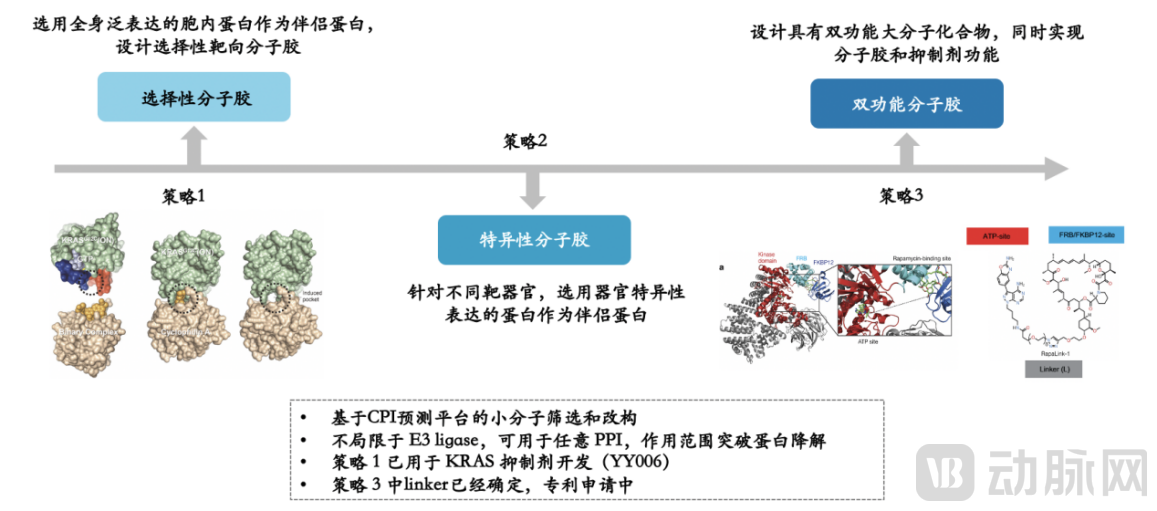 YU YAO BIOTECH Super Molecular Glue Platform
YU YAO BIOTECH's super molecular glue can not only scale the technology to more undruggable target proteins but also enable targeted organ delivery, achieving ultra-precise treatment for specific diseases, especially cancer.
Currently, the company has developed multiple pipelines of super molecular glue targeting difficult-to-drug targets. Projects involving novel mechanism molecular glue targeting KRAS, mutant estrogen receptors, and mutant androgen receptors (AR-V7) are underway. For instance, the RAS molecular glue under development can target all RAS mutations (including KRAS, HRAS, and NRAS). Preclinical data shows that YU YAO BIOTECH's RAS molecular glue significantly overcomes the resistance to existing G12C inhibitors. Mechanistically, the RAS molecular glue specifically targets and binds only to the activated state of RAS with GTP, showing no significant inhibition on the inactive state of RAS.
AI Molecular Design and Screening Platform
YU YAO BIOTECH's AI Drug Discovery Team Has Over a Decade of Experience in Computer-Aided Drug Design (CADD). The company’s AI platform incorporates the CpiFormer framework, integrating a split and rewritten AlphaFold2 project as the Protein Encoder (PEnc) to provide protein structural information. Combined with small molecule data encoded by a 3D Transformer block, it forms a dual-channel deep neural network, creating a large-scale parallel, "off-the-shelf," end-to-end protein-small molecule interaction (CPI) prediction platform. This platform can complete preliminary screening of tens of millions of small molecules within a week and accurately predict the structure of protein-small molecule complexes as well as precisely forecast the changes small molecules induce in protein structure and function.
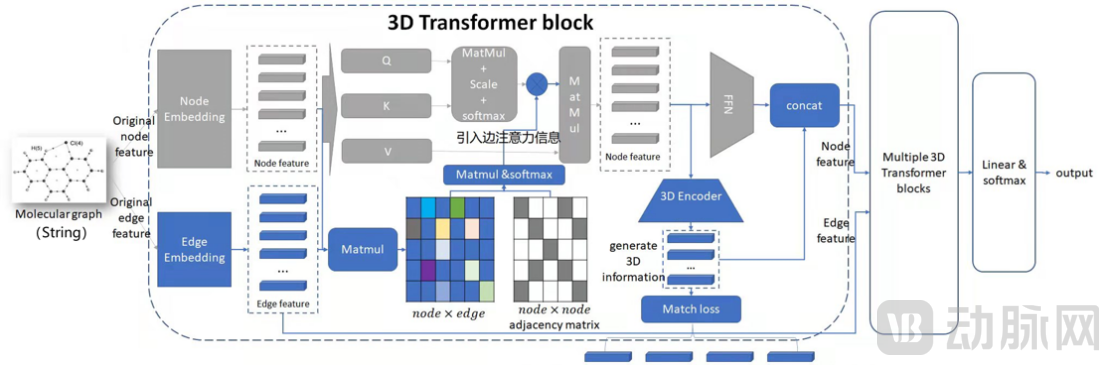
Deep Neural Network CPI Prediction Platform
In the EP4 receptor antagonist YY001 project, YU YAO BIOTECH identified two novel core structures through AI-driven virtual drug screening. Over 30 derivatives demonstrated activity more than 10 times superior to competing products. The project has now entered Phase I clinical trials, and related patents have been granted globally.
Another STAT3 inhibitor project, YU YAO BIOTECH utilized AI to make precise predictions of the STAT3 target protein and small molecule complexes and established a unique screening system. They discovered the world's first picomolar (pM) STAT3 selective small molecule inhibitor, marking a significant breakthrough in small molecule inhibitor research for this target since its discovery over 40 years ago. The product is about to formally submit an IND in China and the United States.
Centering on the super molecular glue technology platform and AI drug-assisted development platform, supplemented by other core technologies, YU YAO BIOTECH has rapidly established nearly 10 global first-in-class product pipelines. Its core products include one item in Phase 1 clinical trials and two clinical approvals in both China and the U.S.
Currently, YU YAO BIOTECH has signed cooperation agreements with five or six domestically renowned double-first-class universities and research institutions to jointly advance the research and development of new drug targets. Additionally, the company has established cooperative relationships with dozens of top-tier tertiary hospitals in China, including Zhongshan University, the First Affiliated Hospital of Zhejiang University, Ruijin Hospital, and Xiangya Hospital, to carry out relevant clinical translational research. As the company’s subsequent proprietary product pipelines increase, the scale of cooperation will further expand.
It is reported that the company has completed an angel round of financing worth tens of millions of yuan and is planning to carry out a new round of pre-A round financing. This financing will be used to advance clinical trials and bring more products into the clinical stage.
Speaking of future plans, Dr. Zhou Wenbo stated that the company plans to advance the development of its subsequent product pipeline at a rate of obtaining two clinical approvals per year in both China and the U.S. He also expressed hope that within five years, the company could achieve a simultaneous listing of its products and the company itself.