

LeadBio Advances as a Regenerative Medicine Platform Company with PULSSIBLE™ Bioengineered Vascular Graft

LEADBIO
Medical Device Developer
On June 17, at the 4th Annual Academic Conference of the Vascular Surgery Physicians Branch of the Chinese Medical Doctor Association, Dr. Fu Qining, Deputy Director of the Vascular Surgery Department at the First Affiliated Hospital of Chongqing Medical University and Chairman of the Youth Alliance for Hemodialysis Access of the Asia-Pacific Vascular Academic Alliance, delivered a speech titled "Introduction to Animal Experiments on PULSSIBLE™ Bioengineered Artificial Blood Vessels."
Fu Qining said, "The PULSSIBLE™ bio-artificial blood vessel demonstrated excellent patency and regenerative properties in the experiments."
In fact, artificial blood vessels and artificial organs have been quietly applied in the medical industry.
Taking artificial blood vessels as an example,Currently, artificial blood vessels have been widely used in various scenarios such as peripheral vascular bypass surgery, vascular trauma, and vascular access for hemodialysis.
In March 2022, Professor Deling Kong and Associate Professor Kai Wang from Nankai University published a research paper on artificial blood vessels in "Science Advances." The conclusion was: Polymer fiber scaffold-reinforced in vivo engineered artificial blood vessels demonstrated excellent patency and regenerative properties in large animal vascular transplantation experiments.
Artificial blood vessels, artificial organs, and other synthetic products are all outcomes of regenerative medicine. In recent years, with the advancement of science and technology and breakthroughs in material technology, regenerative medicine has gradually become a popular field in the healthcare industry. Through regenerative medicine technologies, people can address currently difficult-to-treat or incurable diseases, such as solving diabetes with an artificial pancreas; through regenerative medicine technologies, people can extend life expectancy, such as resolving heart failure with an artificial heart…
It is precisely because of the broad prospects of regenerative medicine that, in recent years, many innovative companies focusing on regenerative medicine have emerged worldwide. LEADBIO is one of them, and its core product under development includes the PULSSIBLE™ bio-artificial blood vessel.
Data shows that LEADBIO was founded in 2019 at the Hangzhou Qiantang New Area Medicine Port by Mr. Xu Pengyun, a veteran of the medical industry, and Professor Kong Deling, then Dean of the College of Life Sciences at Nankai University.
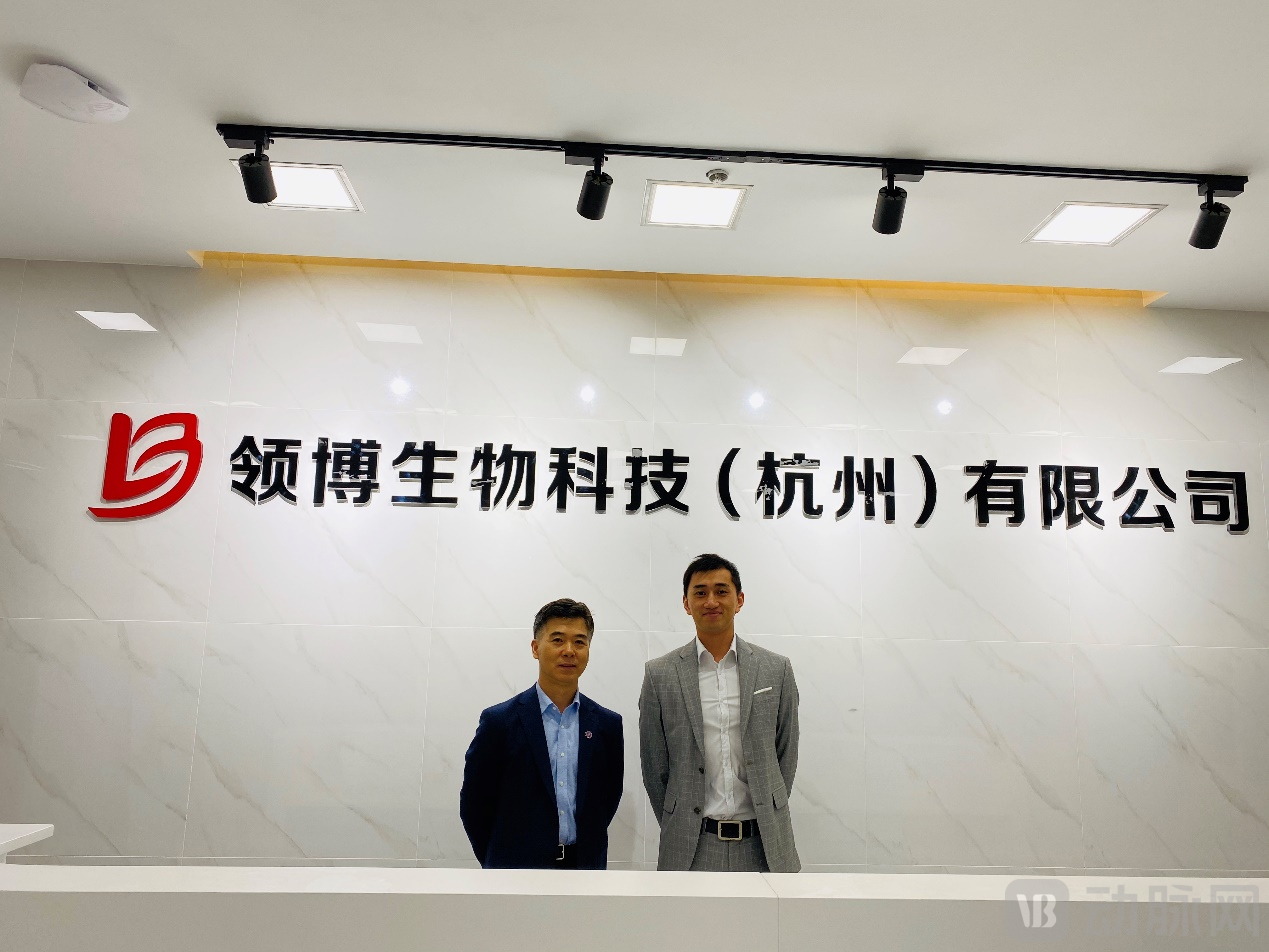
(Photo of Mr. Xu Pengyun and Professor Kong Deling at the founding of LEADBIO)
According to reports, LEADBIO has taken the biologic small-diameter artificial blood vessel, which Professor Deling Kong's team has been dedicatedly researching for nearly a decade, as the industrialization starting point. It focuses on becoming the first company in China to complete the industrialization of biologic artificial blood vessels. Using this platform technology, it continuously extends its research and development into tissue engineering regenerative materials products that can replace and repair human tissues and organs. The company is committed to becoming a globally leading platform enterprise in the research, development, and manufacturing of tissue engineering, artificial organs, and tissue repair products.
Currently,LEADBIO's research and development products include approximately 10 tissue engineering products such as biologic small-diameter artificial blood vessels, biologic large-diameter artificial blood vessels, artificial esophagus, vascular patches, biological tissue patches, and hydrogel series products.Among them, multiple products have completed type inspection and animal experiments, and the biologically derived artificial blood vessel has completed hospital clinical approval and is about to enter the human clinical trial stage.
Currently, artificial blood vessels are mainly used for peripheral vascular replacement and vascular access for hemodialysis.
Industry insiders believe: The market for artificial blood vessels, such as peripheral vascular replacement, will maintain steady growth, while more hemodialysis patients will use artificial blood vessels in the future, bringing significant growth to the artificial blood vessel market.
Data released by clinical experts at the Eastern Nephrology Conference showed that: By the end of December 2020, the total number of hemodialysis patients in China reached 692,700, with 143,500 new hemodialysis patients.
The vascular access of dialysis patients is crucial for maintaining their lives, but with patients requiring dialysis 2-3 times a week, repeated long-term puncturing of blood vessels is detrimental to the health of the patients' blood vessels.
"Chinese Expert Consensus on Vascular Access for Hemodialysis" recommends: Autologous arteriovenous fistula should be the first choice for long-term vascular access. When an autologous arteriovenous fistula cannot be established, a graft arteriovenous fistula should be the second choice. Dialysis catheters with tunnels and polyester cuffs should be the last option.
Currently, autologous arteriovenous fistula is the primary type of vascular access for maintenance hemodialysis patients in China, but tunneled cuffed dialysis catheters are the second most common type of vascular access.
For this situation, experts recommend: maintenance hemodialysis patients who are unable to establish autologous arteriovenous fistulas should opt for prosthetic arteriovenous fistulas whenever possible. The usage rate of prosthetic arteriovenous fistulas should be increased to 10%, further reducing the reliance on tunneled dialysis catheters with Dacron cuffs.
It can be seen that, with the promotion of expert consensus and clinical doctors, the usage rate of arteriovenous grafts will gradually increase. The applied grafts and artificial blood vessels will help more patients while expanding their market scale.
In addition to the aforementioned artificial blood vessels, LEADBIO is also developing small-diameter artificial blood vessels for coronary artery bypass grafting.
It is reported that there are about 1 million coronary artery bypass patients worldwide each year, with the main source of vascular grafts being the great saphenous vein. However, the availability of the great saphenous vein is limited, the lifespan of limb vessels is finite, and there may be discrepancies in vessel caliber matching. These three factors create an urgent need for small-caliber artificial vessels among coronary artery bypass patients.
The caliber of artificial blood vessels required for heart bypass surgery is approximately 4 millimeters, and the technical difficulty is relatively high. Currently, there is still no product available on the global market.
LEADBIO stated: "Based on the company's small blood vessel products for arteriovenous fistula, several small-caliber artificial blood vessels suitable for coronary artery bypass have been designed. Animal experiments are currently being conducted for initial validation. It is expected that the research and development content of this blood vessel will participate in the application for a key national R&D program project."
Large- and medium-caliber artificial blood vessels are mainly made from materials such as polyester, polytetrafluoroethylene, and natural silk. These materials have low blood compatibility and anticoagulant properties, which are not conducive to the adhesion and growth of endothelial cells. Meanwhile, in small-caliber blood vessels, where blood flow is slower and blood pressure is lower, the aforementioned materials tend to cause fibrin and platelet deposition, leading to narrowing and blockage of small vessels.
Therefore, there is still a lack of clinically satisfactory small-caliber artificial blood vessel products on the market.
In response to this situation, Mr. Xu Pengyun, founder of LEADBIO, stated: "The company's polymer scaffold decellularized matrix artificial blood vessel under research is expected to become the first bio-type artificial blood vessel product to be launched in China."
According to the introduction, the bio-artificial blood vessel developed by LEADBIO has four major advantages:
First, the material of this artificial blood vessel is composed of a combination of polymer materials and decellularized matrix. Among them, the polymer material provides suitable mechanical properties for the product, while the decellularized matrix offers excellent biocompatibility and bioactivity. Meanwhile, the polymer material is a degradable substance, which will gradually degrade after being implanted in the patient's body, providing space for cell migration and vascular regeneration.
After this artificial blood vessel is implanted in the patient, the extracellular matrix layer will promote the attachment and growth of endothelial cells, allowing the artificial blood vessel to quickly complete endothelialization, thereby greatly reducing the incidence of stenosis and blockage.
Second, this artificial blood vessel is made by micro-nano fiber textile technology, with a regular fiber structure, ensuring that there will be no bleeding or leakage at the suture site after the completion of the surgery.
Third, this artificial blood vessel has excellent anti-infective properties. LEADBIO stated: "Laboratory research data shows that this is an artificial blood vessel with a low risk of infection, and we are further verifying it." Once the product's anti-infective properties are validated, it could potentially be applied in surgical treatments for patients with infections.
Fourth, this artificial blood vessel model has small-caliber versions, with an inner diameter ranging from 3 to 6 millimeters and a length of over 50 centimeters. Currently, there is a lack of clinically satisfactory small-caliber artificial blood vessels on the market, and this product is expected to fill this gap.
LEADBIO stated: "The preparation technology it has mastered can not only produce small-diameter artificial blood vessels but also exhibits superior properties for large thoracic and abdominal aortic vessels compared to existing polymer-based artificial blood vessels."
So far, this bio-type artificial blood vessel has shown good patency and regenerative properties in animal experiments, and has passed the hospital’s ethical review, and will soon officially enter clinical trials.
So, how did LEADBIO develop such a groundbreaking artificial blood vessel?
On the one hand, Professor Kong Deling, a co-founder of LEADBIO, is a leading expert in the field of tissue engineering and regeneration in China. His team has been deeply engaged in the research and development of artificial blood vessels for over a decade, and their accumulated experience has provided directional guidance to the R&D team. LEADBIO also actively collaborates with many clinical and scientific research experts, listening to their advice and opinions.
On the other hand, the company's management team, led by Mr. Xu Pengyun, has more than ten years of experience in medical market management, registration, and sales. They also possess excellent capabilities in analyzing and introducing cutting-edge overseas technologies, having introduced several outstanding medical products from abroad into the Chinese market. For artificial blood vessel products, plans for technological upgrades have already been made.
LEADBIO, based on Professor Kong Deling's team's long-term research and development, along with the support from clinical experts, scientific research experts, and under the efficient operation of the company's management team, is smoothly carrying out the industrialization of biological artificial blood vessels.
Mr. Xu Pengyun stated: "In the future, after LEADBIO's artificial blood vessel products and other pipeline products are successfully launched, the company will rely on its strong relationships with clinical experts and extensive dealer resources to promote these products in clinical settings, benefiting more patients." As a veteran with over a decade of experience in sales and marketing management, Mr. Xu Pengyun expressed full confidence in future sales.
LEADBIO is positioned as a platform enterprise for the research, development, and manufacturing of artificial organs and tissue repair products. Therefore, in addition to artificial blood vessels, LEADBIO is also expanding its core technologies and developing other product lines according to its long-term planning.
Mr. Xu Pengyun stated: "In addition to being driven by technology as many innovative companies are, LEADBIO incorporates more communication about clinical market needs into its management, adopting the concept of market-guided technology and technology serving the market. With the 'LEADBIO-Nankai University Joint Laboratory' as the base for fundamental research, we strive to bring more revolutionary products to patients. Meanwhile, LEADBIO also hopes to use the industrialization of artificial blood vessel research achievements as an entry point to introduce more experts’ research results. Leveraging our management experience and transformation expertise in cutting-edge technologies, we aim to help more experts commercialize their achievements."
Finally, LEADBIO told VCBeat that it is expected to initiate a new round of financing after the clinical enrollment of its artificial blood vessel, with the funds raised mainly used for the clinical trials of the artificial blood vessel and the research and development of new products.