

VirtuOptica Files IPO Prospectus: Revolutionizing Eyecare with VR-Based Automated Vision Testing

VirtuOptica
Portable VR Device Developer
The eyewear industry is an ancient industry.
Although current advances in science and technology have given rise to a variety of functions, the vast majority of companies are focused only on lens materials and production processing.
AndDownstream terminal market, it is necessary to equip the store with professional equipment and professional optometric personnel to provide consumers with professional services such as eye examinations, glasses fitting, and lens and frame assembly.Have not enjoyed much convenience brought by technology, the optometry method remains the same as it was 100 years ago.
Moreover, about 250 million people globally lack access to optometric prescriptions and suitable glasses.
Israeli innovation company VirtuOptica has grasped the crux of the problem.They have developed two products: one is a game-based automated refraction integration that can be installed on any optometry device; the other is the Opticular 360 portable VR device, which allows users to automatically obtain a glasses prescription by playing a very simple interactive game.
Opticular 360 also supports optometrists in interacting with patients through telemedicine to issue prescriptions when needed. As a portable VR device, Opticular 360 enables patients to navigate interactive menus easily, selecting frames, colors, and multifocal options according to personal preferences.
VirtuOptica's patented automation technology is based on an interactive 3D game that automatically analyzes how a patient's brain perceives visual information, quickly providing optometrists with accurate reference data. This groundbreaking technology represents a new attempt in the field of optometry, combining advanced techniques in biosignal interpretation and human-computer interfaces.
But, what made VirtuOptica think of creating such a product by combining VR with brain-computer technology? And what is it about this fertile ground of Israel that continuously gives rise to innovative products that influence the world? With these questions in mind, VCBeat interviewed Ori Raviv, founder of VirtuOptica, in an attempt to unveil the mystery behind Israel's innovative solutions.

Founder of VirtuOptica, Ori Raviv
For the convenience of readers, VCBeat translated the interview dialogue and edited the text without changing the original meaning.
VCBeat: Please share your personal background and how you entered the healthcare field?
Ori Raviv: I have over 20 years of experience in the research and management of complex product development, and I have always been very interested in connecting software with user behavior. In the past decade, I have mainly focused on researching and developing hardware and software devices for brain research laboratories and startups in the medical technology field. My sister, Dr. Chen Ryder, is a neuroscience expert and also the head of a brain science research institute. Therefore, brain science is often a topic of our after-dinner conversations. I am very interested in this field and believe that brain science has tremendous potential, especially in the medical device industry.
VCBeat: Why did you choose to start your own business? Can you share some details about the founding of VirtuOptica and the process of building the core team?
Ori Raviv: Founders of start-ups often say they are pursuing their dreams and then making them come true. But that's not the case for me; everything actually originated from a dream.
At that time, I went to an optometrist for a vision test and to get a new pair of glasses. But during the refraction process, he kept asking me over and over again which lens was clearer, this one or that one, this one or that one. I found it very tedious, almost no different from the experience my great-grandmother might have had.
After I got home from getting my glasses, I remember it was around 4 a.m. when I had a dream about all the features of this current product. I quickly got up and recorded the product details on my computer, then went back to sleep. When I woke up in the morning, I couldn't believe whether it was a dream or reality. But when I opened my computer and found all the content there, I was extremely excited. From that moment on, I felt that this was a mission in my life. This is the career I want to pursue.
So I collaborated with Dr. Andrey Markus, who used to be my sister's colleague and is also a brain science researcher, to develop the product. Our first-generation product was actually a combination of a bicycle helmet and VR, which was quite heavy to wear but indeed effective. Now, we have optimized and iterated to the fifth version, and the product form has greatly improved.
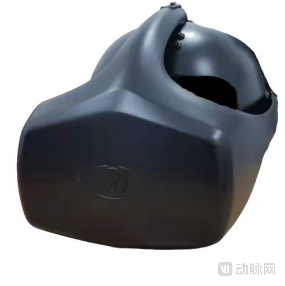
Opticular 360 First Edition Product Image (2017)
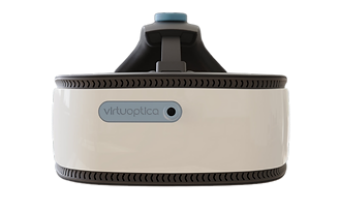
Opticular 360 Fifth Edition Product Image (2022)
VCBeat: This can truly be called the realization of a "dream." So, what specific pain points does your product address?
Ori Raviv: This is actually a completely new way of optometry. First of all, we have liberated optometrists from a technical perspective. Many optometrists have told us that despite studying professional knowledge for such a long time, they still need to spend the whole day asking "this one or that one" questions. Our equipment allows them to focus on what they do best and sell glasses, saving the time needed to question patients. Customers feel the same way—they don’t like this lengthy questioning process. They prefer solving problems in an entertaining way.
Our products can also help those who have no access to professional optometrists. For instance, the device can be brought to remote and impoverished areas, where optometrists can connect with users through telemedicine services and issue prescriptions for glasses. What we are doing is serving more people better and pushing this industry to new technological heights.
VCBeat: So basically this product can simplify the entire glasses fitting process.
Ori Raviv: Yes, and with more flexibility. Currently, an optometrist can only serve communities surrounding his city. However, with our device, the service boundary of an optometrist can theoretically be infinitely expanded, even making it possible to serve users in another country.
VCBeat: It can indeed benefit more people. Behind high-quality products, there is always an excellent team. We would also like to learn more about the company culture of VirtuOptica.
Ori Raviv: Our culture is to create distinctive, interesting, and cutting-edge solutions through multidisciplinary integration, addressing the needs of the optical industry on one hand and meeting customers' demands for novel and engaging experiences on the other. At the same time, we ensure that integrated hardware and software solutions in brain science, gaming, and VR can be adopted by everyone while meeting legal and regulatory requirements.
VCBeat: What positive or negative impacts do you think the pandemic has had on VirtuOptica's business? What lasting changes has it brought to the entire healthcare system?
Ori Raviv:On the negative side, our team has had to work separately. But more positively, we can see that technology is more meaningful than ever before. Especially, our product enables optometrists and consumers to fit glasses without contact, making everyone feel assured and safe. I believe the pandemic is driving the entire healthcare industry to adjust, one of the directions being to make medical devices operate automatically and standardizedly, especially in terms of assisted decision-making and telemedicine service products.
VCBeat: In the process of your current and even future business development, what challenges do you think still exist?
Ori Raviv: The biggest challenge still comes from people's conservative attitude towards technology. Some believe that the advent of technology has replaced human labor. While this is true in some cases, our ultimate goal is not to replace humans but to use intelligent machines to provide better services to society. However, not everyone realizes this. Therefore, we need to reassure everyone not to fear embracing innovative technologies. Although our product disrupts traditional service methods, it truly works and can deliver a different experience.
VCBeat: Do you have plans to expand into the Asia-Pacific region, particularly the Chinese market?
Ori RavivOf course, China has enormous market potential, with hundreds of millions of people in need of innovative optometry services. Our team has visited China multiple times for inspections and is currently conducting clinical trials at an ophthalmology hospital in China. The feedback from these clinical trials has been positive so far. Not long ago, our automatic vision examination product for glasses fitting received patents in both China and the United States. Therefore, we are also seeking Chinese partners in the ophthalmology industry to achieve mutual benefits and win-win outcomes. Friends who are interested are welcome to contact us.
VCBeat: We have interviewed several other Israeli entrepreneurs. It must be said that Israel is a hotbed of innovation. What are your insights on how Israeli companies cultivate innovation?
Ori Raviv: Innovation is something we must do to survive, and we have no other choice. Seventy-four years ago, my great-grandparents' generation had to support the establishment of this country. There is so much wisdom here, so I think using our own wisdom to innovate is the best thing we can do as individuals. Otherwise, we would only have a desert, neither close to the United States nor a populous country, and only technology can bring us to the world. And, generation after generation, Israeli entrepreneurs continue to inspire us with their innovative practices.