

SicaGene Advances Toward IND with Proprietary ASO Drug Development Platform
SicaGene
Oligonucleotide Drug Developer
With the approval of Spinraza (Nusinersen) and its inclusion in the national medical insurance catalog, Antisense Oligonucleotide (ASO) drugs have gradually come into the public eye.
This targeted therapeutic drug for the treatment of SMA provides doctors with a more precise tool while also bringing more hope to patients. Meanwhile, ASO drugs have attracted attention from global capital markets due to their vast market potential and development prospects, with international pharmaceutical giants and innovative biotechnology companies actively investing in this space. ASO drugs have become a highly sought-after field because of their wide disease coverage, rapid R&D progress, and high flexibility.
SicaGene has also become one of the first innovative companies in China to enter the ASO field. This company has an experienced operational team in research and development and commercialization, aiming to be based in China and serve the world (In China, for Global).Adopting various open cooperation methods such as Hub-and-Spoke, focusing on building a global original ASO drug incubation platform., Promote the healthy development of the entire oligonucleotide drug industry chain.
Currently,SicaGeneHas received angel round investment from internationally renowned investment institutions and Yucapital (MSA).
The cohesion of the founding team originated from a report.
In 2020 at Lanzhou University, Dr. Haisheng Wang shared his thoughts on the current state of development and opportunities in the field of oligonucleotide drug research, a report that caught the attention of Dr. Xiaolei Wang, a Lanzhou University alumnus skilled in chemical modification and delivery. Drawn together by their shared interests, discussions around ASO development soon attracted Dr. Yunkun Dang, who focuses on target sequence screening, and Dr. Fan Lai, who studies ASO mechanisms.
Counting the global development trends and domestic opportunities in the ASO field, the four partners were full of passion, unable to sleep at night, and felt they had met too late. After several days of all-night discussions, the four founders with scientific backgrounds decided to establish a company based in China that would develop globally original antisense oligonucleotide drugs.
Dr. Wang Haisheng said, "Starting from the current unmet clinical needs and the gap in the development of antisense oligonucleotide drugs in China, we believe now is the right time to do this. Moreover, our four team members have complementary expertise and experience. My expertise lies in medicinal chemistry and R&D management, while the other three co-founders have extensive experience in target screening, sequence design, mechanism validation, bioinformatics, and modification delivery. Together, we can form a strong antisense oligonucleotide drug R&D team, covering chemical modifications and biological sequence design and screening."
Thus, in November 2021, SicaGene (Beijing) Biotechnology Co., Ltd. (hereinafter referred to as SicaGene) was officially established in the Berun Industrial Park, Beijing, positioning itself as a biotech company focused on the development of global original antisense oligonucleotide (ASO) drugs.
Dr. Wang Haisheng Appointed as Founder, Chairman, and CEO of SicaGene. Dr. Wang Haisheng graduated from the School of Pharmaceutical Sciences at Peking University. During his Ph.D., he studied under Academician Zhang Lihe, a leading figure in China's nucleic acid drug development, and entered the field of oligonucleotide drug research early on. Over the years, he has continuously focused on the development of oligonucleotide drugs and advancements in core technologies.
The long-term industrial accumulation has also given Dr. Wang Haisheng his own insights into innovative R&D in China: "In fact, entrepreneurship often involves making trade-offs. It's not that you don't know how to do something, but rather whether the current circumstances allow you to do it. You need to find a balance between what you can do and what you should do, and achieve your goals by integrating resources."
How to integrate resources? It requires a profound understanding of the environment of China's pharmaceutical market, a clear recognition of technological innovation and clinical needs, as well as balancing the company’s cash flow and sustainable development, among other factors.
Dr. Wang Haisheng's 15 years of experience in innovative drug research and development, strategic management and business cooperation for well-known pharmaceutical companies both domestically and internationally, as well as his management experience at Hayao Group, Yangtze River Pharmaceutical, BeiGene, and BioDuro, have all been transformed into internal strength injected into SicaGene, assisting the company in taking steady steps towards industrialization.
Oligonucleotide drugs are the third generation of drugs following chemical drugs represented by small molecules and biologics represented by monoclonal antibodies. They target the human genome sequence, expand druggable targets, and treat difficult-to-cure diseases.
The world's first approved oligonucleotide drug, Fomivirsen, was co-developed by Ionis Pharmaceuticals, a global leader in ASO drugs, and Novartis. It is mainly used to treat cytomegalovirus (CMV) retinitis in AIDS patients.
In the past decade, an increasing number of oligonucleotide drugs have been successively approved. To date, 15 oligonucleotide drugs have been launched globally. Currently, the research and development of oligonucleotide drugs still primarily follow two main paths: ASO and siRNA. Of the 15 approved nucleic acid drugs, 9 are ASO drugs, which account for the majority. Among the approved ASO drugs, 5 were developed by Ionis Pharmaceuticals, 3 by Sarepta, and 1 by Japan's Nippon Shinyaku. Additionally, over 100 ASO drugs have entered clinical stages.
Among them, Ionis, founded in 1989, is a global leader in antisense nucleic acid drug research and development. Based on its proprietary ligand-conjugated antisense technology (LICA), Ionis has established a rich pipeline of first-in-class and best-in-class drugs. The indications of these drugs under research cover many fields such as cardiovascular, metabolic, neurological, respiratory, ophthalmology, oncology, and infectious diseases.
Dr. Fan Lai, co-founder and CSO of SicaGene, was a senior scientist at Ionis, with profound understanding and extensive experience in the design and mechanism of action of ASO drugs.In 2020, Dr. Fan Lai published his new findings on the mechanism of ASO in Molecular Cell as the corresponding author, linking the cleavage of single-stranded nucleic acid ASO in the nucleus to transcription termination for the first time and proposing its molecular mechanism.
This discovery enables better design and development of RNA drugs based on single-stranded antisense oligonucleotides (ASOs), establishing the molecular biological foundation for ASO activity within the cell nucleus. As a result, the research and development of ASO drugs has entered a new phase. Building on this foundation, SicaGene, leveraging Dr. Dang Yunkun's expertise in bioinformatics and Dr. Wang Xiaolei’s experience in chemical modification and delivery design, is able to accelerate the design and screening of ASO drugs, saving R&D time and moving into clinical research stages more quickly.
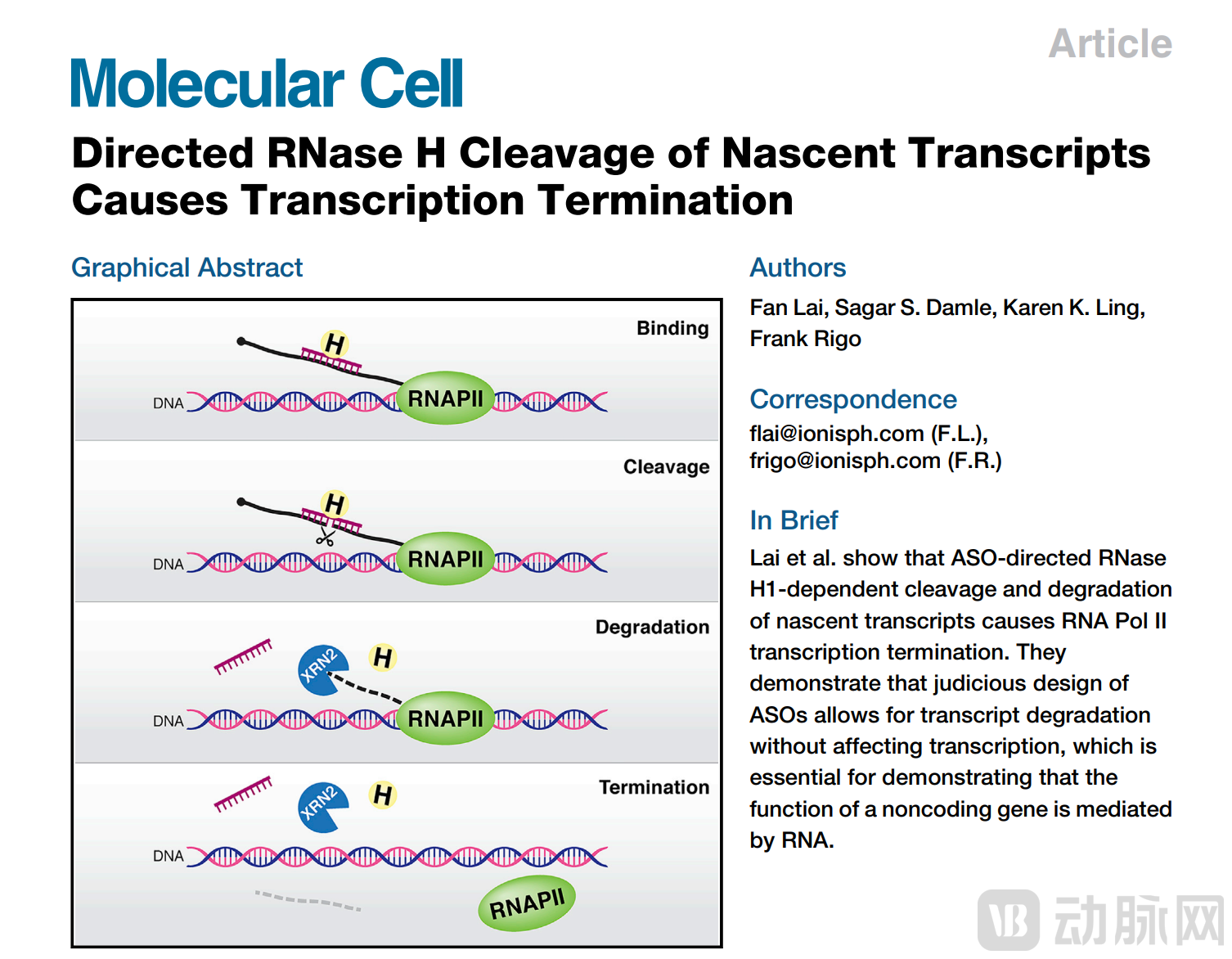
Reference: Lai F, et al. Mol Cell. 2020 Mar 5;77(5):1032-1043.e4.
Although oligonucleotide drugs remain expensive at present, one reason being that the currently marketed products primarily target rare diseases with a limited patient population, and the sales of oligonucleotide drugs have not yet seen explosive growth. However, as progress is made in the development of drugs for broader indications, the market potential for oligonucleotides is immense. Major pharmaceutical giants such as Novartis, Merck, and Pfizer have made significant investments in this field.
SicaGene, upon its inception, established a core technology platform for the development of antisense oligonucleotide drugs, featuring proprietary innovations in sequence screening, chemical modification, and delivery systems. The company focuses on ASO drug development across multiple fields, including metabolism, the central nervous system, oncology, and virology, with the aim of bringing curative hope to patients.
In response to the technical difficulties in the development of oligonucleotide drugs, such as low efficiency in screening effective targets (off-target effects), limitations of chemical modifications (nuclease degradation, immunotoxicity), and restricted delivery to tissues (only able to target the liver), SicaGene successfully constructed proprietary intellectual property.SicaGene Global Original Oligonucleotide Drug Development Platform,Including SicaScreen oligonucleotide sequence design and high-throughput screening platform, SicaChemistry oligonucleotide drug innovative combination modification platform, and SicaDelivery oligonucleotide drug innovative delivery platform (multi-tissue delivery such as liver).
SicaScreen High-Efficiency Screening SystemBased on machine learning, efficiently construct a rich library for target gene sequence screening. The screening efficiency is significantly improved compared to traditional methods; reduces off-target binding, targets traditionally undruggable targets, and enhances specificity; can be applied to the screening of oligonucleotide drug targets such as ASO and siRNA; SicaGene successfully established an in vivo and in vitro activity and off-target evaluation system for ASO drug development, including customized animal models suitable for ASO drug development; the company possesses efficient and stable antisense oligonucleotide sequence synthesis capabilities.
SicaChemistry Innovative Combination Modification PlatformCombination modifications of bases and ribose have been completed at multiple sites, and 2 patent applications for nucleoside monomer inventions have been submitted. The innovative modification method can enhance drug binding efficacy and stability to a certain extent, reduce off-target effects, and decrease dosage and administration frequency.
"When talking about SicaChemistry, Dr. Wang Haisheng specifically mentioned: 'On the one hand, we need to improve the tolerance of ribose, on the other hand, enhance the affinity of base pairing, and also consider cytotoxicity. Therefore, when modifying, we adopt this combination modification approach to enhance its activity and reduce its toxicity.'"
SicaDelivery Innovative Delivery System:SicaGene's stepwise delivery system enhances liver nuclear targeting efficiency, regulates splicing to restore protein expression, and improves Rnase H1-dependent silencing efficiency. It also shows significant improvements in extracellular stability and intracellular release efficiency. SicaGene will develop novel delivery compounds through synthesis, conjugate them with various tissue-specific ligands, and target CNS, muscle, and tumors among other extrahepatic tissues. This approach aims to enhance binding affinity, reduce dosage and administration frequency, minimize off-target effects, and achieve both local and systemic drug delivery.
Besides,SicaGene is also committed to building the DSAI global original oligonucleotide drug development system.To efficiently develop global original antisense oligonucleotide (ASO) drugs driven by continuous innovation, SicaGene will rely on its self-developed SicaScreen high-efficiency screening system, SicaChemistry innovative combination modification platform, and SicaDelivery innovative delivery system. These systems enable the efficient screening of drug targets, focusing on the development of ASO drugs that regulate splicing and silencing mechanisms, improving the efficiency of ASO drug development, and ultimately achieving low-cost, modular production of oligonucleotide drugs.
SicaGene is utilizing the DSAI global original antisense oligonucleotide drug development system to develop mechanism-based drugs such as silencing and splicing regulation, focusing on drug development for refractory diseases in areas like the central nervous system, hereditary disorders, metabolism, cardiovascular and cerebrovascular conditions, oncology, and rare diseases, with a commitment to developing globally original oligonucleotide drugs.
Despite SicaGene having been established for only half a year and being a very young company, according to Dr. Hai-Sheng Wang, by utilizing the company's self-innovated oligonucleotide drug development platform, the fastest project will submit an IND in 2024, with plans for dual filings in China and the U.S. Additionally, the company maintains an open attitude towards project collaborations, hoping to partner with more outstanding pharmaceutical enterprises and institutions.
Regarding the future plans of SicaGene, Dr. Wang Haisheng stated: "In the later stages, SicaGene will also expand the development of oligonucleotide drugs to other indications with unmet clinical needs, such as CNS, and some product pipelines can be co-developed clinically with partners in the later stages." For SicaGene, which is still in the early stages of development, the main focus remains on optimizing the core technology platform and advancing leading product pipelines. As new progress is made or drugs enter the clinical stage, the company hopes to establish multi-dimensional collaborations with biopharmaceutical enterprises both domestically and internationally.
Dr. Wang Haisheng quoted a famous saying from Paul Zamecnik, the father of antisense oligonucleotides: "As long as you can be competitive, you might as well do what you like." He hopes that SicaGene can focus on its areas of expertise and drive the company's growth through differentiated innovation.