

AstraZeneca's ALXN1840 Demonstrates Rapid and Sustained Improvement in Tissue Copper Mobilization in Phase 3 Trial for Wilson Disease

AstraZeneca
Biopharmaceutical Manufacturer
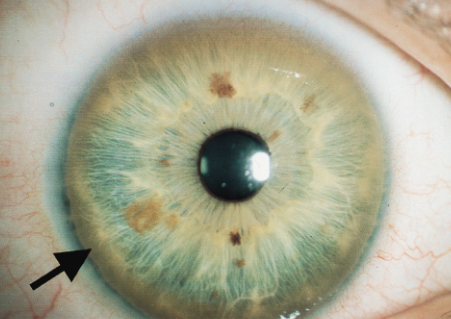
Ocular Manifestations of Wilson's Disease (Image Source: JAMA Ophthalmology)
News on June 24, 2022 /BioValleyBIOON/ -- AstraZeneca recently announced detailed results from the Phase 3 FoCus trial of ALXN1840 (once daily oral) for the treatment of Wilson's disease (WD; also known as "hepatolenticular degeneration") at the International Liver Congress (ILC 2022). The data showed,ALXN1840 enables rapid and sustained improvement in copper mobilization in tissues, with daily average tissue copper mobilization approximately three times higher than that of standard of care (SoC); additionally, ALXN1840 also improves neurological symptoms, demonstrating good safety and tolerability.In addition to the Phase 3 FoCus trial, two mechanism-of-action studies in Wilson’s disease are ongoing. Alexion, AstraZeneca’s rare disease unit, is working closely with regulatory authorities around the world and plans to submit these data for review.
Wilson's Disease (WD) also known as Hepatolenticular Degeneration, which is a rare progressive genetic disorder,The pathway for eliminating excess copper in the body is impaired, leading to copper accumulation in the liver, brain, or other vital organs.Damage caused by excessive copper accumulation in tissues and organs canCausing symptoms of liver, nerve, and mental illnesses, these symptoms may be irreversible. Even after the initiation of standard care (SoC: penicillamine or trientine chelation therapy, zinc therapy, or combination of chelation and zinc therapy), some patients experience disease progression, particularly neurological symptoms. In clinical treatment,No meaningful innovation seen for decades。
ALXN1840 is a novel oral medication taken once daily, designed as the first targeted copper-removal therapy, selectively binding tightly to and removing copper from body tissues and blood.ALXN1840 has a copper mobilization capability approximately three times that of the standard of care (SoC). Currently, ALXN1840 is being developed for the treatment of Wilson's disease (WD). In the United States and the European Union, ALXN1840 has been granted orphan drug designation (ODD).
Karl Heinz Weiss, Professor and Head of Internal Medicine at the Salem Medical Center in Heidelberg, and researcher for the FoCus Phase 3 trial, stated: "These data from the largest global trial of Wilson's disease to date show that ALXN1840 treatment has a significant mobilization effect on copper in tissues, even in patients who have been receiving standard care for an average of over 10 years.Given the current treatment focus on removing copper from the blood, these results have the potential to reshape how doctors think about the disease. We are also encouraged by the following factors:In symptomatic patients, ALXN1840 treatment demonstrated preliminary neurological improvement."We believe that evaluating the patient's personal experience can lead to a better understanding of its impact on daily life."
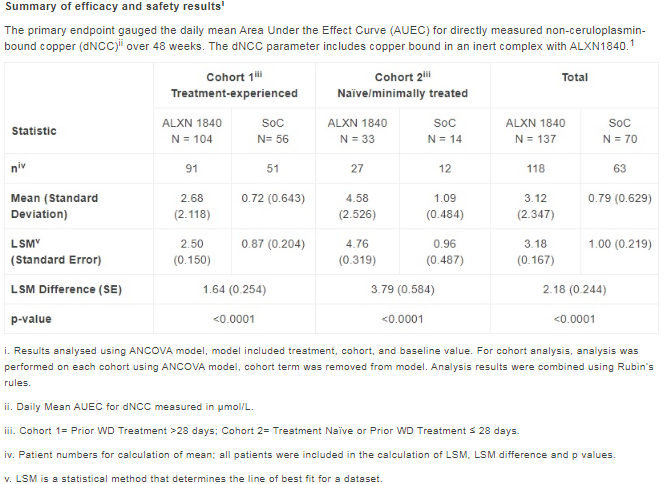
FoCus Phase 3 Trial Results (Source: AstraZeneca Official Website)
The FoCus trial enrolled 214 patients, including previously untreated patients (treatment-naïve) and those who had been on SoC therapy for an average of 10 years or longer (treatment-experienced). The primary endpoint measured the daily average effect area under the curve (AUEC) of directly measured non-ceruloplasmin bound copper (dNCC) over 48 weeks. This method assessed the daily average amount of copper mobilized from tissues, reflecting the potential burden of copper accumulation. The dNCC parameter includes copper bound in inert complexes formed with ALXN1840. Secondary endpoints included neurological function assessments, patient-reported outcomes, and clinician-reported functional evaluations.
The trial met the primary endpoint:Compared with SoC, ALXN1840 treatment increased the average daily tissue copper mobilization by approximately 3 times (Least Squares Mean Difference [LSM Diff] 2.18 µmol/L; p<0.0001), including in patients who had previously received an average of 10 years of SoC treatment. In the trial, patients in the ALXN1840 treatment group experienced rapid copper mobilization, showing a treatment response within 4 weeks that continued up to 48 weeks.
In a post-hoc analysis, the secondary endpoints of neurological score changes and clinician-reported functional assessments were also evaluated.In patients with symptoms at baseline, those treated with ALXN1840 showed greater improvement in neurological scores compared to SoC.(Section 2 of the Unified Wilson Disease Rating Scale [UWDRS] for symptomatic patients: ALXN1840 group -1.7, SoC group -0.8; Section 3 of UWDRS for symptomatic patients: ALXN1840 group -2.91, SoC group -1.31). However, no significant differences were observed between the treatment groups at 48 weeks. Most patients in the trial had low symptom scores at baseline, leaving minimal room for overall improvement (Section 2 of UWDRS: ALXN1840 group -0.6, SoC group -0.3; Section 3 of UWDRS: ALXN1840 group -2.20, SoC group -1.02). Due to the varying levels of symptom severity among patients, the total score may not accurately reflect the disease's severity.
ALXN1840 was well-tolerated and is currently being evaluated for its long-term safety and efficacy in a 60-month extension period. In the study, most adverse events were considered non-serious (ALXN1840 group: 85.4%; SoC group: 75.7%) and/or unrelated to the study treatment (ALXN1840 group: 77.4%; SoC group: 75.7%). The most common AE associated with ALXN1840 was reversible elevation of alanine aminotransferase levels (ALXN1840 group: 14.6%; SoC group: 2.9%). Two deaths were reported in the study but were not related to ALXN1840. (Bioon.com)
Source of the original text:ALXN1840 shows rapid and sustained improvement in copper mobilisation from tissues, potentially closing treatment gaps for Wilson disease community