

Gilead's First-in-Class Viral Entry Inhibitor Hepcludex Demonstrates Significant Efficacy in Phase 3 Trial for Chronic Hepatitis D

Gilead Sciences
Antiviral Drug Developer
Image Source: Shutterstock
News on June 24, 2022 /BioValleyBIOON/ -- Gilead Sciences recently announced antiviral drugs at the International Liver Congress (ILC 2022) in 2022 –First-in-class viral entry inhibitor Hepcludex (bulevirtide) for the treatment of chronic hepatitis D virus (HDV)InfectionWeek 48 Results from the Pivotal Phase 3 MYR301 Trial. The data shows,Hepcludex showed significant efficacy, with a marked reduction in viral load at week 48. Virological and biochemical responses continued to increase from week 24 to week 48, and patient-reported outcomes (PRO) improved significantly. In the study, Hepcludex demonstrated good safety and tolerability.
MYR301 is an ongoing clinical trial being conducted in 150 chronic HDV-infected patients to evaluate the long-term efficacy and safety of Hepcludex. In the study, patients were randomly assigned to receive either Hepcludex 2mg once daily (n=49), 10mg once daily (n=50), or no antiviral treatment (delayed treatment group, n=51). The primary efficacy and safety data were assessed at week 48. After week 48, patients in the delayed treatment group will receive Hepcludex 10mg once daily for 96 weeks. In the study, the treatment duration for all groups is 144 weeks.The primary endpoint was a combined virological and biochemical response, defined as: at Week 48 of treatment, HDV RNA was undetectable (<LoD [limit of detection]) or decreased by ≥2log10 from baseline, and ALT normalization.The secondary endpoints at Week 48 included undetectable HDV RNA (key secondary endpoint), ALT normalization, and change from baseline in liver stiffness as measured by transient elastography.
The results showed that the study met the primary endpoint:At Week 48 of treatment, a significantly higher proportion of patients in the Hepcludex group achieved combined virological and biochemical responses compared to the control group. Specifically, the combined response rates were 45% in the Hepcludex 2mg group and 48% in the 10mg group, while the rate was only 2% in the group without antiviral therapy.
Previously announced interim results showed:At Week 24 of treatment, the combined response rates for the Hepcludex 2mg group and 10mg group were 36.7% and 28%, respectively, while the rate for the control group was 0%.. Comparing the 24-week and 48-week data shows thatThe combined response rate for Hepcludex treatment increased from Week 24 to Week 48, highlighting an improvement in the combined response rate with prolonged treatment duration.
The safety at 48 weeks was consistent with previous reports.No patients experienced adverse events leading to discontinuation of Hepcludex, and no serious adverse events occurred due to Hepcludex treatment.The safety profile at 24 weeks and 48 weeks once again confirms the favorable safety and tolerability characteristics of Hepcludex, which is an important decision-making factor in the treatment of chronic HDV patients.
An exploratory analysis of 48-week data evaluated the impact of Hepcludex (2mg, once daily) on PROs (Patient-Reported Outcomes) in chronic HDV patients. The data showed,In HepatitisQuality of LifeIn almost all health-related quality of life domains assessed by the HQLQ questionnaire, the Hepcludex 2mg group (n=49) showed significant improvement from baseline at 48 weeks.The control group (51 patients) showed significant improvement in general health stress and hepatitis-specific health stress, while other aspects remained largely unchanged. Notably, compared with the control group,Patients in the Hepcludex 2mg group showed significant improvements in daily activity performance related to hepatitis, emotional impact of hepatitis, and work improvement.
Dr. Heiner Wedemeyer, Chief Investigator of the MYR301 study and Director of the Gastroenterology, Hepatology, and Endocrinology Clinic at Hannover Medical School, stated: "As the most severe form of viral hepatitis, HDV imposes a significant disease burden with high healthcare-related costs, and until recently, there were no approved treatment options. The results presented at ILC 2022 not only highlight the crucial clinical role of Hepcludex as a safe and effective treatment option for chronic HDV but also critically demonstrate that with long-term treatment, we can achieve higher response rates, thereby enabling better treatment of this rare, life-threatening disease in more people."
Anu Osiusi, Vice President of Gilead Sciences' Hepatitis, Respiratory and Emerging Viruses Clinical Research, stated: "HDV has a profound impact on patients' quality of life, affecting the physical and mental health of those with HDV. What we are now seeing is that treatment with Hepcludex not only improves clinical indicators related to viral control but also significantly enhances and sustains a range of quality-of-life metrics for HDV patients, ultimately improving the overall disease outcome."Management。”
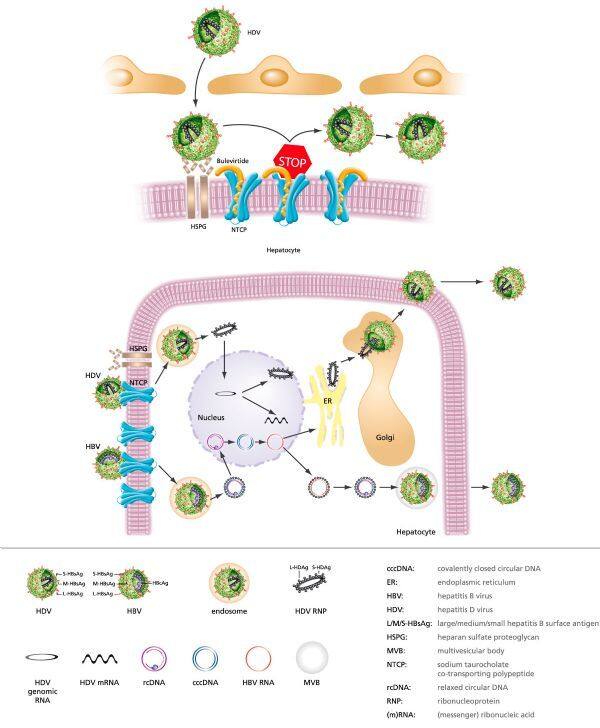
Mechanism of Action of Hepcludex (Click image: View larger image)
Hepcludex Represents the Most Advanced New Therapy for Hepatitis D in Clinical Practice. The active pharmaceutical ingredient of this drug is bulevirtide, which is aFirst-in-class viral entry inhibitor, developed for the treatment of chronic hepatitis B virus (HBV) and hepatitis D virus (HDV) infections. The drug inhibits the HBV/HDV receptor NTCP on the surface of hepatocytes and prevents the infection of regenerating cells and the spread of the virus within the liver.
In the EU, Hepcludex has beenReceived conditional approval for marketing in August 2020, the drug isThe First Drug Regimen in Europe for Treating HDV Infection in Adult Patients with Compensated Liver Disease. Currently, Hepcludex is under review in the United StatesFDAIf approved after the review, Hepcludex will become the first drug regimen in the United States to treat HDV infection in adult patients with compensated liver disease.
Hepcludex was developed by MYR Pharmaceuticals and acquired by Gilead in December 2020 when Gilead purchased MYR, adding Hepcludex to its portfolio.In this acquisition, Gilead paid 1.15 billion euros in cash. If Hepcludex receives approval from the U.S. FDA, Gilead will pay a milestone payment of 300 million euros.
In the EU and the US, Hepcludex has been granted Orphan Drug Designation (ODD) for the treatment of HDV infection. Additionally, HepcludexIn the EU, it was also granted Priority Medicines (PRIME) status, and in the US, it was awarded Breakthrough Therapy Designation (BTD).The PRIME program is similar to the BTD program, aiming to accelerate the review process of key drugs in areas with drug shortages, benefiting patients as early as possible. Drugs granted PRIME or BTD designation must have preliminary clinical evidence demonstrating substantial improvement in clinically significant endpoints compared to existing treatments. (Bioon.com)
Source of the original text:Treatment With Hepcludex® (Bulevirtide) Meets Primary Endpoint and Achieves Significant Response in Chronic Hepatitis Delta Virus at 48 Weeks