

How Did GBAH Biopharma (06998.HK) Lose Over 30% in a Single Day Despite Hitting the mRNA Cancer Vaccine Spotlight?

Abogen
Nucleic Acid Drug Developer
Since June, whether it's CureVac announcing the acquisition of Dutch tumor immunotherapy company Frame Cancer Therapeutics for 32 million euros, or BioNTech's CEO stating that the first cancer mRNA vaccine is expected to hit the market within 2022, the concept of "mRNA anticancer vaccines" has been continuously gaining heat worldwide. These positive developments in the industry have become the "stepping stones" for Genor Biopharma Co., Ltd.'s significant mid-day stock price increase on June 27.
SmartCom APP observed that on June 27, Genor Biopharma-B (06998) opened higher in the morning session, with its share price surging over 36% at one point to reach HK$5.95. The company's trading volume broke through HK$100 million that day, with its market capitalization surpassing HK$2.5 billion, setting a new high for the past four months.
The reason for the sudden surge in Genor Biopharma's stock price lies in its recent announcement of a collaboration with Abogen Biosciences to jointly develop innovative mRNA products and related drugs with global potential. Specifically, Genor Biopharma’s antibody development platform will be combined with Abogen’s mRNA technology platform to co-develop mRNA drugs for cancer treatment.
Accurately hitting the recent international hotspot of "mRNA anticancer vaccines," its speculative value cannot be said to be low, but the market's enthusiasm lasted only 10 minutes. After rising more than 36% at 9:40, Genor Biopharma's stock price fell continuously, eventually closing with a gain of 3.54%. This means investors who chased highs in the morning session may have suffered a loss of over 30 points that day.
Can mRNA Anti-cancer Vaccines Become the Starting Point of a Comeback?
Despite hitting major industry hotspots, the company still experienced a high start and low finish, reflecting to some extent a lack of market confidence in Genor Biopharma. This could be attributed to the "aftereffects" of recent changes in the company's senior management.
On April 14 this year, Zhou Xinhua, President and Executive Director of Genor Biopharma Co., Ltd., announced his resignation. Although Genor Biopharma did not disclose the reason for Zhou Xinhua's departure, industry speculation suggests it might be related to the company's poor performance.
In March, Walvax Biotechnology, one of the shareholders of Genor Biopharma, released its 2021 annual report. The financial report showed that the net profit attributable to the shareholders of the listed company decreased by 57.36% year-on-year. As for the more than 50% drop in net profit, Walvax Biotechnology had already given the answer in its January earnings forecast: a significant increase in R&D expenses during the period; the decline in the end-of-period price of the company's holdings of Genor Biopharma stocks led to a decrease in fair value change gains during the reporting period by approximately 199% compared with the same period last year.
In fact, the market's lack of confidence in Genor Biopharma's subsequent development stems from the significant contrast between its recent performance and its status at the time of its IPO.
According to the Zhitong Finance APP, on October 7, 2020, Genor Biopharma Co., Ltd. was listed on the Hong Kong Stock Exchange with an oversubscription of 1246.52 times for its fundraising. Prior to its listing, it also introduced 12 cornerstone investors, including OrbiMed, Matrix Partners China, and Pacific Asset Management. The thousand-fold oversubscription, along with star-studded cornerstone investors, led to a surge in market investment sentiment towards Genor Biopharma at that time.
However, the subsequent performance of Genor Biopharma has been disappointing. Compared with the highest share price of HK$32.2 per share initially, as of June 24, the company's closing price was only HK$4.2, with a decline of 86.8% in this range.
The significant decline in stock price within two years of its IPO is not unrelated to the overall industry's investment trends. According to the previously disclosed 2021 annual report, eight biotech companies had insufficient cash to sustain R&D investment for more than 2.5 years, with four unable to last even two years. It is under such substantial R&D expenditures that some Hong Kong Stock Exchange Chapter 18A companies have incurred severe losses. Genor Biopharma Co., Ltd. is one of them, having invested 613 million yuan in R&D in 2021 and recorded a net loss of 865 million yuan.
The reasons for the widespread losses of 18A companies are, on the one hand, the "ten years, ten billion" double ten rule; on the other hand, the destruction of the logic behind the me-too R&D strategy.
After a significant investment in research and development, Genor Biopharma's first commercial product, Infliximab biosimilar (GB242, trade name Jia You Jian), has been approved for marketing. This product is currently facing dual challenges from Infliximab biosimilars and Adalimumab. Particularly in the Adalimumab market, in China, apart from the original drug Humira, several biosimilars have also been approved. This creates substantial competitive pressure for the subsequent commercial promotion of Jia You Jian.
According to Guo Feng, the newly appointed Chairman of the Board and CEO of Genor Biopharma, one of the goals that Genor Biopharma plans to achieve in 2022 is to promote the successful commercialization of Jia You Jian. In addition, among several other goals, one of them is to reach a cooperation with the mRNA drug research and development platform for early-stage mRNA cancer immunotherapy research, which is also the key reason for the sharp increase in Genor Biopharma's stock price. Will mRNA anticancer vaccines become the key to Genor Biopharma's future comeback?
Can mRNA Anti-cancer Vaccines Turn the Tide in Research?
At the recently concluded ASCO 2022 Annual Meeting, BioNTech announced that its mRNA-based personalized neoantigen-specific cancer vaccine, autogene cevumeran, in combination with the anti-PD-L1 antibody atezolizumab and chemotherapy, yielded positive results in a Phase 1 clinical trial for the treatment of pancreatic cancer patients who underwent surgical resection. Meanwhile, the CEO of BioNTech also claimed that the first cancer mRNA vaccine will be on the market within 2022.
In terms of R&D progress, there is a significant time gap between Genor Biopharma Co., Ltd., which has only announced the early-stage development of its anti-cancer mRNA vaccine project, and the first-tier R&D group.
Intelligent Finance APP learned that neoantigens are proteins produced by cancer cells, which are different from those produced by healthy cells and can be recognized by immune cells. However, in many tumors, the expression level of neoantigens is relatively low, insufficient to trigger a strong anti-cancer immune response. BioNTech's autogene cevumeran is designed based on the analysis of whole-exome sequencing and transcriptome sequencing data from patients' tumor samples, containing 20 MHC-I and MHC-II type neoantigen epitopes. Therefore, autogene cevumeran is a fully personalized mRNA neoantigen vaccine, aiming to induce a de novo immune response targeting cancer-specific neoantigens, identify residual cancer cells, and prevent recurrence.
Data presented at the ASCO Annual Meeting showed that the autogene cevumeran vaccine can improve the prognosis of patients undergoing surgical resection for pancreatic ductal adenocarcinoma, extending their recurrence-free survival period. The treatment is safe with a low incidence of severe adverse reactions.
Obviously, BioNTech is currently at the forefront of mRNA anticancer vaccine research and development. Compared with vaccines, mRNA protein immunotherapy presents new challenges in formulation delivery, protein production efficiency, and tolerability. This has led to slower progress in the development of mRNA therapeutics compared to mRNA vaccines, indirectly highlighting BioNTech's first-mover advantage.
In fact, aside from BioNTech, the global enthusiasm for mRNA therapeutic drug development is relatively high, with multiple products currently in clinical Phase II/III stages.
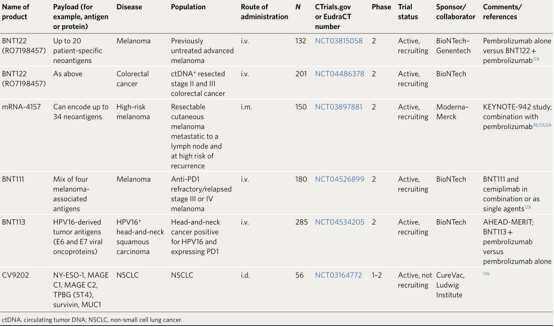
Taking CureVac, one of the three mRNA giants, as an example, on May 25, CureVac and myNEO announced that they would develop a novel mRNA immunotherapy for cancer vaccines by identifying specific cancer antigens; On June 8, CureVac announced the acquisition of Dutch tumor immunotherapy company Frame Cancer Therapeutics for 32 million euros to further strengthen its layout in the field of tumor immunotherapy.
Besides, Moderna has chosen to collaborate with Merck on the development of cancer vaccines. In their research, Moderna's vaccine was combined with Merck's Keytruda (K drug), and the interim data released in 2020 showed promising results: among 10 patients with HPV-related head and neck squamous cell carcinoma, half of the patients experienced relief. Additionally, Moderna previously announced favorable Phase I data for its IL-12 mRNA cancer vaccine, and the combination with Durvalumab holds promising expectations.
In China's mRNA anticancer vaccine landscape, leading research and development companies such as Abogen Biosciences, Stemirna Therapeutics, NeoimmuneTech, and Genor Biopharma are mostly in the preclinical/Phase I clinical stage for their mRNA anticancer vaccine development. For example, on February 12 this year, the personalized tumor vaccine encoding neoantigens developed by Stemirna Therapeutics received formal approval in Australia, marking its official entry into Phase I of overseas registration clinical trials; On March 25, Genor Biopharma announced that its self-developed JCXH-211 had been approved by the U.S. Food and Drug Administration (FDA) for a new drug clinical trial (IND).
Abogen, which has collaborated with Genor Biopharma Co., Ltd. this time, currently has one mRNA COVID-19 vaccine co-developed with Walvax Biotech in Phase III clinical trials, while most of its other products under development are still in the preclinical stage.
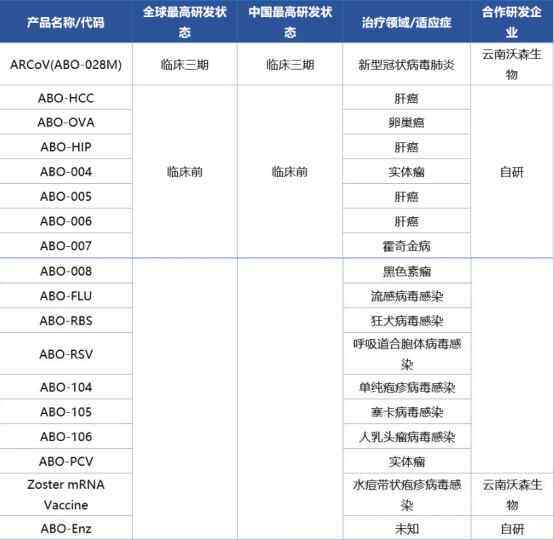
As mentioned above, there are certain technical barriers in the development of mRNA protein immunotherapy, particularly in formulation delivery, protein production efficiency, and tolerability. The journey from successful research to product approval and market launch remains quite long. For Genor Biopharma Co., Ltd., whose current product commercialization prospects are not yet clear, this is undoubtedly a case of far water not quenching immediate thirst.