

Peking University's Prof. Pu Mingliang Team Secures NMPA Approval for Ophthalmic Digital Therapeutics, Leveraging Over 30 Years of Technical Expertise

Precision Sight
Provider of High-Quality Vision Rehabilitation Products
Amblyopia is a visual impairment caused by defects in the visual center.
Generally, the diagnosis of this optometric disease is based on whether there is monocular strabismus, severe refractive error, or form-deprivation amblyopia during the visual development period, leading to the best-corrected visual acuity of one or both eyes being lower than the expected level for the corresponding age. Uncorrected anisometropia is also a criterion. The main treatment methods include occlusion therapy, refractive correction, red-light flicker instrument training, and afterimage therapy.
Due to the manifestation of amblyopia, the greatest pathogenic factor of amblyopia in the past, namely the defect in the visual cortex, has been largely overlooked.
In recent years, with the breakthroughs in amblyopia-related research and the progress in cognitive understanding, digital therapeutic products that target the visual central nervous system and integrate related technologies such as neurobiology, computer vision, and big data have emerged, opening new avenues for amblyopia treatment.
Digital therapy products can leverage the plasticity of the brain's nervous system, combining amblyopia treatment with games, videos, and other forms, through various neural stimulation methods., enhancing the visual information storage, processing, and handling capabilities of individuals with amblyopia, and restoring their visual function. According to statistics from VCBeat, as of now, a total of 18 digital therapeutic products addressing indications such as amblyopia examination and treatment in children and insufficient fusion function have been approved in China.
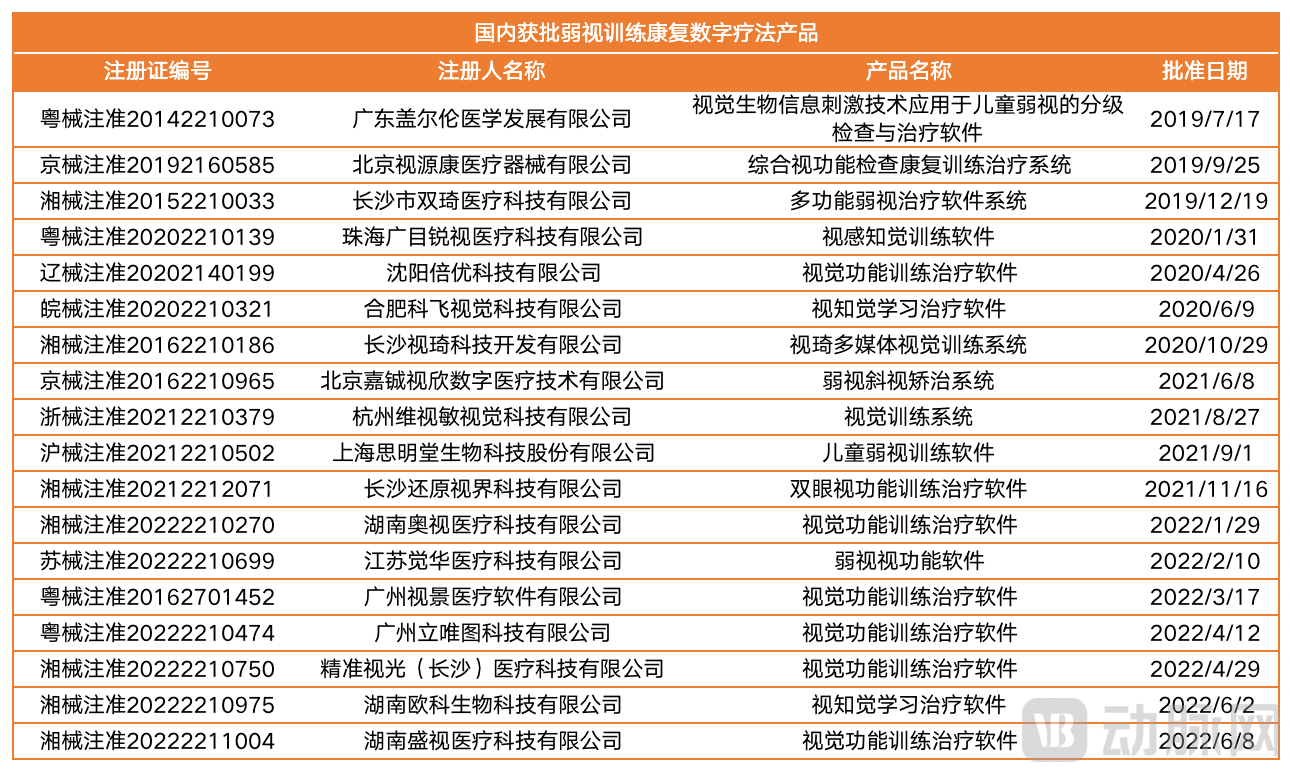
Statistics on Digital Therapeutics Products for Amblyopia Training and Rehabilitation Approved in China
As digital therapeutics gradually gain market recognition, this treatment method has entered a golden age of development.
In the past, for the treatment of amblyopia, clinicians often chose traditional occlusion therapy, which is time-consuming, monotonous in treatment process, and has poor compliance among children. However, the light signals received by the eyeball are imaged on the retina and then require the visual cortex and visual center of the brain to perform related compensation, filtering, and integration processes to complete the identification, storage, and utilization of necessary visual information. The pathogenesis of amblyopia is mainly due to the lack of normal binocular visual information integration in the visual cortex of the brain.
Therefore, the most effective treatment for amblyopia is therapy that targets the visual central nervous circuitry.
Precision Sight (Beijing) Medical Technology Co., Ltd. (hereinafter referred to as "Precision Sight") was established in April 2018.It is a new medical technology company that aims to provide high-quality visual rehabilitation products, driven by artificial intelligence, and is committed to promoting the development of digital therapeutics in China.The company was initiated and established by a scientific research team led by Professor Mingliang Pu from the School of Basic Medical Sciences at Peking University.
It is reported that Precision Sight has gone through about 10 years from the initial basic scientific research, to product development, and now the product approval, being on the eve of commercialization. During these 10 years, Precision Sight has fully utilized the technical achievements combining brain vision science with computer vision in the development of vision products to improve, restore, and enhance human visual perception.
Not only that, but relying on years of research from the Key Laboratory of Visual Damage and Repair of the Ministry of Education at Peking University's School of Basic Medical Sciences, the company's core technology has received funding and support from the National 863 and 973 projects of the Ministry of Science and Technology, as well as projects from the National Natural Science Foundation of China. It has been granted five national invention patents and has filed several international patent applications. After years of research and development, Precision Sight has established a product line in optometric digital therapeutics, focusing on the detection, prevention, control, and treatment of amblyopia, myopia, and glaucoma in children.
Among them, the digital therapeutic product for pediatric amblyopia has obtained the Class II medical device registration certificate and production license. Meanwhile, the digital therapeutic products related to Precision Sight have submitted an application for FDA approval in the United States.
Looking back on the journey, Huang Xin, co-founder and CEO of Precision Sight, told VCBeat"In the laboratory, we initially only dealt with animal models of amblyopia. After discovering effective amblyopia intervention methods in experimental animals, we further validated the effectiveness of this amblyopia intervention method in adults with normal vision. Only then did we move from the lab to clinical settings. In actual clinical practice, we found that patients and parents encountered many more problems during the routine treatment of amblyopia than we had anticipated. The new treatment methods we provide can bring substantial changes to families, which is also our original intention to commercialize this innovative technology."
A decade of research accumulation has laid the foundation for the product development of Precision Sight. The enterprise's relevant research findings, titled "New treatment for amblyopia based on rules of synaptic plasticity: a randomized clinical trial," were published as a cover article in Science China Life Sciences (IF:6.0) earlier this year.
It is reported that its amblyopia treatment digital therapy product is a virtual reality (VR)-based amblyopia treatment visual training system. The product employs the latest brain science research findings in its treatment methods, utilizing a VR-based asymmetric binocular visual stimulation therapy combined with personalized treatment technology driven by big data models, providing digital therapy solutions for optometric treatment and vision care.
Relevant experimental data show that,The system achieves core efficacy indicators for children with amblyopia, such as a treatment effectiveness rate and compliance rate both exceeding 90%, placing it at the leading level among similar products.
Unlike traditional amblyopia treatment technologies, Precision Sight products are more targeted.It targets the neural circuits corresponding to visual function, further investigates the abnormal parts of the neural circuits causing amblyopia, and then intervenes in the synaptic connections within these neural circuits through digital therapeutic products. Based on the underlying pathological mechanisms of visual disorders, it employs evidence-based methods to construct targeted treatment plans, providing patients with personalized therapeutic technologies.
Based on this underlying technology, in terms of the treatment effectiveness for optometric diseases, this product allows children to complete training and treatment at home without the need for full supervision by doctors or parents during amblyopia training. Children are no longer forced to complete training assignments; instead, they can wear VR glasses to watch their favorite films or cartoons, unknowingly completing amblyopia treatment in a pleasant and relaxed environment. This greatly improves children's compliance and also enhances the cure rate.
In the future, Precision Sight will continue to expand its product pipeline based on underlying technologies.
It is challenging for scientists to commercialize products starting from basic science, but the team from the Key Laboratory of Visual Damage and Repair of the Ministry of Education, Department of Basic Medical Sciences, Peking University, has taken the initiative to do so.
Founder of Precision Sight, Mingliang PuAt the end of 2004, he was appointed as a professor by Peking University to establish the Visual Function Reconstruction Laboratory and carry out research on visual function reconstruction. He has received over ten million yuan in funding and support from the National Natural Science Foundation of China and the Ministry of Science and Technology, among other national sources. He has published more than 40 papers in renowned academic journals such as Science, Nature Neuroscience, and Neuron. With over 30 years of experience in visual neuroscience and optometry research and development.
Huang Xin told VCBeat:"Neuroscience research is extremely challenging, and it is difficult to develop reliable products without the accumulation of long-term experience. Professor Pu's more than 30 years of research in optometry and neuroscience has greatly supported our understanding of the mechanisms of optometric diseases and the application of core technologies."
Dr. Huang Xin graduated from the School of Basic Medical Sciences at Peking University, with a research focus on the neural mechanisms of amblyopia formation and intervention methods. He is a co-inventor of the core technology behind amblyopia treatment software. After graduation, he worked at ByteDance, serving as the technical lead for user growth marketing in the Growth Marketing Department. He led a technical team to develop automated marketing customer acquisition platforms for products like Douyin and TikTok from the ground up, gaining extensive experience in internet product development, digital marketing, and technical team management.
The industry often talks about "promoting the integration of industry, academia, and research," and for scientists to start a business, they must solve the proposition of integrating industry, academia, and research solely by themselves. For Precision Sight, the experiences of Mingliang Pu and Xin Huang complement each other perfectly, enabling Precision Sight to possess both top-tier scientific research technology and a deep understanding of the industry.
It is reported that Precision Sight currently maintains close cooperative relationships with multiple scientific research and medical institutions. Clinical trials of myopia prevention and control products have also been carried out simultaneously in Beijing and Xiamen.