

Single-Nucleus Atlas of Human Heart Reveals Shared Transcriptional Signatures in Dilated and Hypertrophic Cardiomyopathy

Bayer
Pharmaceutical Product R&D Developer

Broad Institute
The Broad Institute is a mission-driven community that brings together researchers from MIT, Harvard University, and Harvard-affiliated hospitals—spanning medicine, biology, chemistry, computation, engineering, and mathematics—as well as collaborators worldwide. Its aim is to advance our understanding of the biology and treatment of human disease through genomics, lay the foundation for next-generation therapies, and improve human health.
Heart failure is one of the most common reasons for hospitalization in the United States. Existing drugs are limited, and many patients eventually die from heart failure. In a new study, researchers from the Broad Institute and Bayer AG constructed a detailed atlas of various cell types in the heart that are involved in two major causes of heart failure: dilated cardiomyopathy (DCM) and hypertrophic cardiomyopathy (HCM), both of which impair the heart's pumping ability. Their findings suggest new therapies targeting specific cell types and biological mechanisms. The related research results were published online in the journal Nature on June 22, 2022, with the paper titled “Single-nucleus profiling of human dilated and hypertrophic cardiomyopathy”.
To build their cell atlas, the authors used single-nucleus RNA sequencing (RNA-seq), which reveals which genes are active and at what levels in individual cells. They studied heart tissue from patients with advanced heart failure and found that the genes expressed in DCM and HCM hearts were different from those in non-failing hearts, but the gene expression profiles of DCM and HCM patients were similar. Some cardiomyopathy patients also had a unique set of fibroblasts, which they believe may contribute to tissue scarring in heart failure patients and could become a target for future treatments.
This new study builds on previous efforts to catalog individual cells of healthy human hearts and is the result of close collaboration with Ken Margulies, a professor of medicine at the University of Pennsylvania and a heart failure physician. Mapping the cells involved in different forms of heart failure could help scientists identify biomarkers, enabling them to distinguish disease types and predict clinical outcomes.
Patrick Ellinor, the corresponding author of the paper and a member of the Broad Institute, said, "Currently, almost all forms of heart failure, regardless of their cause, are treated similarly. Our goal was to find out whether there are cell populations or gene expressions that differ between healthy and diseased individuals. Yes, we discovered genes indicating highly active cardiac fibroblasts in some patients with the disease."
"Bayer and the Broad Institute's Joint Precision Cardiology Laboratory Senior Director and Head, Carla Klattenhoff, said, 'Scientists from Bayer and the Broad Institute worked side by side to generate, analyze, and validate the data for this study. This level of collaboration between academia and the pharmaceutical industry is extremely rare. This cell atlas is a fantastic resource for the field of cardiology.'"
Cell by cell
Previous studies have found that failing hearts have a unique gene expression profile or transcriptome compared to healthy hearts, but they only generated a single gene fingerprint for the entire heart. In contrast, Ellinor's team used single-nucleus RNA-seq to computationally separate transcriptional signatures by cell type. This also allowed them to uncover characteristics of rare cell types, whose signals might have been overwhelmed in bulk analyses.
In their study, these authors examined DCM and HCM, which lead to heart failure in different ways. In DCM, the left ventricle of the heart dilates and the heart walls thin, whereas in HCM, the heart walls become stiffer and thicker. To their surprise, they found that despite these differences, the two diseases share the same transcriptional fingerprint. With further research, this discovery may help doctors better determine which forms and stages of heart failure are similar and which are not, and adjust treatments accordingly.
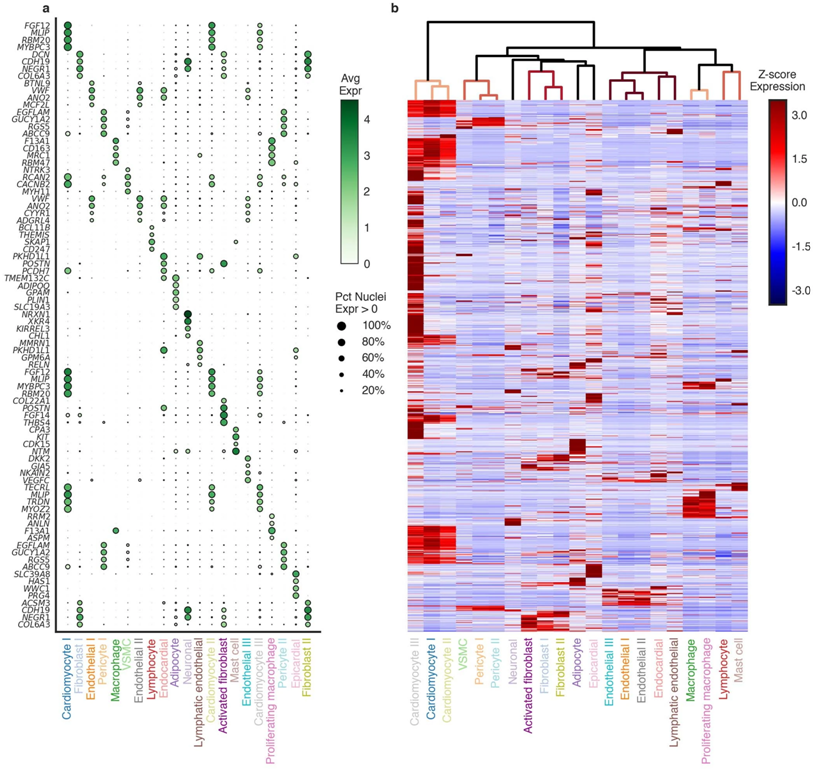
Marker genes and cell type clustering, image from Nature, 2022, doi:10.1038/s41586-022-04817-8.
Ellinor's team also found differences in the abundance of certain types of cardiac cells between cardiomyopathy patients and healthy individuals. Failing hearts had fewer cardiomyocytes but more fibroblasts than non-failing ones, possibly indicating the presence of scar tissue. Among these fibroblasts, they also discovered that only failing hearts contained a unique population of fibroblasts. "The transcriptional signature of these cells is really distinct, which was quite surprising to us. There are thousands of such cell nuclei in cardiomyopathic hearts, but hardly any in non-failing hearts," said Mark Chaffin, the paper’s first author and a computational scientist at the Broad Institute.
Using CRISPR screening, the team studied the function of key genes that distinguish this group of fibroblasts from normal cardiac fibroblasts. They found that several genes are essential for cardiac fibroblasts to transition from a dormant state to an active state, in which these cells form scar tissue that impedes the heart's ability to pump blood. Chaffin said that these genes could be potential targets for future treatments aimed at chronic scar tissue formation, also known as fibrosis.
In the future, these authors hope to find a way to detect heart failure at the earliest stage in patients by looking for certain types of fibroblasts or signs of higher levels of scar tissue formation in the heart. To achieve this goal, the team has begun investigating whether they can detect markers of activated fibroblasts in the blood.BioValley Bioon.com)
References:
Mark Chaffin et al. Single-nucleus profiling of human dilated and hypertrophic cardiomyopathy. Nature, 2022, doi:10.1038/s41586-022-04817-8.