

Janssen Announces FDA Breakthrough Therapy Designation for Talquetamab, a First-in-Class GPRC5DxCD3 Bispecific Antibody, for Relapsed/Refractory Multiple Myeloma

Johnson & Johnson
Healthcare Product Manufacturers, Health Service Providers

Janssen Pharmaceuticals
Pharmaceutical R&D Developer
Image source: Shutterstock
News on June 30, 2022 /BioValleyBIOON/ -- Janssen Pharmaceuticals, a subsidiary of Johnson & Johnson (JNJ), recently announced that the U.S. Food and Drug AdministrationManagementBureau (FDA) has been grantedGPRC5DxCD3 Bispecific Antibody Talquetamab (JNJ-64407564) Granted Breakthrough Therapy Designation (BTD):Used to treat patients who have previously received at least 4 therapies (including proteasome inhibitors,ImmunityAdult patients with relapsed or refractory multiple myeloma (R/R MM) who have received prior treatment including modulators and anti-CD38 antibodies. This marks Janssen'sThe 12th BTD Obtained in the Field of Oncology, and it is also the companyThird BTD for Bispecific Antibody PortfolioIn 2021, the European Medicines Agency (EMA) granted talquetamab Priority Medicines (PRIME) designation.
Talquetamab is a first-in-class, off-the-shelf T-cell redirecting bispecific antibody that simultaneously targets GPRC5D (a novel target on multiple myeloma) and CD3 (a surface receptor on cytotoxic T cells).GPRC5D (G protein-coupled receptor C5 family subtype D) is highly expressed in multiple myeloma, and CD3 is involved in T cell activation. Preclinical study results indicate that talquetamab recruits and activates CD3-positive T cells, induces T cell-mediated killing of GPRC5D-positive multiple myeloma cells, and inhibits tumor formation and growth.
GPRC5D is a new target for the treatment of multiple myeloma. As a bispecific antibody, talquetamab is being developed as a potential new treatment option for heavily pre-treated R/R MM patients by targeting CD3 to bind with T cells.
FDA Grants Talquetamab BTD Based on Results from the First-in-Human, Phase 1/2 Dose-Escalation Study MonumenTAL-1 (Phase 1: NCT03399799; Phase 2: NCT04634552). The study was conducted in R/R MM patients who had previously received a high number of treatment regimens (median of 6). The data from this study were presented at this year's American Society of Clinical Oncology (ASCO) Annual Meeting, the data shows:At the recommended subcutaneous Phase 2 dose (RP2D), talquetamab administered once weekly (QW) or once every two weeks (Q2W) demonstrated encouraging therapeutic responses.。
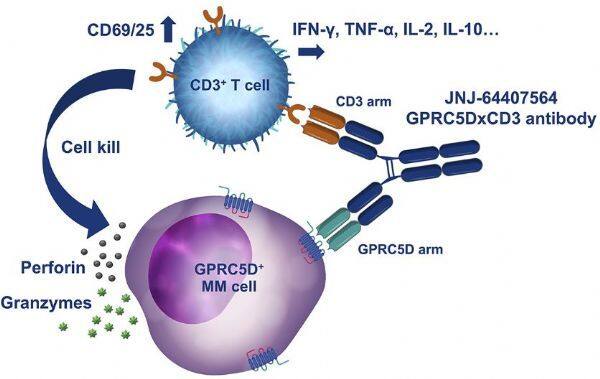
Talquetamab (JNJ-64407564, Image source: PMID:32040549)
The primary objective of the MonumenTAL-1 study is to determine the recommended subcutaneous Phase 2 dose (RP2D, Part 1) and to evaluate the safety and tolerability of talquetamab at the recommended dose (Part 2). As of April 6, 2022, 130 patients with relapsed or refractory multiple myeloma (MM) have received talquetamab treatment. For Part 2, 30 patients received the RP2D of 405 μg/kg once weekly (QW) after dose escalation: 100% were exposed to triple-class therapy (proteasome inhibitor [PI], immunomodulatory drug [IMiD], CD38 antibody), 80% were penta-drug exposed (2 PIs, 2 IMiDs, 1 CD38 antibody), 76.7% were triple-class refractory, 20% were penta-drug refractory, and 30% had prior B-cell maturation antigen (BCMA)-targeted therapy. Additionally, 44 patients received the RP2D of 800 μg/kg every two weeks (Q2W): 97.7% were triple-class exposed, 68.2% were penta-drug exposed, 77.3% were triple-class refractory, 27.3% were penta-drug refractory, and 27.3% had prior BCMA-targeted therapy. MM patients who are triple-class refractory and penta-drug refractory face poor survival outcomes due to limited treatment options.
Data shows,The overall response rate (ORR) for talquetamab treatment was consistent at both doses.In patients receiving 405 μg/kg QW dose treatment, the median follow-up was 13.2 months (range 1.1-24), with 70% (21/30) achieving disease response (ORR=70%), 56.7% achieving very good partial response (VGPR) or better, 6.7% achieving complete response (CR), and 23.3% achieving stringent complete response (sCR). In patients receiving 800 µg/kg Q2W treatment, the median follow-up was 7.7 months (range 0.7-16), with 63.6% (28/44) achieving disease response (ORR=70%), 56.8% achieving very good partial response (VGPR) or better, 11.4% achieving complete response (CR), and 9.1% achieving stringent complete response (sCR). Regarding the median duration of response (DOR), the 405 µg/kg QW dose group had 10.2 months (95% CI: 3.0-not estimable), and the 800 µg/kg QW dose group had 13.0 months (95% CI: 5.3-not estimable).
In evaluable efficacyAmong the three categories of drug-refractory patients, 65.2% (15/23) of patients receiving 405µg/kg QW dosing and 67.6% (23/34) of patients receiving 800µg/kg Q2W dosing achieved disease remission.. InAmong penta-drug refractory patients, 83.3% (5/6) of those receiving 405µg/kg QW dosing and 75% (9/12) of those receiving 800µg/kg Q2W dosing achieved disease remission.
During the long-term follow-up, no new safety signals were identified in any of the treatment cohorts. At the 405 µg/kg QW dose, the most common adverse events (AEs) were cytokine release syndrome (CRS; 76.7%; 3.3% were grade 3/4), neutropenia (66.7%; 60% were grade 3/4), skin-related adverse events (66.7%; all were grade 1/2), and dysgeusia (63.3%; all were grade 1/2). At the 800 µg/kg Q2W dose, the most common AEs were CRS (79.5%; all were grade 1/2), skin-related adverse events (72.7%; 2.3% were grade 3/4), and dysgeusia (56.8%). Dysgeusia was managed with supportive care and, if necessary, dose adjustments. Cytopenias were primarily confined to the dose-escalation phase and cycles 1 and 2, generally resolving within one week. At the 405 μg/kg QW dose, 46.7% (grade 3/4, 6.7%) of patients experienced...InfectionAt a dose of 800 μg/kg Q2W, 38.6% (Grade 3/4, 9.1%) of patients experienced infections. (Bioon.com)
Source of the original text:Janssen Announces U.S. FDA Breakthrough Therapy Designation Granted for Talquetamab for the Treatment of Relapsed or Refractory Multiple Myeloma