

Novartis’ B-Cell Therapy Kesimpta Shows Sustained Efficacy in RMS: Nearly 80% of Patients Achieve NEDA-3 After Four Years of Continuous Treatment

Novartis
Drug Development and Manufacturing
Image Source: Shutterstock
News on June 30, 2022 /BioValleyBIOON/ -- Novartis recently announced at the 2022 European Academy of Neurology (EAN) Annual MeetingKesimpta (Chinese trade name: Quanxinda, generic name: ofatumab, ocrelizumab) for the treatment of relapsing multiple sclerosis (RMS)New Data from Phase 3 ASCLEPIOS I/II Trials and ALITHIOS Open-Label Extension Study. The results show:Compared to switching from Aubagio (teriflunomide) to Kesimpta, continued treatment with Kesimpta significantly increased the odds of achieving no evidence of disease activity (NEDA-3).
Data presented at the meeting indicated that,After 4 years of treatment, 78.8% of patients who continued to receive Kesimpta achieved NEDA-3 (defined as no MS relapses, no disability progression, and no MRI activity).In the open-label extension study,Only 51.8% of patients switching from Aubagio to Kesimpta achieved NEDA-3 (odds ratio [OR]: 3.89; p<0.001).。
Early use of Kesimpta increased the likelihood of maintaining NEDA-3 throughout the study by more than three times, highlighting the importance of early intervention with highly effective therapies.These data build on the previously published efficacy data from the ASCLEIOS I/II and ALITHIOS trials. These data show,Compared with patients who switched to Kesimpta treatment later, patients who continued to receive Kesimpta treatment showed sustained differences in cumulative relapses, MRI lesion activity, and the risk of disability progression.
Another analysis of the ASCLEPIOS I/II trials indicates that,Compared with the Aubagio treatment group, the cognitive processing speed (CPS) of patients in the Kesimpta treatment group significantly improved. These improvements were recentlyDiagnosisIt is more pronounced in the RMS subgroup of patients.
Professor Ludwig Kappos from Basel University Hospital stated: "Compared with upgrading from less effective therapy to highly effective therapy, early initiation of highly effective therapy for treating relapsing multiple sclerosis (RMS) can improve long-term outcomes."NEDA-3 is an important endpoint for clinicians to consider when deciding to initiate highly effective treatment. According to the latest data from the ALITHIOS trial, the benefits of early use of Kespimat are clearly evident compared to later upgrading from Aubagio to Kespimat."
Multiple Sclerosis (MS) is a chronic inflammatory disease of the central nervous system that disrupts the normal function of the brain, optic nerves, and spinal cord through inflammation and tissue damage, affecting approximately 2.3 million people worldwide. MS is typically categorized into four types: Clinically Isolated Syndrome (CIS), Relapsing-Remitting Multiple Sclerosis (RRMS), Secondary Progressive Multiple Sclerosis (SPMS, generally defined by the overall accumulation of cognitive and physical changes as well as disability), and Primary Progressive Multiple Sclerosis (PPMS). The various types of MS can be differentiated based on whether patients experience relapses (clearly defined as acute inflammatory episodes of neurological worsening) and/or whether they experience progression of neurological damage and disability from the onset of the disease. Approximately 85% of patients initially present with the relapsing form of multiple sclerosis.
ManagementOne of the goals of RMS is to preserve neurological function and slow the progression of disability. Although several disease-modifying therapies (DMTs) are available for RMS, most patients with RMS still experience disease activity. Evidence suggests that early initiation of highly effective treatment can improve long-term outcomes for patients with RMS.
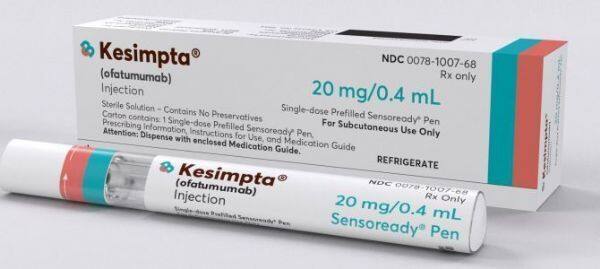
Kesimpta is a new targeted B-cell therapy that received U.S. approval in August 2020.FDAApproved as a subcutaneous injection for the treatment of adults with relapsing forms of multiple sclerosis (RMS), including clinically isolated syndrome, relapsing-remitting disease, and active secondary progressive disease. In the EU, Kesimpta was approved in March 2021 for the treatment of adult patients with RMS who have active disease as defined by clinical or imaging features.
Kesimpta is a new generation of B-cell depleting agent, with a more rapid B-cell depletion effect while preserving...ImmunityThe favorable safety profile of the drug, along with the convenience of once-monthly subcutaneous self-administration.
Notably, Kesimpta is the first targeted B-cell therapy that can be easily administered and managed at home, delivered via a once-monthly subcutaneous injection using the Sensoready autoinjector pen. In Phase 3 clinical trials, compared to the commonly used first-line drug Aubagio, Kesimpta demonstrated significantly high efficacy and a similar safety profile, positioning it as a potential first-choice treatment for a broad population of RMS patients.
The active pharmaceutical ingredient in Kesimpta is ofatumumab, a fully human anti-CD20 monoclonal antibody that works by binding to the CD20 molecule on the surface of B cells and inducing potent B-cell lysis and depletion. Ofatumumab was first approved by the U.S. FDA in 2009 and marketed under the brand name Arzerra for the treatment of chronic lymphocytic leukemia.Leukemia(CLL), the drug needs to be administered via high-dose intravenous infusion in a medical institution. (Bioon.com)
Source of the original text:New Novartis extension phase data show nearly 80% of RMS patients treated with Kesimpta (ofatumumab) had no evidence of disease activity (NEDA-3)