

Blood Glucose Monitoring Market Booms as Abbott's Blockbuster Hits $20B; China's 'Big Four' CGM Players Vie for a $10B Domestic Opportunity

Abbott
Diagnostic and pharmaceutical product manufacturers

Sibionics
Medical Device R&D and Manufacturing Company

MicroTech Medical
Developer of Medical Device Products for Diabetes Management
Recently, the ceiling of the CGM industry has been broken consecutively.
CGM can be said to be the fastest evolving sector in the entire medical device industry. In May this year, Abbott launched the third-generation Libre 3, which has reached the pinnacle of the industry in terms of size, user experience, and accuracy. Additionally, the implantable CGM Eversense E3, with a six-month usage period, was approved in Europe and the US, becoming the longest-lasting CGM product.
In China, the commercialization of CGM is also in full swing,In 2021, CGM products from four companies—Yuwell, Joino Medical, Sibionics, and MicroTech Medical—were launched in quick succession. Two listed companies, Sinocare and Cofoe Medical, are also heavily investing in the research and development of CGM products. The impact of domestically produced CGM products entering the market has been significant, with the price of Abbott’s FreeStyle Libre dropping below 300 yuan, and a single Abbott FreeStyle Libre sensor available on Pinduoduo for just 294 yuan.
CGM is a large market for blockbuster products. In 2021, Abbott's Libre series generated $3.7 billion globally, while Dexcom, operating only in the U.S. market, achieved $2.5 billion in sales. This market is still experiencing rapid growth, with Abbott’s Libre series revenue increasing over 20% in Q1 of 2022.
China's CGM market has a potential of tens of billions and is highly explosive. Yuyue's CGM product, EaseTouch, broke a million in sales during the 2021 Double Eleven shopping festival.
In the Chinese market, Abbott's price reduction indicates a wariness of domestically produced CGM products, as Chinese CGM companies have become close competitors that Abbott needs to guard against.Chinese-produced CGM has already made a breakthrough; will it be able to capture the lucrative market in the future and become a company that can rival Abbott? After a year of commercial trial, have gaps emerged among Chinese companies? Has Abbott's dominant position been shaken? VCBeat (WeChat ID: vcbeat) conducted research.
In the global CGM market, the European and American markets are the main base. The global diabetes management products market has experienced rapid growth in the past few years. Major global diabetes management companies have made substantial profits.
How will the continuous launch of new products in the global CGM market impact the global CGM market landscape?
In the current market landscape of the global diabetes market, Abbott is the leading player with a 53% market share, followed by Dexcom and Medtronic with 39% and 8% market shares, respectively.
Abbott Dominates the CGM Market with its Freestyle Series.Since 2019, Abbott's CGM product FreeStyle Libre has continued its growth myth, becoming the "cash cow" of Abbott's diabetes management business. According to data from Abbott's annual report, FreeStyle Libre generated $1.8 billion in revenue in 2019, $2.6 billion in 2020, and $3.7 billion in 2021, representing a year-over-year increase of 36.8%. In Q1 of 2022, it contributed another $1 billion in revenue, marking a year-over-year increase of 20%.
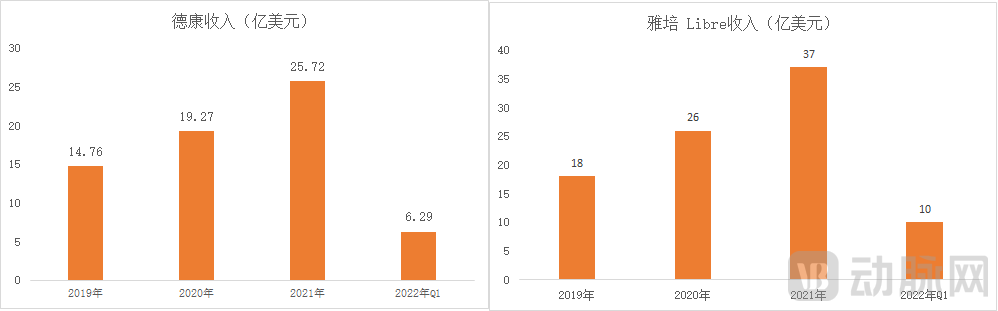
Globally, only Dexcom can rival Abbott in terms of product and revenue. Most of Dexcom's revenue comes from the U.S. market, and it still achieved a revenue of 2.5 billion U.S. dollars in 2021.
The global CGM market, characterized by a tripartite standoff among major companies, is unlikely to be disrupted in the short term.
Although Senseonics’ 180-day CGM Eversense E3 has recently been launched with an ultra-long battery life, it does not pose a threat to existing products. The biggest issue with Eversense E3, a 6-month CGM, is that it is implantable—users need to have the sensor implanted by a professional doctor after anesthesia, and during use, it also requires daily calibration with a blood glucose meter. In contrast, Abbott and Dexcom’s products have already achieved calibration-free functionality, and their patch-style devices are painless.
From the data, Senseonics had previously launched a 3-month CGM, but the installation volume across the U.S. was not high, nor did it yield significant commercial returns. In 2021, the company's total revenue was only $13.7 million, with only 3,200 installations.
Although the tripartite market structure will not change in the short term, the competition between Abbott and Dexcom will become more intense.In the past, Dexcom's advantage was in the Type 1 diabetes market, while Abbott's strength lay in the Type 2 diabetes market.
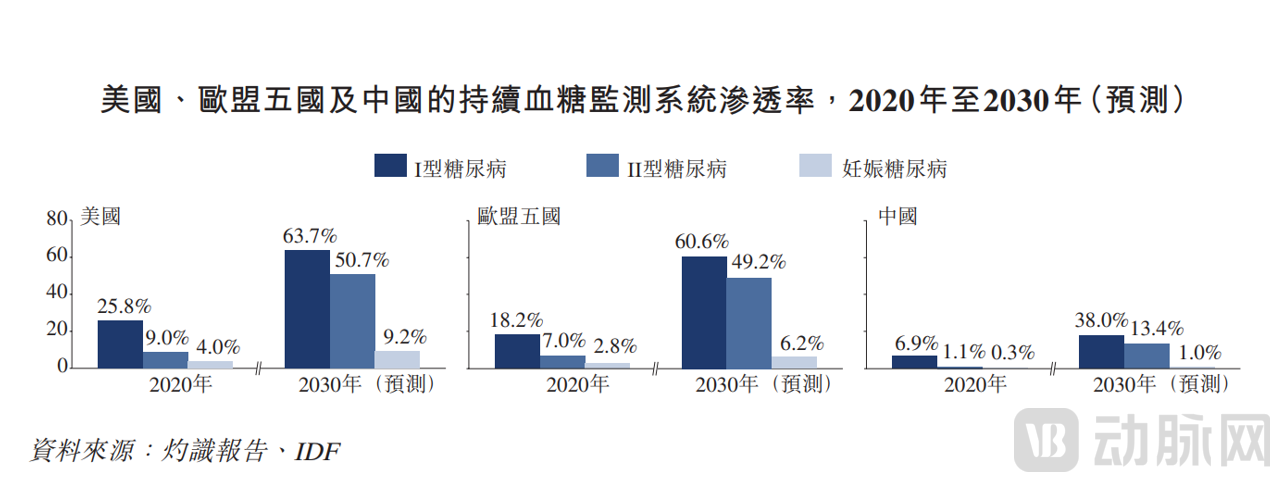
Therefore, although the number of people with type 1 diabetes is smaller, the penetration rate is higher, leading to a larger usage volume and a market size that should not be underestimated. According to MicroTech Medical's prospectus, in 2020, the penetration rate of CGM systems in the United States was 25.8% for type 1 diabetes, 9.0% for type 2 diabetes, and 4.0% for gestational diabetes.
In addition, the population of Type 1 diabetes patients accounts for about 5% of the total diabetes population. However, since most cases of Type 1 diabetes are diagnosed during childhood or adolescence, and blood glucose levels need to be continuously monitored for life after diagnosis, the long-term per capita medical expenditure on continuous blood glucose monitoring is much higher for Type 1 diabetes patients compared to Type 2 and adult diabetes patients.
Dexcom has an advantage in the Type 1 diabetes market because the accuracy of Dexcom G6 is higher than that of Abbott Libre 2.In terms of the MARD value, which evaluates the accuracy of CGM, MARD refers to the Mean Absolute Relative Difference, representing the average of absolute errors between the detected values of continuous glucose monitoring systems and reference values. The lower this value, the higher the accuracy. The MARD value for Abbott's FreeStyle Libre 2 is 9.3%, while that for Dexcom's G6 is 9.0%.
An industry insider stated, "The difference in technical routes between Abbott and Dexcom leads to differences in accuracy. Dexcom has an advantage among Type 2 diabetes patients with significant blood glucose fluctuations. To illustrate, the difference between Abbott's and Dexcom's CGMs is akin to the difference between Sony and Zeiss in digital cameras. Zeiss serves a more specialized market while still achieving considerable revenue."
But Abbott's Libre3 surpasses Dexcom in accuracy. The MARD value of the latest generation of Abbott's FreeStyle Libre 3 is 7.9%, while that of Dexcom G7 is 8.2%. With the approval of Abbott's Libre3, Abbott is likely to further seize Dexcom's market share.
An industry insider stated: "The launch of Abbott's Libre has brought a significant shock to the industry. In terms of size, Abbott's Libre 3 is the smallest CGM in the world. At the same time, Abbott's Libre 3 has resolved the reliability issues of the sensors in the first two generations, so the reliability for users will improve significantly and the failure rate will decrease considerably. After Abbott's second-generation product was launched, its market share gradually increased, eroding Dexcom's market share in the United States. After the launch of the third-generation product, Abbott's market share is expected to expand further."
In response to the pressure brought by Abbott's Libre3, Dexcom is also planning to expand into the European market. The future CGM market will have more developments worth watching.
In the global market, Abbott and Dexcom will continue to dominate.
In China, as a batch of CGMs with calibration-free and 14-day usability have been approved for marketing, the market pattern where Abbott dominates the Chinese CGM market also ushers in changes.
In the C-end market, domestically produced CGM has been launched on multiple e-commerce channels such as Taobao, JD.com, and Pinduoduo. In the B-end market, several manufacturers have indicated that the advancement of the in-hospital market has been affected by the pandemic.
How are China-produced CGMs selling? In terms of revenue data, MicroTech Medical's CGM was approved for marketing in November last year. According to MicroTech Medical’s 2021 annual report, it recorded sales of 3.94 million yuan, meaning nearly 4 million yuan worth of sales in just two months. Another company, Shenzhen Sibionics' CGM, saw a sales volume increase of over 500% year-on-year during the June 18 shopping period this year. Sales almost equaled the sum from January to May, with new user growth surpassing 300%. First-half sales exceeded fifty million yuan.
In the C-end market, in terms of reviews, many users have expressed approval for the calibration-free function and service provided by domestically produced products, but some comments have also indicated insufficient accuracy, especially among the first batch of buyers.
Is this because the quality of CGMs produced in China is not up to standard? In fact, this involves issues of production consistency.
In terms of MARD values, domestically produced products have gained recognition from the pharmaceutical regulatory authority and meet the required MARD standards. However, there are variations in data variability and consistency across different populations. The consistency of CGM production is influenced by many factors, especially during the early stages of production.
In terms of pricing strategy, domestically produced products have adopted a differentiated pricing strategy based on product positioning.
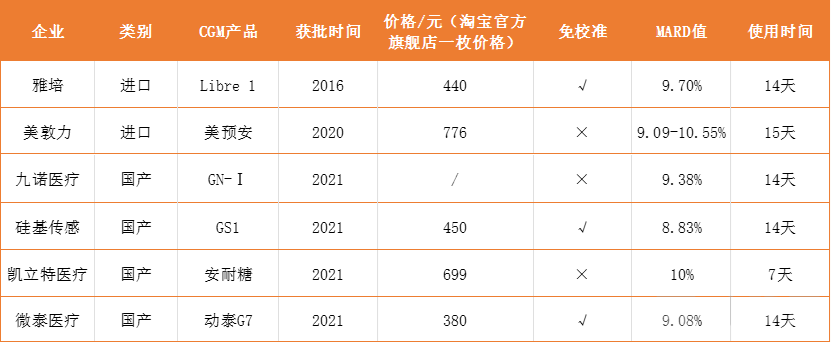
Why do domestically produced CGM companies choose such a pricing strategy?
First, based on the gap in product performance, the product approved for sale by Abbott is the FreeStyle Libre first generation, which is not a real-time retrospective product, while some domestically produced products have made optimizations and improvements in data transmission and accuracy.
Chinese production has also innovated on the service end. Han Mingsong, CEO of Sibionics, told VCBeat: "Sibionics leverages the resource advantages of its affiliated internet hospital to build a professional medical service team, including specialized physicians, health managers, and nutritionists, combining intelligent monitoring with scientific guidance to better help users establish personalized blood glucose management plans and improve blood glucose target achievement rates. These values reflect the vision of Sibionics in the blood glucose management industry and have created a differentiated pricing system."
On the other hand, some industry insiders have indicated that it is already quite an achievement for domestically produced CGMs to have prices close to those of Abbott. Due to Abbott's higher shipment volume and larger production scale, its shipment costs are also lower from a production scale perspective.
An industry insider stated: "The current price of CGMs is actually far below the cost. Chinese-produced CGM companies are relying on the funding they previously received from venture capital to support their independent research and development. If it weren't for the significant investments from venture capital, CGM companies in China would have likely shut down already."
Chinese CGM Companies Adopt Technology Optimization to Reduce Costs. For example, improving the yield rate. The yield rate is crucial in CGM production. Even for multinational giants like Abbott and Medtronic, the yield rate remains a significant challenge, as low yield rates can increase production costs. Chinese companies have made considerable efforts to improve the yield rate.
Since the large-scale market promotion, China-produced CGM has been on the market for less than a year. There is still a gap in sales compared with Abbott. For the commercialization of China-produced CGM products, this is just the beginning.
Abbott Copes with the Impact of China-Made Products by Cutting Prices: How Can China-Made CGM Products Break Through Commercialization? From the current attempts of enterprises, domestic companies have explored diverse routes.
First, products and services are the 1, marketing is the 0. Chinese-produced CGM companies need to enhance service capabilities and create differentiated advantages.Differentiate competition with Abbott. In China's CGM market, Abbott has entered China and developed the domestic online C-end market, with annual sales exceeding 700 million yuan in the Chinese market. Although Abbott holds over 99% of the market share in China, the penetration rate of China's CGM market is still at a very low level. The concept of blood glucose management among Chinese patients is still relatively lacking, leaving much room for domestic companies to operate, especially in providing more services to CGM users.
Han Mingsong stated: "Currently, the popularization of CGM in the Chinese market still has a long way to go. Some believe that CGM is a substitute for fingertip blood testing, just without the need for needles. In fact, an increasing number of clinical studies show that using CGM can assist in improving users' blood glucose control rates and quality of life. Good blood glucose management is the result of multiple factors combined. We believe that excellent blood glucose monitoring products, along with digital blood glucose management solutions and personalized service guidance based on continuous glucose data, can effectively improve the blood glucose management success rate of diabetes patients in China, supporting Healthy China 2030."
Second, open up more customer acquisition channels in China and tap into more niche markets.Diabetes, as a chronic disease, offers entry points for CGM throughout the entire life cycle of prevention, diagnosis, treatment, and management. Currently, the penetration rate of CGM in China is still very low, and multiple niche markets can be developed. For example, health check-ups, prenatal health management, and corporate employee health management can all become traffic entry points for CGM products.
Taking Sibionics as an example, beyond the C-end market and the in-hospital market, Sibionics has partnered with Meinian Onehealth Healthcare to expand into the health checkup market. They have developed a digital health package based on CGM, providing better services for populations at high risk of diabetes and diabetic patients.
Third, explore overseas markets and enter the main global CGM sales markets, especially the European market.
Whether viewed from the perspective of disease prevalence, penetration rate, or payment capability, the overseas CGM market is larger. The European market has well-established distribution channels and payment systems. In the U.S. and Europe, CGM is covered by most private insurance plans and is also included under Medicare. In terms of penetration rate, in 2020, the adoption of CGM in Type 1 and Type 2 diabetes in the EU5 reached 18.2% and 7.0%, respectively, far exceeding the rates of 6.9% and 1.1% in China. Additionally, the entry barrier for the European market is not particularly high.
Some companies in China have started to focus on overseas markets. Taking Nine Medical as an example, it was the first in China to obtain the CE certification for CGM and began to expand into overseas markets.
However, the European and American markets are the stronghold of import giants, while there are also small participants. The key for domestic companies to capture the European and American markets lies in whether they have sufficient channels. Building overseas channels from scratch requires a long time of accumulation, which will become the key for domestic CGM companies to break through in the European and American markets.
Among numerous diseases, few have achieved as much as diabetes, whether in terms of diagnosis or treatment. However, in China, the disease burden caused by diabetes remains heavy. According to the prospectus of Zhiyun Health, in 2020, the number of people with diabetes in China was 133.1 million, and it is expected to increase to 151.7 million by 2025 and 170.3 million by 2030; the direct expenditure on diabetes treatment in 2020 was approximately RMB 752.1 billion.
In this billion-dollar market, CGM is expected to change the current status of diabetes management. With the advancement of technology, the role of CGM in diabetes management is becoming increasingly significant. It is hoped that through the efforts of global CGM manufacturers, more patients can better control their blood glucose levels, enhance the safety of life-threatening hypoglycemia, and improve their quality of life.