

GE Announces New Brand Identities and IPO Plans for Three Independent Companies: GE HealthCare, GE Vernova, and GE Aerospace
GE Healthcare
Digital Solution Provider
Source: Instrument Family, unauthorized reproduction is prohibited, and reprinting is allowed 24 hours later.
On July 18, GE released the new brand identities for its three planned global leading investment-grade public companies to be formed through spin-offs.These three companies will focus on the three growth sectors of healthcare, energy, and aviation, respectively.

GE Healthcare Business Will Use New Name GE HealthCare;GE Energy Business, including renewable energy, power generation, digital business, and energy financial services,Will merge and use the new name GE Vernova; GE Aerospace will be the brand name of GE's aviation business.The three new companies will continue to benefit from GE's brand value and global recognition, which are approximately $20 billion.
It is worth noting that,GE Healthcare Technologies, Inc. will be listed on the Nasdaq Global Select Market under the stock code "GEHC" after the spin-off is completed. Through its listing on the Nasdaq Stock Exchange,GE Healthcare will benefit from Nasdaq's market image as an innovation and technology-led public company, especially in the healthcare sector.
01
GE Announces Three Companies Plan to List Independently
Company's New Brand Logo
Chairman and CEO of GE, and CEO of GE Aerospace, H. Lawrence Culp, Jr., stated: “Today marks another significant milestone in GE's plan to establish three independent publicly traded companies. The GE brand, valued at tens of billions of dollars, will enhance the competitive edge of these businesses in their respective markets, serving as a cornerstone for the future success of the three companies."Adhering to the principles of lean management and continuous innovation, these three companies will carry forward our mission of 'Meeting Global Challenges, Driving an Efficient Future' and continue to provide customers and partners with the GE solutions they recognize."
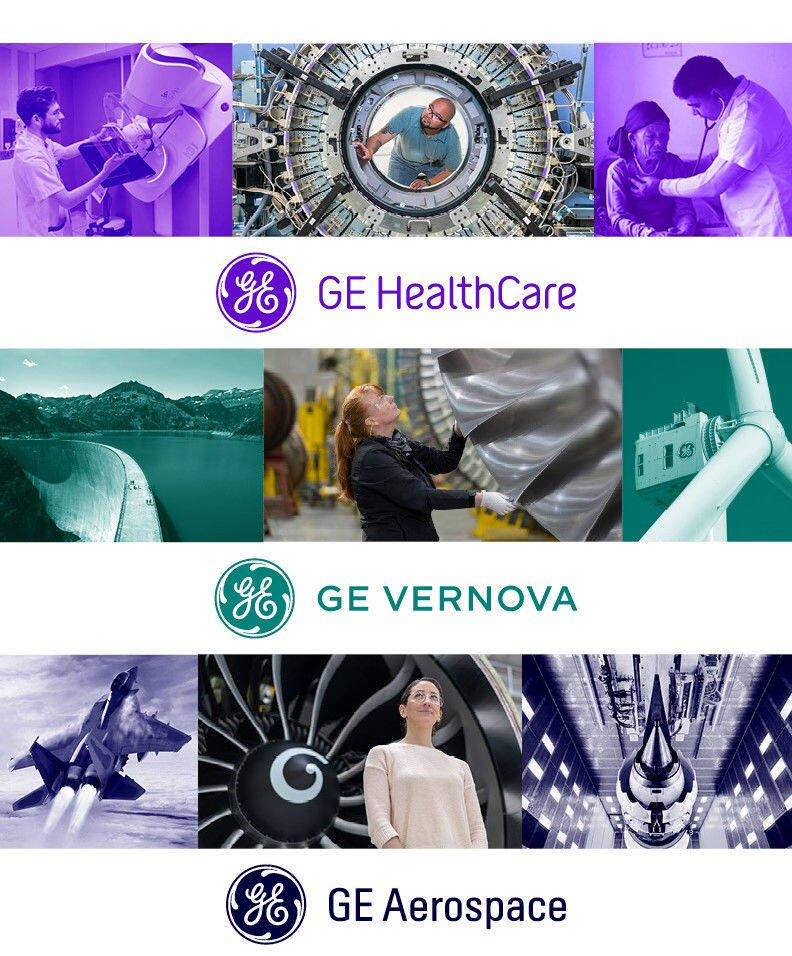
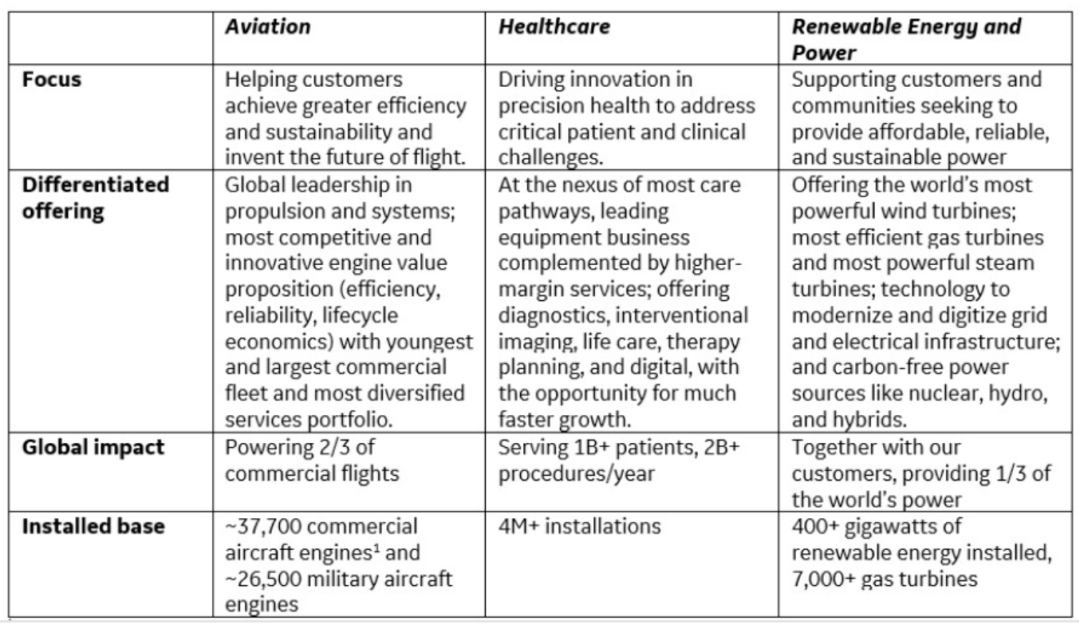
GE plans to complete the spin-off of its healthcare business in early 2023.The independent healthcare business will drive innovation in the field of precision medicine, focusing on improving patient outcomes and the level of disease diagnosis and treatment, addressing the severe challenges faced by patients and clinicians. Building on GE's over a century of historical accumulation,The new name and brand identity of GE HealthCare reflect the company's unwavering commitment to safety, quality, trust, and innovation; while the new brand color "Warmth Purple" symbolizes humanity, warmth, care, and the company's pursuit of excellence.GE Healthcare has an installed base of 4 million units worldwide, performing over 2 billion patient exams annually, and will continue to lead the forefront of innovation in the healthcare industry, caring for vital moments in life.
As planned, GE will execute the split of GE Vernova in early 2024.Namely, the spin-off of GE's energy business. Currently, GE's energy business and customers account for one-third of the world's power supply and will continue to focus on improving the reliability, accessibility, and sustainability of energy.The new brand identity integrates "ver," derived from "verde (green)" and "verdant (lush)," symbolizing the earth's green mountains and clear waters; "nova" comes from the Latin word "novus" and "new," representing the commitment to lead a new era of low-carbon energy. GE Vernova’s brand color, “Universal Green,” also conveys this meaning. Currently, GE Vernova has an installed capacity of over 7,000 gas turbines and 400 gigawatts of renewable energy equipment globally.The all-new brand identity GE Vernova symbolizes the company's commitment to upholding quality, valuing partnership collaboration, and leading industry innovation.
After completing the above business split,GE will become a company named GE Aerospace with aviation as its core business.Currently, GE Aerospace has 39,400 in-service commercial aircraft engines and 26,200 in-service military aircraft engines worldwide. Building on this strong business foundation, GE Aerospace will play a key role in the historic recovery of the aviation industry and is committed to shaping the future of flight.Combined with GE's lettering, the new company name GE Aerospace, and the brand-new brand color "Vast Blue," symbolize the company’s continuous pursuit of breakthroughs while building on its deep-rooted foundation in the aviation field.Propose a future-oriented vision —— building competitiveness and leadership in the aerospace and defense fields.After completing the business spin-off, GE Aerospace will own the GE brand trademark and grant long-term licenses to the other two companies to use this trademark.
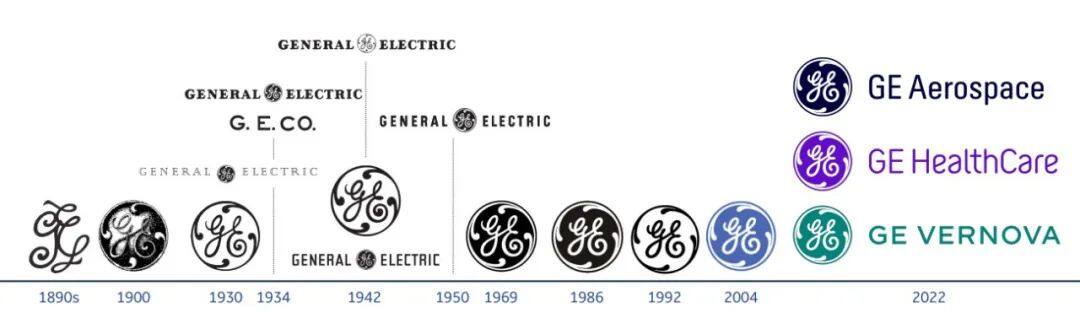
GE Chief Marketing Officer Linda Boff stated: "Over the past six months, we have conducted a series of comprehensive, customer-oriented research to analyze the importance of the three planned independent companies continuing to use the GE brand. Based on extensive market research and data analysis,We have fully demonstrated that the GE brand and its century-old letter combination represent the continuation of innovation, symbolize the trust of global customers, the honor of the team, and the company's appeal to future talents."For this reason, we are extremely proud that the three future companies will inherit GE's innovative DNA and drive the future of the industry."
The three independent companies will all benefit from more focused business operations, more customized capital allocation, and more flexible development strategies.Thereby driving long-term growth more effectively and realizing brand value.
02
The Development History of GE
In November 2021, GE announced its spin-off plan: the creation of three independent publicly traded companies, with the tax-free spin-off of GE Healthcare in early 2023.In early 2024, the tax-free spin-off will be completed by merging "GE Renewable Energy, GE Power, and GE Digital" into a business focused on energy transition; after completing the above transactions, GE will transform into a company with aviation as its core business.
After the announcement, GE's stock price rose more than 6% in early trading on the same day Eastern Time, once hitting a new high in three and a half years.
This is not GE's first transformation. After 130 years of development and continuous reforms and active transformations led by multiple CEOs,GE has continuously driven the world forward through innovation, once being called "the symbol of American business" by Warren Buffett, and has ranked first on the Fortune's list of the World's Most Admired Companies seven times.
Jack Welch, who took office in 1981, implemented the "Rank and Yank" system internally and actively expanded externally, leading GE into a golden age of diversification—covering more than a dozen fields, once becoming the world's most valuable company by market capitalization, and representing the era of diversified conglomerates in the 20th century.
In 2001, Jeffrey Immelt took over, starting to streamline operations and allocate more resources to technology research and innovation. In 2015, GE announced the divestiture of its financial services business, returning to industrial manufacturing, while establishing a digital division to begin the transformation towards industrial digitalization.
In 2018, GE welcomed its current CEO, Larry Culp. He advocates for "lean management," clearly focusing the business landscape on three major areas: aviation, healthcare, and energy. He sold off the lighting and biopharmaceutical businesses and completed the merger transaction between GE Aviation Financial Services and AerCap.These measures have significantly improved GE's financial situation — drastically reducing debt, increasing cash flow, and building a business portfolio focused on aviation, healthcare, and energy.
In an April interview with Fortune this year, Wei Ming Xiang, GE's Global Vice President and President of GE China who has served GE for 30 years, believed that as an externally recruited CEO, Larry Culp was able to shed historical burdens and view matters from the perspective of business operations and the company’s future development. Therefore, the spin-off is an inevitable trend for GE to move towards more specialized development and transformation, marking the beginning of a whole new chapter ——In the future, GE will transform into an industrial group focused on high-tech industries, leveraging industry-leading innovative technologies, a global business network, and outstanding professional talent to continue leading the aviation, healthcare, and energy fields for the next 130 years.
03
GE Healthcare to Officially Launch in 2023
According to the plan,GE Healthcare Technologies, Inc. will officially debut in early 2023.
GE has long been a leader in the large medical equipment field, often referred to as one of the "Big Three" alongside Philips and Siemens Healthineers.GE Healthcare was the first in the industry worldwide to launch high-end medical equipment such as commercial cyclotrons, translate-rotate CT scanners, and whole-body magnetic resonance imaging systems.
Data shows that the three major businesses of GE Group are of similar scale. According to the 2020 annual report,GE's traditional energy segment revenue was $17.6 billion, new energy business revenue was $15.7 billion, GE's aviation business revenue was $22 billion, and healthcare business revenue was $18 billion.
On the surface, among GE's three major business segments, the energy business is the strongest, and the healthcare business is the weakest. However, in reality, the net profit margin of GE's traditional energy sector is only 1.6%, while the aviation business has a net profit margin of just 5.6%, and the new energy sector is even loss-making.Only GE Healthcare has achieved a net profit margin level of 17%.

In fact, there has always been a plan for the spin-off of GE Healthcare. In 2018, GE was removed from the Dow Jones Industrial Average, and in June of that year, GE announced that it would divest its healthcare business unit to focus solely on energy and aviation.GE Healthcare's CEO Kieran Murphy immediately stated, "Independence will drive GE Healthcare's growth."
GE has indeed sold assets and restructured its business multiple times since 2018. In February 2019, GE spun off its biopharmaceutical business under the life sciences division, selling it to Danaher for $21.4 billion. In its annual report, GE statedThere is no better way to deal with the leverage challenge except for selling the business.
The announcement shows that GE has made significant progress in improving its financial condition and operational performance, with strong development momentum. GE will continue to focus on strengthening business operations to achieve long-term profitable growth, thereby realizing high single-digit cash flow profit by 2023. GE will use the proceeds from the recent spin-off of GE Aviation Financial Services (GECAS) to significantly reduce debt. While committed to reducing liabilities, GE will orderly carry out strategic capital deployment.
Among them,GE Healthcare's operational focus is to drive innovation in the field of precision medicine and address critical disease and clinical diagnosis and treatment challenges.Play a pivotal role in the majority of medical diagnoses; focus on the development of equipment business and expand the profitable service business;Providing diagnostic, interventional imaging, life care, treatment planning, and digital products and services; with an installed base of over 4 million.
04
Precision Medicine to Become GE Healthcare's Latest Strategy
In February this year, GE released its 2021 annual report. The report showed that the total revenue of the GE Group was 71.1 billion US dollars. Among the four major business segments of aviation, healthcare, renewable energy, and power,Only healthcare achieved positive growth, but the growth slowed somewhat due to the impact of GE BioPharma's divestiture.
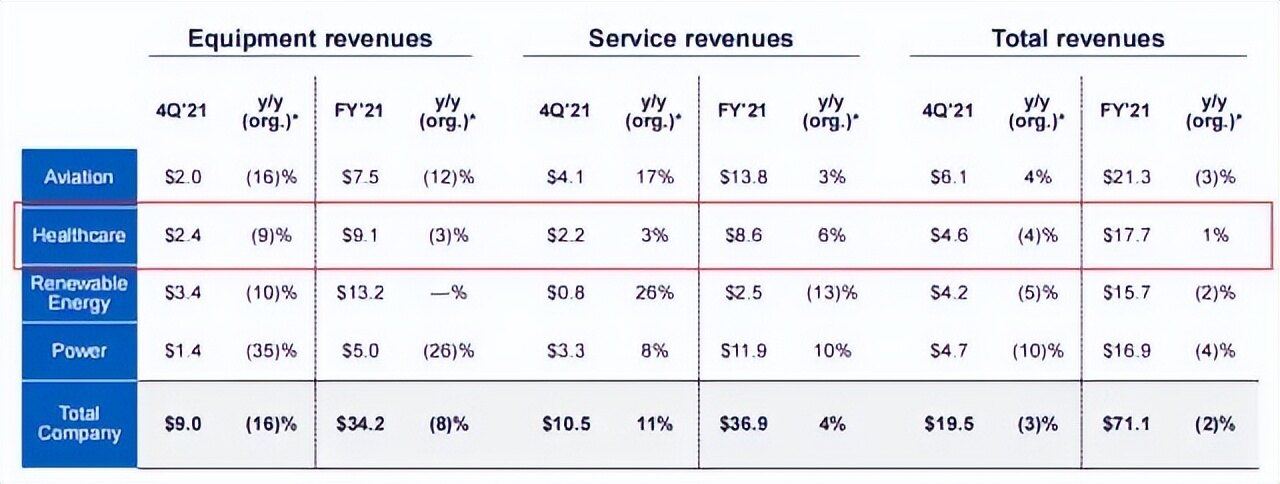
Data shows, 2In 2021, GE Healthcare's business segment achieved a revenue of $177 billion.Of which, equipment accounts for 51%, customer order value reached 19.6 billion US dollars, increasing by 5% year-on-year, and profit reached 2.97 billion US dollars, decreasing by 3% year-on-year.Profit margins have declined somewhat due to supply chain issues and inflation.
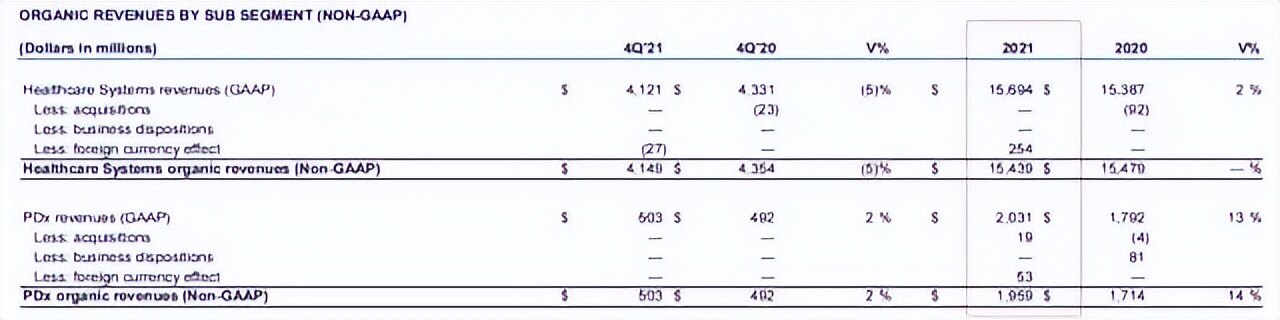
Healthcare Systems (abbreviated as HCS, including imaging, ultrasound, life care solutions, enterprise software and solutions, abbreviated as HCS) generated revenue of $15.7 billion, a year-over-year increase of 2%, accounting for 89% of GE Healthcare's total revenue; Pharmaceutical Diagnostics (abbreviated as PDx, including contrast agents and nuclear tracers) generated revenue of $2 billion, a year-over-year increase of 13%, accounting for 11% of GE Healthcare's total revenue.Global installations of equipment reach 4 million, with 2 billion patient scans annually. GE Healthcare expects supply chain challenges to last until the first half of 2022 at most and is confident in the long-term sustainable growth of the business.
In its latest strategy, GE Healthcare stated that it is driving organic growth through innovation.Focused on precision solutions, from precise diagnosis to targeted treatment and then to accurate monitoring, the goal is to achieve precision solutions by integrating the entire patient process data from clinical diagnosis and treatment to health management.At the same time, it is believed that ultrasound will experience mid-single-digit growth over the next three years, second only to enterprise digital solutions and medical imaging.
This can also be seen from its new product launches and acquisitions in 2021. In March of last year,GE Healthcare Releases Vscan Air, a Wireless Handheld Ultrasound Device: A Pocket-Sized, Portable Ultrasound Device That Transmits Images Detected by the Ultrasound Probe to a Smartphone App.Currently, the Vscan series has been sold to 300,000 national medical institutions across more than 100 countries worldwide, benefiting many areas including rural regions, and contributing to the strong growth of its ultrasound revenue in 2021.
And in December 2021,GE Healthcare also acquired BK Medical, a provider of advanced surgical visualization technology, for $1.45 billion (equivalent to 9.24 billion RMB).The latter has the technology to help clinicians observe the inside of a patient’s body in real time during surgery, which can improve treatment outcomes, accelerate surgical procedures, and reduce the occurrence of complications.
It should be noted that,GE Healthcare has also been continuously accelerating its layout in China in recent years, positioning China as a key strategic base.March 3,GE Healthcare's high-end obstetrics and gynecology ultrasound products, Voluson™ E8 and Voluson™ E10 (hereinafter referred to as the China-produced Gold Standard E8 and China-produced Gold Standard E10), have received registration approval from the Jiangsu Provincial Medical Products Administration and have officially gone into production and launched in the market.It is reported that these two products are ultra-high-end products in the field of professional obstetric and gynecological ultrasound, and also the latest achievement of GE Healthcare's comprehensive innovation in Wuxi production base in China.
——
The financial data for 2021 showed that GE Healthcare was the only segment among the four major business units of the GE Group to achieve positive growth in performance. Prior to the spin-off plan, internal stakeholders at GE Healthcare also believed,Previously, profits were centrally distributed by the group, but now GE Healthcare, which is more profitable, can shed its burden.
Murphy, the former CEO of GE Healthcare, also wrote an article stating,"The spin-off plan marks an exciting moment, representing the acceleration of precision healthcare opportunities for hospital customers and patients."So, after the split is completed in the future, can GE Healthcare achieve this vision?What new developments will GE Healthcare usher in after the announcement of its brand-new logo?Instrument Family will continue to follow up and report.