

Breaking High-Barrier Core Manufacturing Technologies: MingCe Bio Advances a Portfolio of Miniaturized Ophthalmic Devices for Monitoring and Therapy

Mingche Biotechnology
Ophthalmic Medical Device Researcher
The ophthalmology industry is a rare high-growth, high-barrier track.
On the one hand, ophthalmology is highly specialized with strong professional segmentation. Moreover, China's ophthalmic device market has relatively weak technical accumulation. The development of domestically related ophthalmic drugs and devices is still in its early stages, with imports dominating the market. Compared to the United States, the market size of China’s ophthalmic devices and drugs is only one-eighth to one-fifth of that of the U.S. Overall, China’s ophthalmology market still has significant growth potential in the future.
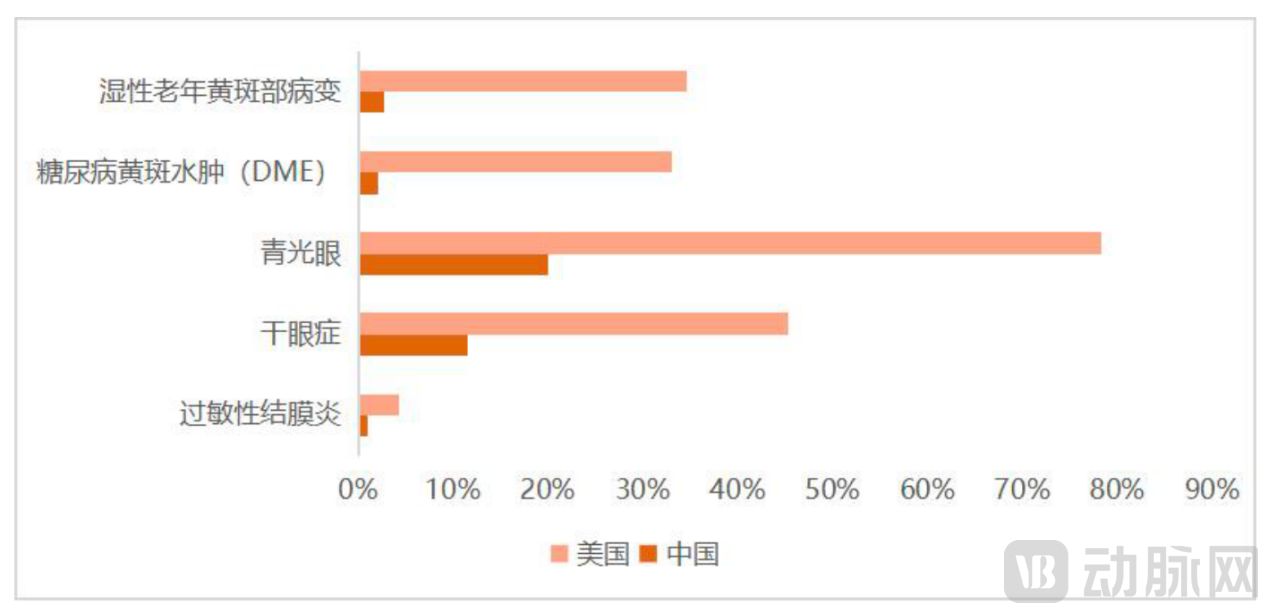
Comparison of Diagnosis Rates of Major Ophthalmic Diseases in China and the United States in 2019
Data Source: CIC, VCBeat
On the other hand, the release of the "14th Five-Year Plan" for National Eye Health in China (hereinafter referred to as the "Plan") this year has further propelled the ophthalmology industry to the eve of rapid development, with a more focused direction for the industry. Early detection, early diagnosis, and early treatment of glaucoma, diabetic retinopathy, myopic retinopathy, macular degeneration, retinal vascular occlusion, hypertensive fundus lesions, and other fundus diseases have become key areas of policy concern.
However, despite the enormous potential and clear development direction of the ophthalmology industry, as a field characterized by numerous sub-sectors and fragmentation within non-fatal diseases, companies must focus on key growth areas and understand the future logic of the industry to maintain momentum in this track.
Recently, VCBeat learned that,MINGCHE (hereinafter referred to as "MINGCHE") utilizes intelligent manufacturing and control technologies such as "two-photon micro-nano printing" and "microfluidics.", developing a series of miniaturized innovative medical devices for ocular monitoring and treatment, including minimally invasive glaucoma surgery (MIGS) and intraocular pressure monitoring instruments, microneedles for ocular drug delivery, micro-robots for ocular surgery, and micro-sensors for detecting other eye diseases, further covering niche application scenarios in ophthalmology.
It is reported that MINGCHE has currently completed the material system exploration, material performance verification, product structure design, and finite element calculations of the theoretical model for improving drainage efficiency for MIGS 1.0 and 1.5 generations. Pilot production has successfully achieved mass production of the product, and validations including registration testing, biological evaluation, and systematic animal experiments have been carried out. In the future, with its unique "hydrogel material + near-field control technology" platform, the company is expected to break the import monopoly of minimally invasive glaucoma drainage tubes.
MINGCHE's solution is particularly worth mentioning for glaucoma treatment.
Glaucoma is a group of eye diseases characterized by optic nerve damage and visual field defects. In 2020, the number of glaucoma patients in China reached 21 million, with 5.67 million cases of blindness (data sourced from "China Glaucoma Guidelines (2020)"). With the progression of aging in the future, the number of glaucoma patients will continue to increase, and significant market potential will gradually be unleashed.
Currently, the internationally recognized MIGS (Minimally-Invasive Glaucoma Surgery) is considered the latest advancement in surgical techniques. Although MIGS offers higher safety, compatibility with other treatments, significantly reduced trauma and risk of complications, and faster postoperative recovery compared to traditional methods, in China, only the XEN Gel Stent developed by Allergan has been put into use, and the relevant market for domestically produced ophthalmic devices remains underdeveloped.
As China advances in research related to the mechanisms of glaucoma, gene screening and function, optic nerve protection and regeneration, and scar modulation after glaucoma surgery, some findings are approaching or have reached international advanced levels. With the emergence of new technologies and enhanced R&D capabilities, domestic companies are expected to accelerate the弥补of shortcomings and gaps in China's minimally invasive glaucoma surgical products.
MINGCHE's self-developed minimally invasive glaucoma drainage tube inherits the most comprehensively advantageous technical pathway from MIGS product XEN. On this basis, it has been optimized and innovated in terms of materials, structure, processes, and surgical operation.
In terms of materials,MINGCHE Adopts Dual-Material Approach. By utilizing proven gelatin material and photocurable hydrogel material, MINGCHE is developing MIGS products. The gelatin material demonstrates excellent biocompatibility with verified safety, facilitating the future large-scale commercialization of the product. The photocurable hydrogel material offers advantages such as a modulus similar to ocular tissue, good aging resistance and mechanical properties, rapid molding, convenient processing, and outstanding material platform expandability.
In terms of product structure,Unlike XEN's constant-diameter drainage tube, MINGCHE adopts a gradient inner diameter design to effectively enhance drainage efficiency while achieving directional drainage, anti-reflux, and preventing postoperative complications such as excessively low intraocular pressure. Its product’s outer wall features a fixation structure for intraoperative positioning, increasing the success rate of single-step implantation during surgery while preventing postoperative displacement complications.
In terms of technology,MINGCHE adopts microfluidic intelligent manufacturing technology to optimize processing techniques. While reducing costs and increasing efficiency, it controls product quality, improves batch stability, and facilitates mass production. Meanwhile, its process platform is compatible with various materials, matching the verified gelatin system or pairing with the hydrogel material route, which is expected to achieve better therapeutic effects under controllable costs.
In addition, to address the pain points in clinical surgical operations such as high surgical difficulty and long learning curves for doctors, MINGCHE has optimized the compatibility of its self-developed MIGS product with commercial medical syringes. This aims to further simplify surgical difficulty, shorten the learning curve for doctors, and facilitate future product promotion and implementation.
In this regard, Ren Dongni, the founder of MINGCHE, stated"In fact, minimally invasive glaucoma devices are already the mainstream treatment method internationally. Currently, related products from overseas are undergoing clinical registration in Boao, Hainan. As these products gradually enter the market over the next two to three years, and with increasing acceptance of this surgical approach by doctors and patients, we believe that minimally invasive glaucoma treatment will undergo a new iteration of techniques and experience rapid development."
As one of the most complex and sophisticated organs in the human body, the development of implantable medical devices related to the eye is extremely challenging. Restricted by the insufficient ultra-micro precision processing capabilities in the supply chain, most related research and attempts have failed in the past.
MINGCHE's founding team has years of technical accumulation in hydrogel biomaterials, micro-nano manufacturing, and the design and manufacture of medical devices based on microfluidic technology. They have independently built a smart manufacturing platform for polymer biomaterials and near-field control technology, developing products such as minimally invasive glaucoma drainage tubes, while also establishing a closed-loop control system for glaucoma "diagnosis + treatment + chronic disease management."
MINGCHE independently develops the iterative product of minimally invasive glaucoma drainage tube.
The 2.0-generation sensor model integrates the functions of drainage treatment and postoperative intraocular pressure (IOP) monitoring. Through the 2.0-generation drainage stent combined with a micrometer-level optical sensor, which is minimally invasively implanted in a one-time procedure using an injector during surgery, it enables in-situ, real-time, continuous, and permanent IOP monitoring. The IOP data transmitted to the cloud allows for routine intelligent IOP management after surgery. This product design not only reduces the frequency of postoperative follow-ups but also greatly facilitates patients in promptly detecting abnormal conditions such as elevated IOP and implementing relevant interventions to prevent severe outcomes like blindness.
According to REN Dongni,Its independently developed glaucoma drainage tube technology has full independent intellectual property rights. The product has been validated through systematic animal experiments (in-situ implantation in New Zealand rabbit eyes), showing good intraocular pressure reduction and bleb formation, with no signs of inflammatory response, scarring, or displacement.
In the future, MINGCHE will focus on MIGS as its core product. The 1.0 generation will primarily target the Chinese market (NMPA), followed by the European Union market (CE), to achieve large-scale product implementation. The 2.0 generation will prioritize entering the U.S. market (FDA) to quickly capture the global market.
However, MINGCHE's layout in ophthalmic devices goes far beyond this.
In addition to MIGS devices, the company is currently developing various microdevices for ocular monitoring and treatment based on its "hydrogel material + near-field control technology" platform, including treatments for posterior segment eye diseases and ocular vascular conditions.(Micro instruments for eye surgery, micro robots for eye surgery, micro sensors for detecting intraocular pressure and other eye diseases).
For the treatment of invasive fundus diseases with high operational difficulty, where conventional drug delivery methods are hard to reach, MINGCHE has developed ocular microneedle drug delivery and magnetic-controlled robotic products to achieve targeted drug delivery.
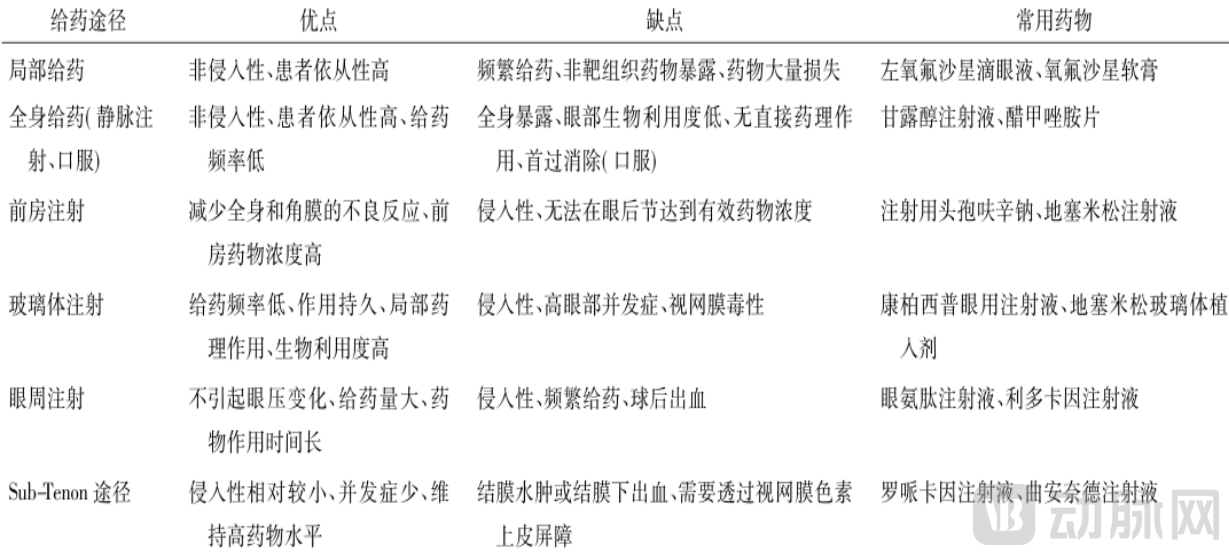
Advantages and Disadvantages of Different Ocular Drug Delivery Methods
Image provided by MINGCHE
Among them, the ocular microneedle drug delivery product features strong elasticity and adjustable stiffness, making it suitable for injection sites that require bending. In the future, it can be applied to various drug delivery scenarios such as choroidal and retinal injections, as well as CRA/CRV vascular interventions.
The overall size of the magnetic-controlled robot is hundreds of micrometers. It can be fully magnetically controlled and driven by an external magnetic field, achieving minimally invasive, painless, and magnetic-driven operations, further penetrating the blood-retinal barrier to deliver drugs to the target site.
In addition, its self-developed sensors have also expanded into ophthalmology, enabling applications such as contact lens-based corneal electrograph monitoring and dry eye syndrome monitoring, demonstrating broad market potential.
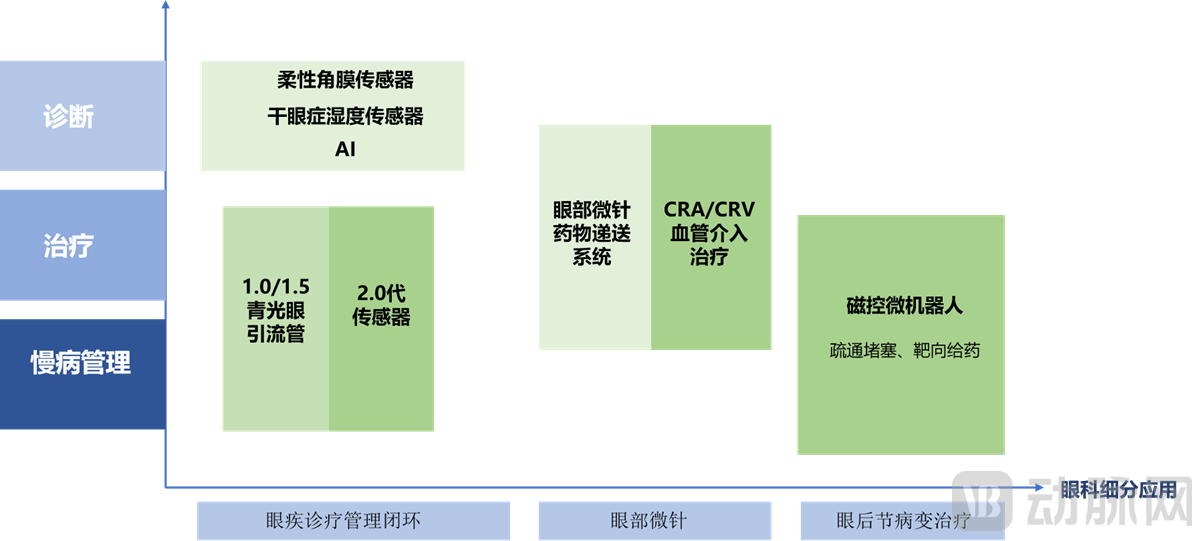
MINGCHE Product Layout
MINGCHE is currently undergoing a new round of financing.
In recent years, the scale of China's ophthalmic device market has grown rapidly, increasing from 111 billion yuan in 2014 to 375 billion yuan in 2021, with a compound annual growth rate as high as 19%.
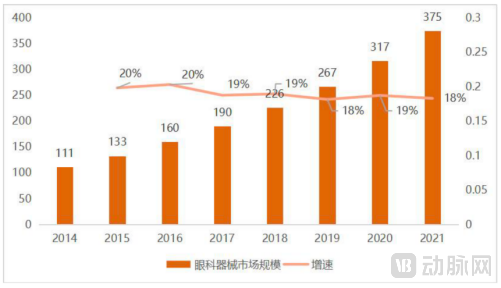
The Scale of Ophthalmic Devices Market in China
Data source: China Medical Device Industry Development Report, Guosen Securities, VCBeat
The continuous construction of ophthalmology-related infrastructure by the state, as well as the formulation of standardized treatment protocols for key ophthalmic diseases, keeps driving the sector towards positive development.
As mentioned in the guidelines, the future will see continuous improvement in the management model for patients with chronic eye diseases, reducing the disease burden and blindness rate. At the same time, the construction of ophthalmology-related medical consortiums will be continuously promoted, gradually extending fundus photography screening technology to cover grassroots medical and health institutions. Efforts will explore the establishment of a "grassroots examination, higher-level diagnosis" service model, enhancing the diagnostic and treatment capabilities for eye diseases such as fundus diseases and glaucoma. Implementing the technical solutions for hierarchical medical treatment of ophthalmic diseases like diabetic retinopathy, promoting the implementation of the "Thousand Counties Project," building chronic disease management centers in county-level general hospitals, steadily advancing the family doctor contract service work, and constructing an eye disease chronic disease management system, among others. These measures will further expand the market space for the ophthalmology industry.
At present, the overall diagnosis and treatment penetration rate in China's ophthalmology market is extremely low, indicating significant growth potential in the future. With the continuous innovation of domestic companies like MINGCHE, the substitution of domestically produced devices for eye disease treatment will undoubtedly open new breakthroughs.