

AbbVie Submits Marketing Authorization Application to EMA for Qulipta (Atogepant) for Preventive Treatment of Migraine

AbbVie
Innovative Drug Developer

European Medicines Agency
The European Medicines Agency (EMA) is a decentralized agency of the European Union (EU), located in London. It began operations in 1995. The agency is responsible for the scientific evaluation, supervision, and safety monitoring of medicines developed by pharmaceutical companies for use in the EU. By ensuring that all medicines available on the EU market are safe, effective, and of high quality, the EMA protects public and animal health in the 28 EU Member States and countries of the European Economic Area.

Image Source: Shutterstock
News on July 25, 2022 /BioValleyBIOON/ -- AbbVie recently announced that it has submitted to the European MedicinesManagementThe European Medicines Agency (EMA) has submitted a Marketing Authorization Application (MAA) for Qulipta (atogepant):For adult patients with at least 4 migraine days per month,PreventionSexual Treatment for MigraineMigraine is a complex neurological disease and one of the leading causes of disability worldwide. Migraine affects more than 1 billion people globally and impacts approximately 11.4% of the population in Europe.
If approved,Qulipta will become the first oral calcitonin gene-related peptide (CGRP) receptor antagonist (gepant) in Europe for the preventive treatment of migraine.At the same time, AbbVie will become the only company offering two preventive treatments for patients with chronic migraine (CM), namely the oral medication Qulipta and the injectable BOTOX (onabotulinumtoxinA).
This MAA is based on the results of two pivotal Phase 3 clinical trials (ADVANCE [NCT03777059], PROGRESS [NCT03855137]). These two trials respectively evaluatedQulipta for the Preventive Treatment of Episodic Migraine (EM) and Chronic Migraine (CM) in Adult PatientsSafety, efficacy, and tolerability.
——ADVANCE trial met the primary endpoint: during the 12-week treatment period, compared with placebo, all three doses (10mg, 30mg, 60mg, once daily [QD]) of Qulipta reduced the average number of migraine days per month.StatisticsA statistically significant and clinically meaningful rapid and sustained reduction (reduction range: 50%-100%) was observed, particularly a significant decrease during weeks 1-4. Additionally, the two higher doses (30mg, 60mg) demonstrated statistically significant improvements across all six secondary endpoints.
——The PROGRESS trial also met the primary endpoint: during the 12-week treatment period, both Qulipta regimens (60 mg once daily [60 mg QD] and 30 mg twice daily [30 mg BID]) significantly reduced the average number of migraine days per month from baseline compared to placebo. In addition, both Qulipta regimens (60 mg QD and 30 mg BID) showed statistically significant improvements over placebo on all secondary endpoints.
In 2 trials,All doses of Qulipta were well tolerated., the overall safety was consistent with the safety outcomes observed in previous clinical studies conducted in CM and EM populations. The most common adverse events were constipation and nausea.
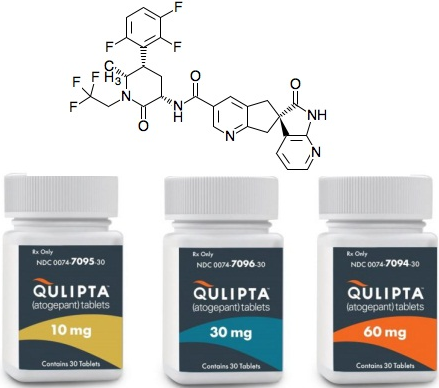
Chemical Structure of Atogepant (Source: genome.jp)
Migraine is the third most common disease and the sixth leading cause of disability globally, and it is a common chronic neurologicalBlood VesselSexual disease, characterized by recurrent severe headaches, mostly on one side. It is estimated that globally, the total number of migraine patients exceeds 1 billion, with approximately 90% having episodic migraine (EM), characterized by up to 14 migraine days per month; the remaining 10% have chronic migraine (CM), characterized by headache occurring on at least 15 days per month, with 8 or more days being migraines, and the condition lasting over 3 months. Currently, there are no drugs that can cure migraines. The World Health Organization (WHO) has listed migraines as one of the top 10 most disabling diseases. Compared with other populations, migraine patients are more likely to experience depression, anxiety, sleep disorders, other pain, and fatigue.
Qulipta is an oral CGRP receptor antagonist specifically developed for the preventive treatment of migraine. CGRP and its receptors are expressed in areas of the nervous system associated with the pathophysiology of migraine. Studies have shown that CGRP levels increase during migraine attacks, and selective CGRP receptor antagonists have demonstrated clinical efficacy in treating migraine.
In October 2021, Qulipta was approved in the United States.FDAApproved for the prophylactic treatment of episodic migraine (EM) in adult patients. Notably,Qulipta is the first oral CGRP receptor antagonist specifically developed for the preventive treatment of migraine, offering patients a simple, once-daily, safe, and effective preventive treatment option.
Based on the results of the Phase 3 PROGRESS trial, in June this year, AbbVie submitted a supplemental New Drug Application (sNDA) to the U.S. FDA for the use of Qulipta in the preventive treatment of chronic migraine (CM) in adult patients. According to the announcement released by AbbVie, if approved, Qulipta will become the first oral calcitonin gene-related peptide (CGRP) receptor antagonist (gepant) with a broad indication for the preventive treatment of migraine, covering both CM and episodic migraine (EM). (Bioon.com)
Source of the original text:AbbVie Submits Marketing Authorization Application to EMA for Atogepant for the Preventive Treatment of Migraine