

Nubeqa (Darolutamide) Demonstrates Consistent Overall Survival Benefits Across Key Subgroups in Metastatic Hormone-Sensitive Prostate Cancer

Bayer
Pharmaceutical Product R&D Developer

Image Source: Shutterstock
News on July 25, 2022 /BioValleyBIOON/ -- Bayer recently announced new subgroup analysis data from the pivotal Phase 3 ARASENS trial of the next-generation oral androgen receptor inhibitor (ARi) Nubeqa (generic name: darolutamide) in combination with docetaxel and androgen deprivation therapy (ADT) for the treatment of metastatic hormone-sensitive prostate cancer (mHSPC). The results showed,Based on the extent of metastatic spread (bone or visceral metastases) and alkaline phosphatase (ALP) levels (< or ≥ upper limit of normal [ULN] at study entry),In subgroups of patients with different types of metastatic disease, the Nubeqa + docetaxel + ADT regimen provided consistently favorable overall survival (OS) benefits compared to the standard-of-care regimen (docetaxel + ADT), with similar rates of adverse events between the two groups.。
ARASENS is the only randomized, double-blind, pivotal trial with a prospective design aimed at evaluating the second-generation ARi (Nubeqa) in combination with docetaxel + ADT for the treatment of mHSPC patients, compared with docetaxel + ADT. (Note:Docetaxel + ADT isGuidelinesRecommended Standard Care Protocol). In this trial, 1,306 patients were randomized in a 1:1 ratio to receive either Nubeqa + docetaxel + ADT or placebo + docetaxel + ADT.
In the trial, the most widely used cancer staging system, TNM (Tumor, Node, Metastasis) classification, was adopted. Patients were randomly stratified according to the extent of metastatic spread [only non-regional lymph node metastasis (M1a), bone ± lymph node metastasis (M1b), visceral ± lymph node/bone metastasis (M1c)] and ALP levels (< or ≥ upper limit of normal [ULN] at the start of the study). Among 1306 patients with mHSPC, 79.5% had bone metastases (M1b), 17.5% had visceral metastases (M1c), and 55.5% had ALP ≥ ULN. The extent of metastatic spread and ALP levels are known prognostic factors for patients with mHSPC.
Previously released results show,In the overall patient population, compared with the docetaxel + ADT regimen, the Nubeqa + docetaxel + ADT regimen significantly extended overall survival (median OS: not predictable [NE] vs 48.9 months) and significantly reduced the risk of death by 32.5% (HR=0.68; 95% CI: 0.57-0.80; p<0.001).
The newly released data shows:In pre-specified patient subgroups, the Nubeqa + docetaxel + ADT regimen demonstrated consistent OS benefits compared to docetaxel + ADT.:In the M1b subgroup, the risk of death was reduced by 33% (HR=0.66, 95%CI:0.54-0.80), and in the M1c subgroup, the risk of death was reduced by 21% (HR=0.76, 95%CI:0.53-1.10).. The number of patients in subgroup M1a (n=39) was too small for meaningful comparison.In the subgroup with ALP < ULN, the risk of death was reduced by 36% (HR=0.65, 95%CI:0.47-0.89); in the subgroup with ALP ≥ ULN, the risk of death was reduced by 31% (HR=0.69, 95%CI:0.56-0.85).. Safety analysis showed that, in the entire population,The incidence of adverse events at any grade, grades 3-5, and severe adverse events was similar in the two treatment groups.
French medical professor Karim Fizazi, M.D., Ph.D., from the Gustave Roussy Institute, commented: "These latest results from the ARASENS trial reaffirm the overall survival benefits of the Nubeqa + docetaxel + ADT regimen across different patient populations with mHSPC and provide physicians with more details on which patients may benefit from this treatment approach."
Globally, prostate cancer is the second most common malignant tumor in men and the fifth leading cause of cancer-related deaths, primarily affecting men over the age of 50, with the risk increasing as age advances. In 2020, it was estimated that 1.4 million men worldwide were diagnosed with prostate cancer.DiagnosisAbout 375,000 men die from prostate cancer. At the time of diagnosis, most men have localized prostate cancer, which means that their cancer is confined to the prostate and can be treated with surgery or radiation therapy. When the disease recurs, metastasizes, or spreads, androgen deprivation therapy (ADT) is the foundation for treating this hormone-sensitive condition.
Approximately 5% of men are diagnosed with prostate cancer with distant metastases at the time of initial diagnosis. Male patients with metastatic hormone-sensitive prostate cancer (mHSPC) will initiate hormone therapy, such as ADT, androgen receptor inhibitor (ARi) + ADT, docetaxel + ADT, etc. Despite such treatments, most male patients with mHSPC will eventually progress to castration-resistant prostate cancer (CRPC), a disease with limited survival.
Nubeqa, developed by Bayer in collaboration with Finnish pharmaceutical company Orion, has been approved in multiple markets worldwide, including the United States, the European Union, China, and Japan, for the treatment of men with non-metastatic castration-resistant prostate cancer (nmCRPC). Nubeqa provides an important treatment option for men with nmCRPC, significantly extending metastasis-free survival (MFS) and overall survival (OS), with a favorable long-term safety profile that supports continuous treatment and helps achieve therapeutic goals.
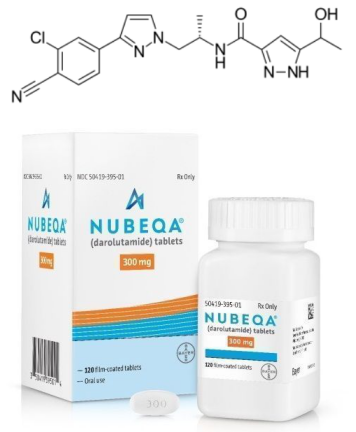
Nubeqa is an oral next-generation non-steroidal androgen receptor (AR) inhibitor with a unique chemical structure that binds to the receptor with high affinity, demonstrating strong antagonistic activity, thereby inhibiting receptor function and the growth of prostate cancer cells. Unlike other existing nmCRPC treatments, Nubeqa does not cross the blood-brain barrier, resulting in fewer potential drug interactions and central nervous system side effects such as seizures, falls, and cognitive impairment.
Currently, Bayer and Orion are developing Nubeqa for the treatment of mHSPC. In addition to the ARASENS trial, another phase 3 trial (ARANOTE) evaluating the Nubeqa + ADT regimen for mHSPC is underway. (Bioon.com)
Source of the original text:Darolutamide plus androgen deprivation therapy and docetaxel demonstrates consistent overall survival benefits across various patient segments in metastatic hormone-sensitive prostate cancer