

Immunofocus Advances Rapidly in Solid Tumor CAR-T with Over 10 Pipelines in Under Two Years, Files for Hong Kong IPO

Immunofoco
Developer of Novel Therapeutics for Solid Tumors
In 2017, Fosun Kite was newly established and hoped to introduce the CAR-T drug Yescarta from American company Kite.®, and through technology transfer, localized production and sales are carried out in China.
As a founding executive of Fosun Kite, Sun Minmin successfully promoted the industrialization application of Yescarta® in China and participated in the formulation of domestic cell therapy regulations and the writing of guidelines, leveraging her years of experience in R&D project management and registration regulations.
Fosun Kite's experience is only the starting point for Sun Minmin’s development and establishment in the cell therapy industry. According to WHO statistics, there were nearly 19.3 million new cancer cases globally in 2020, with nearly 10 million deaths. Sun Minmin recognized a significant unmet clinical need in the field of solid tumor treatment. With favorable conditions aligning, she co-founded Immunofoco in September 2020 with her partners, committing to the development of cell therapy drugs capable of conquering solid tumors.

The journey begins with Fosun Kite and advances through Immunofoco.
Before joining Fosun Kite, Sun Minmin participated in promoting China's first biosimilar rituximab "Hanlikang" at Henlius.®" approval for marketing, and is responsible for the submission of multiple antibody drugs, accumulating rich experience in project management of drug research and development as well as regulatory registration.
This also gave her the opportunity to participate in the establishment of Fosun Kite. However, the Wei Zexi incident in 2016 sparked a public outcry, and at that time, the cell therapy industry was in chaos, with no genuine CAR-T drugs available on the market either domestically or internationally. This left Sun Minmin feeling quite hesitant about the future of CAR-T therapy.
However, when Sun Minmin saw the excellent key clinical trial data of Yescarta® and learned that Kite was preparing to file a BLA with the U.S. FDA, she realized the future of CAR-T therapy—its standardized development could bring curative hope to cancer patients.
From 2017 to 2020, Sun Minmin personally experienced Yescarta.®The technology transfer and close communication with the National Medical Products Administration (NMPA), participated in the discussion and formulation of domestic CAR-T cell therapy-related guidelines, and led the NDA submission for this product in China during the outbreak of the COVID-19 pandemic in early 2020.
During her three years at Fosun Kite, Sun Minmin gained a more comprehensive understanding of the cell therapy industry, becoming familiar with the entire process of CAR-T treatment from research and development to process development, and finally to commercialization submission.
These three years have also been a period of vigorous development for cell therapy in China. In 2017, the "Technical Guidelines for Research and Evaluation of Cell Therapy Products (Trial)" were issued, which initially standardized the research, development, and evaluation methods for cell therapy products. The guidelines comprehensively reformed the chaotic cell therapy industry, promoting the growth and expansion of China's cell therapy sector.
According to data provided by the Clinicaltrials.gov website, China became the country with the most registered CAR-T clinical trials in September 2017. Currently, the number of registered CAR-T clinical trials in China has exceeded 600.
Sun Minmin, who is in the golden period of cell therapy development in China, not only sees the development prospects in this field but also clearly recognizes the limitations of CAR-T therapy. "At that time, I realized that CAR-T therapy has made breakthroughs in hematological tumors, while solid tumors have a larger unmet clinical need." Thus, Immunofoco was born.
Currently,Immunofoco has already built a professional team of nearly 50 people, forming a comprehensive organizational structure with functions including strategy, R&D, quality and production, clinical, and regulatory affairs. The average industry experience of the department heads exceeds 10 years.Among them, Shen Qingshan, the quality and production director and co-founder of Immunofoco, has jointly experienced the development of Yescarta with Sun Minmin at Fosun Kite.®The core members of technology transfer. The founding team covers the entire process from early research and development to industrialization, laying the talent foundation for Immunofoco's development in the immunotherapy field.
Refining Dimensionality Reduction Strategies to Tackle Solid Tumors
At present, the competition in the CAR-T therapy track is becoming increasingly fierce. In addition to a group of companies crowding into the treatment of hematological tumors, leading to homogeneous competition, enterprises focusing on solid tumor treatment and the development of universal CAR-T products are also gradually emerging.
However, there are many problems to be solved in CAR-T treatment of solid tumors, such as the lack of specific targets, tumor heterogeneity, the tumor microenvironment, and poor tumor infiltration, which pose challenges to the development of CAR-T products for solid tumor treatment.
Facing fierce industry competition and the urgent need to address issues in CAR-T therapy for solid tumors, Immunofoco has already established a differentiated position.
When many companies attempt to enhance the efficacy of CAR-T products through modulation, reconstruction, or amplification, Immunofoco was the first to recognize the limitations that potential safety risks impose on boosting CAR-T product functionality. Most solid tumor targets currently used in CAR-T development are tumor-associated antigens, which are also expressed at certain levels in normal tissues. Consequently, while CAR-T cells kill tumors, they inevitably cause toxicity to normal tissues, known as the "on-target off-tumor" effect. "For CAR-T to conquer solid tumors, the primary focus must be on resolving safety issues before better addressing efficacy concerns," emphasized Sun Minmin.
Based on this,Immunofoco's founding team creatively proposed a "dimensionality reduction attack strategy of transforming solid tumors into hematological tumors," utilizing CAR-T drugs to eliminate smaller or invisible tumor tissues and circulating tumor cells, thereby achieving the goal of controlling and clearing metastatic lesions while avoiding recurrence and metastasis.For larger tumor tissues, treatment can be combined with surgery, ablation, and other methods. Some patients who have lost the opportunity for surgery due to metastasis can also regain the chance for surgery. By using a lower dose targeting smaller tumor tissues and circulating tumor cells, the safety of the product can be ensured.
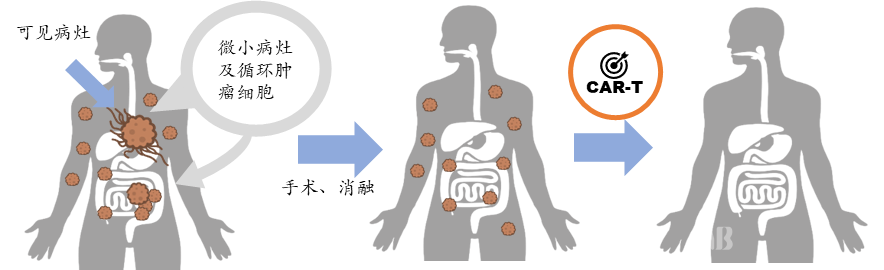
ImmunofocoFurtherDeveloped Peri Cruiser®Patent technology. This technology can alter the distribution of CAR-T cells in the body, reducing migration to normal tissues while maintaining the ability to infiltrate and kill tumor tissues, significantly expanding the safe dosage window for CAR-T applications.
On the basis of ensuring the safety of CAR-T products, Immunofoco is also actively developing more technical platforms to enhance the functionality of CAR-T. For instance, they are working on fourth-generation CAR-T with different armors to overcome the tumor microenvironment, heterogeneity, and tumor tissue infiltration, as well as the T-Booster platform technology. This involves expressing CAR homologous targets on dendritic cells (DC) while expressing specific signaling molecules to further activate CAR-T cells in vivo, significantly improving the expansion, infiltration, and cytotoxic capabilities of CAR-T cells.
Based on these technical platforms,From September 2020 to now, Immunofoco has established more than 10 product pipelines in less than two years, among which IMC001 and IMC002 have entered the IIT research stage.
Not long ago, the IMC001 project targeting the EpCAM antigen showed good safety and efficacy in the low-dose group trials of two IIT studies for advanced gastric cancer and advanced gastrointestinal malignancies. The trial results revealed that all six subjects passed the 28-day safety evaluation without observation of dose-limiting toxicity (DLT). Among them, five cases demonstrated stable disease (SD), with a disease control rate (DCR) of 83.3%.One of the cases showed a tumor reduction of over 30% at the 8-month mark, with complete regression of ascites, achieving PR efficacy. The patient’s overall condition is excellent and they have resumed normal work for over four months. This research has been invited for an oral presentation at the European Society for Medical Oncology Congress (ESMO 2022) to be held in September 2022.
"These data confirm the feasibility of our treatment strategy of 'transforming solid tumors into hematological tumors' — it is not necessary to administer very high drug doses to patients to achieve a treatment effect that is both safe and effective," said Sun Minmin.
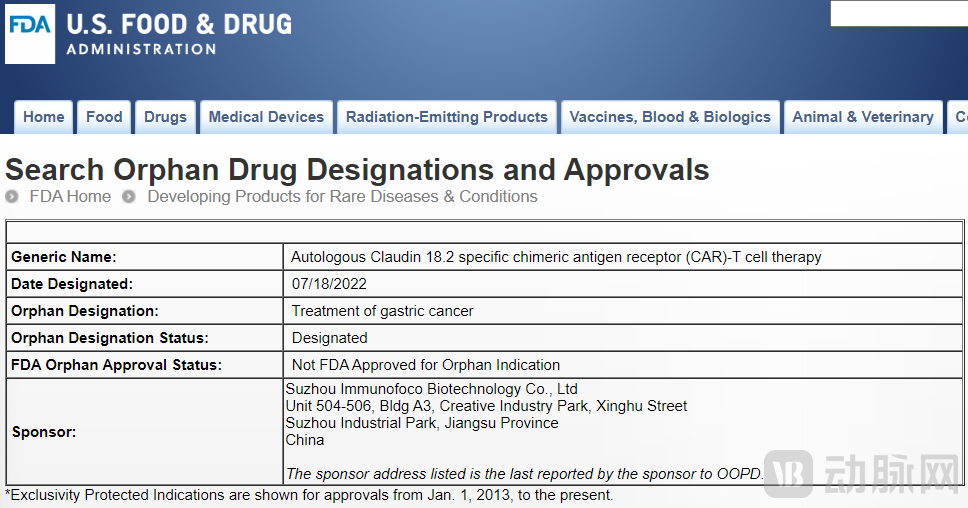
IMC002 is a highly specific CAR-T product targeting the CLDN18.2 antigen.“We are simultaneously advancing the IIT trial and the IND application.Granted FDA Orphan Drug Designation in the U.S. on July 18Sun Minmin said confidently, "We plan to complete the IND applications in China and the United States by the end of this year, hoping to become one of the first CLDN18.2-CAR-T products to receive IND approval in the industry. Our goal is to achieve Best-in-Class."
Sun Minmin mentioned, "When I was at Henlius, the company advocated for affordable innovation in terms of speed and quality." Under the influence of this corporate culture, Immunofoco places great emphasis on the advancement speed of products, as well as the balance between innovation and risk. Each project is scheduled with a tight timeline and also prepares a Plan B in case of potential risks.
Regarding the future of Immunofoco, Sun Minmin hopes to see the company’s products achieve a breakthrough in treating solid tumors, thereby driving product approval and market launch. However, the pace of development does not stop there. Sun Minmin mentioned that solving solid tumors is only the first step in the company’s development. Immunofoco hopes to expand cell therapy into more disease treatment areas, bringing clinical benefits to more patients.