

Real Braincare Files IPO Prospectus: Pioneering Medical-Grade Epilepsy Monitoring Wearables for Out-of-Hospital Quantitative Management of Brain Disorders

WECARE MEDICAL
Integrated Digital Healthcare Platform for Brain Function Disease Diagnosis and Treatment
On Zhihu's Hot List, a netizen's question, "If I have epilepsy, is my life over?" quickly attracted 130 respondents and nearly a thousand comment interactions. Whether it is the netizen’s personal journey or the firsthand experiences or observations of those who responded, we can feel that epilepsy brings not only physical harm to patients but also psychological damage.
WHO data shows that there are approximately 50 million people with epilepsy globally, with about 5 million new cases added each year. The risk of premature death in epilepsy patients is three times higher than that of the general population. As a result, epilepsy is ranked as the top one among the five major preventable and treatable mental/neurological disorders (in order: epilepsy, dementia, intellectual disability, depression, schizophrenia). According to the "Clinical Diagnosis and Treatment Guidelines (Epilepsy Volume)" published by the China Association Against Epilepsy, there are about 6 million people with active epilepsy in China, including over 3 million children, and around 400,000 new cases occur annually. Currently, the treatment gap for active epilepsy patients in China reaches 63%, which means that an estimated 4 million people with active epilepsy have not received appropriate and effective treatment. The harm caused by epileptic seizures is extremely serious; during an episode, sudden loss of consciousness may lead to accidental injuries such as falls, burns, drowning, or traffic accidents, and continuous epileptic seizures can even cause systemic functional failure leading to death.
In recent years, although the diagnosis and treatment of epilepsy have made considerable progress, there is still a lack of effective monitoring and alarm systems as well as objective quantitative evaluation tools for managing aspects such as out-of-hospital seizures, medication adherence, and treatment efficacy. This situation is not conducive to improving the efficiency and precision of epilepsy care.
The epilepsy field is in urgent need of a digital revolution. By utilizingWearable Devices and Intelligent Medical Digital TechnologyThe integration can capture more precious data "beneath the iceberg." Various new algorithms empowered by artificial intelligence and machine learning technologies can promptly monitor and alert patients outside the hospital, safeguarding their daily lives. Meanwhile, they can assist doctors in improving diagnostic accuracy, enhancing medical quality, and optimizing workflows within the hospital, allowing patients to receive better treatment. And this is exactlyWECARE MEDICAL(Hereinafter referred to asWECARE MEDICAL) A career of relentless effort over five years.
WECARE MEDICAL is committed to becoming China's leading integrated digital healthcare platform for the diagnosis and treatment of brain function disorders, empowering personalized closed-loop care for patients with brain function disorders. Its predecessor was "Ruier Brain Health," established in 2017. By 2021, Ruier Brain Health, which had already been deeply engaged in the epilepsy field for four years, had developed...A digital health technology platform that integrates hardware, software, and algorithms, This set of technology platforms can not only be used forField of Brain Diseases, and can also extend toCardiovascular System, Tumors, Respiratory Diseasesand other fields, even extending toMilitary Industry, Public Transportation, Education, SportsIn the field of human factors engineering, the company has comprehensively upgraded its strategy and brand, and changed its name to "WECARE MEDICAL". At that time, WECARE MEDICAL, which had achieved phased progress, was favored by the capital and completedLead HealthLeading the investmentMillions of Angel RoundFinancing.
Turning the clock back to 2017, when mature epilepsy wristwatch products were already available overseas, while wearable devices in China were still in their infancy, and epilepsy wristwatch products were a complete blank slate.
Due to family reasons, Sheng Duozheng, who has been paying attention to the diagnosis and treatment of epilepsy, discovered a foreign epilepsy wristband product and closely followed its clinical progress. It is worth mentioning that, due to reasons such as data security and service region restrictions, the product has not been introduced into China to this day.
In the first half of 2017, Sheng Duozheng, as a co-founder of the company China Electric Ruida, was acquired by iSoftStone. With a gap period at hand, he devoted all his energy to the technology and market research of the epilepsy wristband product, and discovered three unmet clinical needs in the epilepsy field that are significantly representative for many diseases:
Casualty incidents caused by epileptic seizures represent an unexpected risk issue associated with acute episodes of a certain class of diseases;
The current situation in epilepsy diagnosis and treatment, where the mastery of medical history relies on doctors' inquiries and patients' oral accounts, represents a category of diseases that lack objective evaluation of symptoms outside the hospital.
A large number of patients have developed refractory epilepsy due to non-standard treatment or delayed treatment, representing a category of diseases lacking prognosis outcome prediction and compliance intervention.
As an entrepreneur with business acumen, he "saw the entire forest through a single tree." In September 2017, WECARE MEDICAL (Ruier Brain Health) officially set sail.
Although there are mature products abroad for reference, related technologies, products, and standards in China are still a blank slate. The scientific principles of the epilepsy wristwatch, the overall structural design, monitoring signal dimensions, core algorithms, functional implementation pathways, user experience… everything must be centered around real clinical needs, and everything has to be built from scratch. Soon after, Sheng Duozheng began reaching out and quickly recruited a group of like-minded collaborators. Together, they formed a deeply integrated team of medical, industrial, and commercial expertise and gained strong support from multiple clinical and academic experts—
Founder and CEO Sheng Duozheng, Master of Biomedical Engineering from Xi'an Jiaotong University, has worked at GE Healthcare and iSoftStone. Skilled in the design and development of medical devices, particularly in technologies such as weak signal detection and analysis, multimodal biosensing, and the integration of IoT technology. Possesses extensive experience in product development and business management. Currently leads the company’s industry-university-research-medical collaborations.
Co-founder Li HongliGraduated from Dalian Medical University with a degree in Clinical Medicine, furthered studies at Tiantan Hospital, served as a neurologist for 7 years, and has over 15 years of experience in the sales of neuromodulation products. For multiple years, led the sales team to achieve the highest market share in China's neuromodulation field. Currently responsible for the company’s clinical operations, sales, and resource integration.
Co-founder Li ChenGraduated from Beijing Jiaotong University, with 15 years of experience in foreign pharmaceutical companies. Worked at multiple multinational pharmaceutical companies such as Janssen and UCB, serving as the Head of Government Affairs and External Liaison for the central nervous system sector. Responsible for the launch of multiple drugs and liaising with various associations and departments.
Chief Clinical Expert Yu Tao, Chief Physician and Professor at Xuanwu Hospital, Capital Medical University, Doctoral Supervisor, Deputy Director of Beijing Institute of Functional Neurosurgery, focusing on the surgical treatment of refractory epilepsy, leading and participating in multiple national and provincial-level scientific research projects.
Chief Scientific Advisor Wang Gang, Professor, Doctoral Supervisor, Head of the Intelligent Digital Health and Diagnosis Center at Xi'an Jiaotong University, with main research focus on intelligent monitoring of dynamic neurophysiological information and neural rehabilitation engineering.
The core R&D personnel of the research and development team are senior engineers and scientists in the fields of wearable medical devices and neurology, with rich experience in successful research and development. They have unique insights into technology and industry cognition. This not only provides solid technical support for WECARE MEDICAL's R&D and products but also empowers the clinical research and application of the products through abundant marketing resources. This allows WECARE MEDICAL to form a healthy business development cycle from product R&D to application to sales.
WECARE MEDICAL, which has built a strong R&D team, focuses on the niche field of epilepsy, with a narrow scope but deep expertise. Through steady progress in product development and clinical applications, and after two major version updates and dozens of minor optimizations over four years, it launched a groundbreaking product in 2021—Biovital Epilepsy Wristwatch.
Biovital Epilepsy Watch is a medical-grade wearable device that monitors and alerts epileptic seizures by collecting multi-modal biological signals from the wrist. It collectsWrist-worn EDA (electrodermal activity), SEMG (surface electromyography), acceleration, gyroscope, skin temperature, dynamic pulse rate, blood oxygen, and other biomarkers can effectively reflect epileptic seizures. By training a fusion analysis algorithm model on 7-modal data, it enables monitoring alarms and quantitative assessment of epilepsy.
Biovital Epilepsy Watch Comes in Two Models: S1 and L1. The S1 watch is mainly used for the automatic monitoring and quantitative evaluation of patients with GTCS seizure types. It can synchronously collect skin conductance, electromyography, acceleration, angular velocity, and skin temperature signals from the wrist. When a GTCS seizure is detected, the watch will vibrate, light up, and promptly trigger an alarm. It also notifies guardians via phone calls and text messages to reduce harm to the patient during seizures. The L1 watch is suitable for manual seizure recording, quantitative evaluation, and medication reminders for patients with all types of epileptic seizures. It can synchronously collect dynamic pulse rate, blood oxygen, acceleration, and angular velocity signals from the wrist, which are used for daily monitoring management outside the hospital.
Both watches upload the collected data to WECARE MEDICAL Cloud, where multi-modal data is fused and analyzed to generate personalized epilepsy monitoring reports. During consultations, patients can provide these monitoring reports to their attending physicians, enabling doctors to gain a quicker and more comprehensive understanding of the patient's seizure conditions, thereby improving the precision of treatment.
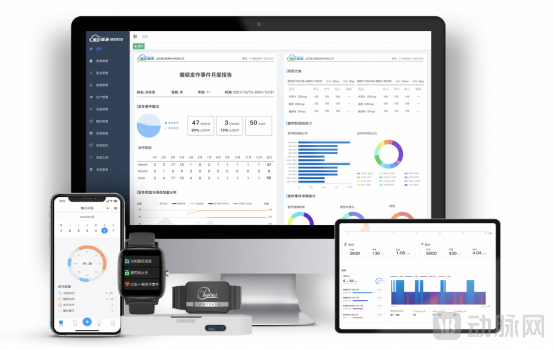
Biovital Epilepsy Wristwatch
Among them, the advantages of Biovital Epilepsy Wristwatch are reflected in two aspects.
In terms of hardware, the more modal signals a wearable device can synchronously collect, the greater the technical difficulty. WECARE MEDICAL is currently capable of achieving this.Seven modalities synchronized acquisition, the richest modality signals among similar products globally and the only one in China.On the other hand, signal quality is crucial for the accuracy of application algorithms such as those used for epilepsy. WECARE MEDICAL has conducted consistency analyses between dynamic pulse rate collected on the wrist and Holter monitoring, as well as between skin temperature and core body temperature. Comparisons of skin electrical signals collected on the wrist with professional equipment have also demonstrated high accuracy.
In terms of software, a large number of algorithms are used to extract patterns from signals. The model construction usually takes 2-3 years, with time and complexity as barriers. WECARE MEDICAL has currently accumulated...Basic Vital Signs Model(Including respiration, heart rate, heart rate variability, body temperature, blood oxygen, etc.),Daily Activity Model(Activity, Sleep, Emotion Indicators),Specialized Disease Model(Three major model systems: epilepsy, Parkinson's disease, sleep disorders, etc.)
According to Sheng Duozheng, there are currently various technologies on the market with epilepsy monitoring functions, including intracranial EEG, scalp EEG, wrist multimodal signal solutions, and more. Considering characteristics such as non-invasiveness, accuracy, ease of use, convenience, patient acceptance, and reducing patient stigma, he believes that wristband monitoring devices are the best choice for continuous dynamic monitoring of patients' daily lives in clinical settings. Additionally, to improve patient compliance while benefiting them during wear, the device also provides services such as sleep monitoring, activity evaluation, and mood monitoring. From the perspective of user experience, the size and power consumption of the smartwatch have been continuously optimized. The entire device is known to be the smallest wrist multimodal signal acquisition device in China; it has a battery life of 20 hours and can be fully charged in 1 hour. The watch adopts a curved electrode design, significantly improving wearing comfort and reducing skin rejection reactions.
The company has obtained 8 invention patents, and another 10 core patents are in the process of application.
On June 26 this year, Professor Yu Tao from Xuanwu Hospital of Capital Medical University and Sheng Duozheng, founder of WECARE MEDICAL, officially released the "China Epilepsy Digital Phenotype 1.0 Project" on behalf of the China Association Against Epilepsy. The project is based on a series of clinical studies of epilepsy digital phenotypes, aiming to build a comprehensive, objective, and dynamic epilepsy digital phenotype data platform to provide high-quality data support for disease prevention, clinical diagnosis and treatment, scientific research, and epidemiological investigations.[1]
China Epilepsy Digital Phenotype 1.0 Project WillFor Epilepsy Doctors in China, and carry out extensive cooperation in data collection, data analysis, clinical application and academic exchange, etc. The first phase plans to enroll10,000Epilepsy patients of different ages, etiologies, and classifications are monitored through wearable out-of-hospital epilepsy monitoring devices and an integrated information system. This setup collects digital phenotypic data such as out-of-hospital seizure symptoms, basic vital signs, treatment plans, and prognosis for enrolled patients. It aims to address clinical issues like daily monitoring, symptom quantification, and improving treatment adherence, ultimately enhancing the diagnosis and treatment of epilepsy.

China Association Against Epilepsy Partners with WECARE MEDICAL for Strategic Cooperation in Digital Field
At the same time, WECARE MEDICAL is also conducting byXuanwu HospitalLead,Tiantan Hospital, Beijing Children's Hospital, 301 Hospital, First Affiliated Hospital of Jiaotong University...and other centers participating in scientific research clinical trials. Currently, the Biovital watchCompleted the first phase of clinical trials for efficacy validation`, and will carry out with`China Association Against EpilepsyThe collaborative project is preparing to draft the Chinese Expert Consensus on Out-of-Hospital Monitoring for Epilepsy.The product is expected to be approved for marketing in 2023.
In terms of business model, the payment model for similar products abroad is "selling watches + monthly subscription based on the number of functions and the number of caregivers needed to be notified." For example, monitoring services require a monthly subscription. The basic fee is $9.9/month, which includes seizure detection, sleep and physical activity monitoring, and allows binding to one alarm service recipient; $19.9/month adds minor seizure detection, GPS alerts to guardians, and limits the number of bindings; $44.9/month allows unlimited caregivers to be bound.
WECARE MEDICAL has made adjustments based on the situation in China. The Biovital epilepsy smartwatch can be linked to 10 guardians for free, and its main sources of revenue are hardware sales, service annual fees, and subsequentProvide patients with one-stop diagnosis and treatment service packages based on efficacy, and offer digital services to B-end clients such as pharmaceutical and medical device companies and insurance companies.
At the technical product level, the company will continue to refine the epilepsy monitoring wristwatch, maintaining"Sales Generation, R&D Generation, Pre-research Generation"The leading rhythm is also attempting to make relevant monitoring technologies feasible.Migration to Other FieldsInitiate the Second and Third Growth Curves. The company has currently collaborated with a renowned expert team from the National Clinical Research Center for Neurological Diseases to develop a Parkinson's disease monitoring wristwatch. This device quantitatively evaluates symptoms such as bradykinesia, dyskinesia, and tremors outside the hospital setting, generating quantitative assessment reports. These reports provide precise diagnostic and therapeutic evidence for medication adjustment, regulated treatment, and daily rehabilitation of Parkinson's disease.
In terms of financing, in 2021, WECARE MEDICAL completed an angel round of financing worth several million yuan led by Leading Health. The company is currently seeking a new round of financing.
Reference: "Official Release of China Epilepsy Digital Phenotype 1.0 Project"