

Higher Daily Insulin Dose Linked to Increased Cancer Risk in Type 1 Diabetes Patients, JAMA Oncology Study Reveals

Merck Group
Pharmaceutical R&D Developer

OhioHealth Castrop Health Center
OhioHealth Castrop Health Center provides radiation oncology, medical oncology, cancer care, and infusion services. The cancer care team at OhioHealth Castrop Health Center collaborates with the broader OhioHealth Cancer Care team—a multidisciplinary group of expert physicians and nurses—to deliver the most comprehensive cancer care. We have dedicated cancer specialists, oncology-trained nurses, and patient navigators who specialize in addressing the unique needs of cancer patients; state-of-the-art linear accelerators (LINACs) that are customized to each patient’s individual cancer treatment plan; and shared waiting areas and a resource center for cancer patients.
Ohio University
Ohio University, located in the state of Ohio, United States, was founded in 1804. With a history spanning nearly two centuries, it is the first university in Ohio and the earliest institution of higher learning established in the Old Northwest Territory of the United States. Ohio University comprises the College of Arts and Sciences, the College of Business, the College of Education, the College of Fine Arts, the College of Health Sciences and Professions, and the Heritage College of Osteopathic Medicine, among others. The university offers undergraduate, master’s, and doctoral programs. Undergraduate majors include Accounting, Anthropology, Biology, Business Administration, Business Economics, Chemistry, Civil Engineering, Classics, Communication Studies, Computer Science, Criminal Justice, Dance, French, Film Studies, International Trade, and Information and Telecommunications Systems. Master’s programs include Applied Economics, Art History, Biological Sciences, Composition, Counseling, Educational Administration, Early Childhood Education, Film Production, History, Journalism, Neuroscience, and Nursing Administration. Doctoral programs include Audiology, Biological Sciences, Chemistry, Civil Engineering, Clinical Psychology, Counselor Education, English and British Literature, and Environmental and Plant Biology. According to U.S. publications, Ohio University is recognized as one of the top public universities in the United States.
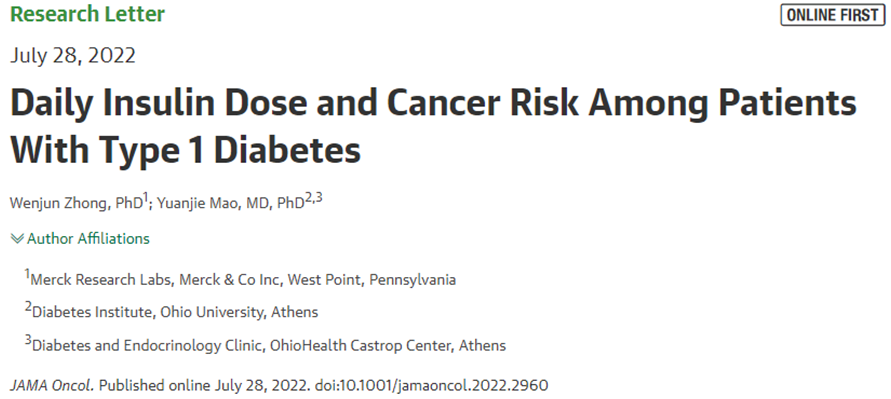
In a new study, researchers from Ohio University, OhioHealth Kettering Medical Center, and Merck Research Laboratories investigated Type 1DiabetesCorrelation between patients' daily insulin dose and cancer incidence (new cases), finding that higher daily insulin doses are positively correlated with cancer incidence, especially in those with insulin resistance.Type 1 DiabetesThis association was stronger among patients. The relevant research findings were published online on July 28, 2022, inJAMAIn the Oncology journal, the paper title is "Daily Insulin Dose and Cancer Risk Among Patients With Type 1 Diabetes".
"The traditional metabolic factors, such as obesity (represented by body mass index), glucose control (represented by hemoglobin A1c), and blood pressure control, were not associated with cancer incidence in patients with type 1 diabetes, according to our findings," said Dr. Yuanjie Mao of Ohio University, the corresponding author of the paper. "However, patients using higher doses of insulin had a higher incidence of cancer. Our results suggest that clinicians may need to balance the potential cancer risk when treating type 1 diabetes patients with high daily doses of insulin, or improving insulin sensitivity may be preferable to simply increasing insulin dosage."
For this new study, Mao collaborated with Dr. Wenjun Zhong, an epidemiologist at Merck Research Laboratories in Pennsylvania, to analyze over 50 common risk factors—such as smoking, alcohol consumption, exercise, metabolic risk factors, medication use, and family history—in 1,303 patients with type 1 diabetes for associations with cancer incidence. The data was collected over 28 years. They sourced the information from the U.S. National Diabetes,DigestionThe Central Database of the Kidney Disease Research Institute obtained data from the Diabetes Control and Complications Trial (DCCT) and its follow-up Epidemiology of Diabetes Interventions and Complications (EDIC) study, and conductedStatisticsAnalysis. The DCCT was a controlled clinical trial involving 1,441 patients with type 1 diabetes, who were randomly assigned to receive either conventional diabetes treatment or intensive treatment, to assess whether reducing hyperglycemia could lower the risk of complications in type 1 diabetes.
Mao also found that, when evaluated separately, age and gender were associated with cancer incidence, and daily insulin dose posed a higher cancer risk than age, especially at higher insulin doses.
According to this paper, when the daily insulin dose is divided into three groups: low-dose group: less than 0.5 U/kg per day; medium-dose group: greater than or equal to 0.5 U/kg and less than 0.8 U/kg per day; high-dose group: greater than or equal to 0.8 U/kg per day; compared with the low-dose group, the high-dose group has a significantly higher hazard ratio. The cancer incidence rates in the low-dose group, medium-dose group, and high-dose group are 2.11/1000 people, 2.87/1000 people, and 2.91/1000 people, respectively.
He continued to explain that, specifically, the risk is higher for women than for men; however, it is currently unclear what risk factors may lead to a higher incidence of cancer in individuals with type 1 diabetes.
U.S. National Diabetes,Digestion"And the co-director of the Kidney Disease Institute, Dr. Liz Beverly, said, 'We know that compared to people without diabetes, the incidence of cancer is higher in patients with type 1 diabetes. Dr. Mao’s research has identified a potential mechanism explaining this association. His findings will lead to ongoing research in this field, as well as in cancer.'"Screening"And potential policy changes in insulin dosing recommendations."
Although previous studies have concluded that people with diabetes generally have a higher risk of cancer, this is the first study to explore the related cancer incidence factors in type 1 diabetes.
Mao explained, "Type 1 diabetes is estimated to account for 5% to 10% of all diabetes cases. Recent research on type 1 diabetes has also found that, compared with the general population, individuals with type 1 diabetes face increased risks in areas such as...Gastric Cancer, Liver Cancer,Pancreatic CancerEndometrial cancer and kidney cancer, among others, have a higher incidence rate. In type 2 diabetes, the increased risk of cancer is attributed to metabolic factors such as obesity, chronic inflammatory conditions, and insulin resistance."
Although the findings of this new study suggest that higher doses of insulin are associated with a higher incidence of cancer, Mao says further research is still needed.BioValley Bioon.com)
References:
Wenjun Zhong et al. Daily Insulin Dose and Cancer Risk Among Patients With Type 1 Diabetes. JAMA Oncology, 2022, doi:10.1001/jamaoncol.2022.2960.