

Tessa Therapeutics Advances Three CD30-Targeted Cell Therapy Platforms with Over $120M Backing from Leading Investors

Temasek
Investment Company

Polaris Partners
Venture Capital Firms in Digital Media, Life Sciences, and Enterprise Software

Tessa Therapeutics
Solid Tumor T Cell Immunotherapy Developer
On June 5, 2022, Singapore-based cell therapy company Tessa Therapeutics (hereinafter referred to as Tessa) announced the completion of a US$126 million Series A financing round.This financing was led byPolaris PartnersLed by Polaris Partners, with Temasek, EDBI, Heliconia Capital, and Heritas Capital following suit. Meanwhile, Amy Schulman and Darren Carroll, Managing Partners of Polaris Partners, have joined the board of directors of Tessa Therapeutics.
Securing hundreds of millions in financing from major healthcare investors marks an important milestone for Tessa's recent development, based on the positive performance of its CAR-T therapy Phase 2 clinical trial results. Prior to this,Tessa Therapeutics also completed a US$130 million financing round in 2018 led by Temasek Holdings, with participation from investors including EDBI, Karst Peak Capital, Heliconia, and Heritas., which will be mainly used for the construction of the company's Virus-Specific T-cell (VST) platform and the advancement of its clinical trials.
In the cell therapy market with high technical barriers and accelerating competition, what core competitiveness does Tessa possess to continuously secure hundreds of millions of investments from two large investment institutions within a few years?
Tessa Therapeutics is developing a series of next-generation cell therapies for cancer.
Immune Cell Therapy TechnologyIt involves collecting the patient's own immune cells, culturing them in vitro to expand their numbers and enhance their targeted killing function, and then reintroducing them into the patient's body to eliminate pathogens, cancer cells, and mutated cells in the blood and tissues.Chimeric Antigen Receptor T cell (CAR-T) TherapyRecently attracted widespread attention in the scientific community and clinical applications.
CAR-T is considered one of the major breakthroughs in the field of cancer immunotherapy in recent years, demonstrating significant advantages in the treatment of hematologic malignancies. HoweverThe current technology also has certain limitations.:Autologous CAR-T TherapyFacing issues such as time costs, manufacturing success rates, cell potency, and production costs;Allogeneic CAR-TTherapy faces challenges of graft-versus-host disease (GvHD) and T-cell persistence in patients.
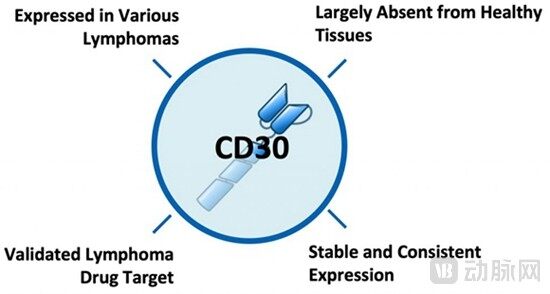
CD30 is a transmembrane protein that is essentially absent in healthy tissues.It is fully validated.Lymphoma Target, in multiple subgroups of classical Hodgkin lymphoma and non-Hodgkin lymphomaStable and Consistent Expression, even after CD30-targeted treatment and re-treatmentEffective even in cases of drug resistance or recurrence. Moreover, CD30 is only expressed on activated T cells and B cells, making targeting this antigenUnlikely to have significant off-target related adverse reactions. More importantly, preclinical data show that CD30 targeting helps activate T cells, therebyImprove Cell Expansion and Persistence。
Tessa Therapeutics is conducting clinical trials of the TT11 CD30-CAR-T therapy through its self-developed CD30-CAR-T platform, primarily targeting classical Hodgkin lymphoma (cHL) and non-Hodgkin lymphoma.The therapy adoptsAutologous Cell Therapy, by designing CD30-targeted CAR-T cells to specifically kill CD30-positive HL cell lines 1-2.Baylor College of Medicine(Study ID: NCT02917083) andUniversity of North Carolina(Trial Number: NCT02690545) Two independent Phase I/II studies of CD30-CAR cells in patients with relapsed or refractory CD30-positive Hodgkin lymphoma demonstrated that TT11 CD30-CAR T cells exhibited favorable efficacy and a low toxicity profile in heavily pretreated Hodgkin lymphoma patients.
Virus-specific T cells (VSTs) are highly specialized T cells produced during viral infections.These cells have the abilityIdentify and kill infected cells, simultaneouslyActivate other parts of the immune system to coordinate a response. Early experiments have shown that allogeneic VSTs without genetic modification possessGood safety and efficacy, and demonstratedVery low incidence of severe rejection reactions such as GvHD。
Utilizing the precise targeting of CD30 on lymphoma, the enhancement of cell expansion and persistence, and the risk of VSTs on GvHD, afterScientific Co-founder Dr. Malcolm Brenner and his Baylor College of Medicine teamDecades of research and development on the properties of virus-specific T cells (VSTs),Tessa Therapeutics Builds CD30-CAR-VSTs Treatment Platform. The platform is able to achieve precise targeting,To date, Tessa has successfully manufactured and delivered more than 150 VST therapies in Phase III clinical trials.

Scientific Co-founder and Scientific Advisor Malcolm Brenner, Ph.D.
Currently,Tessa Enhances Epstein-Barr Virus-Specific T Cells (EBVSTs) with CD30-CAR Technology, Improving VST Cell Persistence and ExpansionCurrently, Tessa is collaborating with Baylor College of Medicine to evaluate this technology in a Phase I clinical trial in the United States.
Current CAR-T cell therapy has achieved limited clinical success in solid tumor patients.Some aspects of CAR-T cell therapy for solid tumorsObstacleIncluding: Heterogeneity in cancer antigen expression in solid tumors leads to the growth of escape variants; low-level expression of tumor antigens in organs results in off-target tumor activity; physical barriers that restrict immune cell access; and the development of an immunosuppressive microenvironment, among others. Tessa Therapeutics believes that CAR-T cell therapy for solid tumors urgently needs transformative innovation.
Tessa's Solid Tumor Targeted Therapy
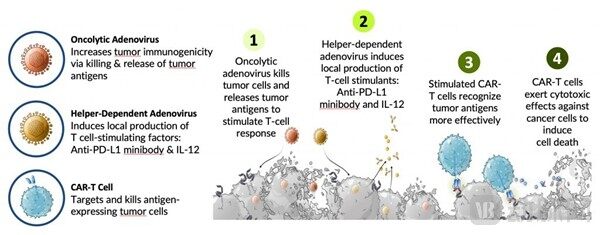
Tessa's approach to overcoming the challenges of applying CAR-T cells in solid tumors isCombining CAR-T Cells with Binary Oncolytic Virus Therapy. This therapy is administered in two steps,First, an adenovirus composed of oncolytic viruses and helper adenoviruses is locally applied to the tumor, followed by systemic infusion of tumor antigen-targeted CAR-T cells.。Tumor Virus Directly Kills Tumor Cells, meanwhileGenerate an inflammatory tumor microenvironment, LetCAR-T Cells More Prone to "Infiltration"CAR-T cells begin the second round of tumor killing after entering.
Tessa Therapeutics collaborates with Baylor College of Medicine to combine HER2-CAR-T cell therapy with binary oncolytic virus treatment, targeting ER2-positive solid tumors, with its Phase I clinical trial conducted in the United States.
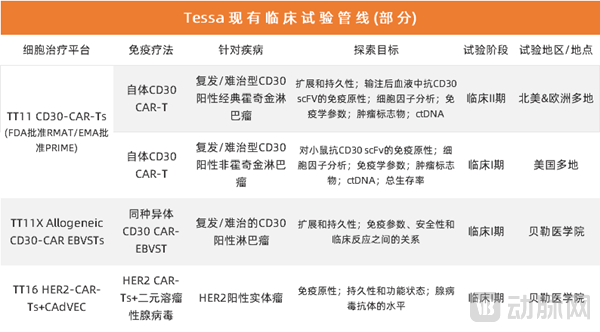
Clinical Pipelines Involved in Tessa's Three Cell Therapy Platforms
Tessa is headquartered in Singapore,Boasting Asia's top cell therapy manufacturing facility, spanning 134,000 square feet. It possesses comprehensive cell therapy processing technology, analytical testing capabilities, process/analytical development, training facilities, and an IT GxP platform,Capable of supporting Tessa's autologous and allogeneic cell and gene therapy products in clinical trials and commercial production.。In view of its excellent technical research capabilities and production manufacturing standards, Tessa Therapeutics has gainedBaylor College of Medicine、University of North Carolina、St. Jude Children's Research Hospital、National Cancer Centre Singapore、Singapore Institute of Science and Technology (IMCB)And a series of strategic partners.
Next,Tessa will use the funds from this financing to continue advancing the clinical development of its autologous TT11 CD30-CAR-T therapy and allogeneic TT11X-CD30-CAR-EBVST therapy.,Related clinical consumables will be manufactured in the cGMP facility that has just completed commercial approval.
As a popular track in cell therapy, CAR-T has attracted many companies both in and outside China. According to statistics from the VCBeat database,Currently, there are five CAR-T cell products targeting CD19 approved for marketing globally.They are Kymriah from Novartis, Breyanzi from Juno Therapeutics, Tecartus and Yescarta from Gilead Sciences, and Relma-cel Injection from JW Therapeutics.All are used for the treatment of lymphoma.。Currently, the R&D pipeline in the CAR-T field almost occupies half of the entire immune cell therapy pipeline.Among them, the CD19 target is the most popular, with a relatively concentrated distribution of indications, and a trend of crowded tracks has already appeared.
Tessa's current clinical development is mainly focused on lymphoma,The next phase will involve the development of an allogeneic CD30-CAR-VSTs platform for the treatment of multiple cancer types., in response to the fierce competition on the track.