

SinoVasc Medical's Intracardiac Echocardiography (ICE) System Completes Domestic Animal Trials and Enters Clinical Study Phase

SONOSEMI
Active Vascular Implantable and Interventional Medical Device R&D and Manufacturer
Recently,Sonosemi Medical Co., Ltd. (hereinafter referred to as "SONOSEMI") successfully completed animal experiments in China for its independently developed intracardiac echocardiography (ICE) system. The experimental results demonstrated good device safety and image function effectiveness.The intracardiac echocardiography (ICE) system consists of the UDG3900 color Doppler ultrasound diagnostic instrument and the DynaSight 2D single-use intracardiac echocardiography catheter. It is suitable for intracardiac and large vessel lumen imaging, as well as ultrasound imaging of other devices within the heart.
This animal experiment selected ordinary white pigs as the research model, and the study content covered test items related to functional evaluation and safety evaluation. In terms of functional evaluation, more than a dozen image sections were successfully obtained according to the operation process, and color flow and spectral images were collected for the valves, with the relevant images showing excellent clarity; the surgical procedure for a single animal took about 35 minutes, which was efficient and concise in operation. The catheter demonstrated good pushability, bending adjustment, and withdrawal capabilities, receiving recognition from well-known interventional experts.
The successful implementation of this animal experiment marks that SONOSEMI's intracardiac echocardiography (ICE) system has successfully completed the design finalization and preclinical research and validation, and has officially entered the clinical research stage.
SONOSEMI's breakthrough progress in this field fills the technical gap in China's intracardiac ultrasound imaging sector, and will further promote the widespread application of this technology in related cavity treatment areas such as arrhythmia and structural heart disease, continuously enhancing clinical benefits and creating value for a wide range of medical professionals and patients.
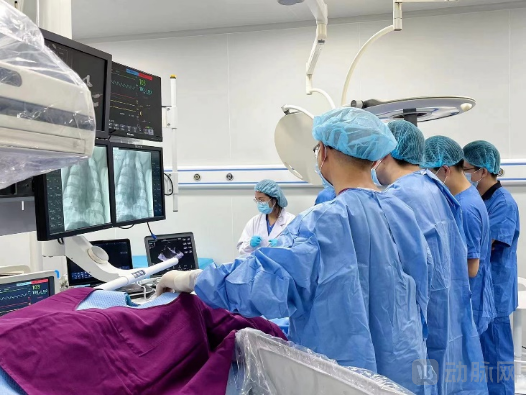
Intracardiac Echocardiography (ICE) is a vascular interventional ultrasound imaging technology that integrates phased-array ultrasound imaging with cardiac catheterization.
SONOSEMI's Intracardiac Echocardiography (ICE) System Adopts Steerable Catheter Solution, the miniature ultrasound probe is installed at the end of the catheter. After local anesthesia is administered to the patient, it is delivered through the femoral vein approach into the patient's heart chambers. Not limited by the imaging window, the spatial position and imaging angle of the miniature ultrasound probe can be flexibly adjusted. It provides direct visualization of anatomical structures such as the fossa ovalis, left atrial appendage, left and right atria, and ventricles. It can also guide and position implantable devices like occluders, ablation catheters, and ventricular assist devices. Additionally, it can measure physiological features such as blood flow, thrombus, and pericardial effusion, thereby enabling intraoperative safety monitoring and postoperative effect evaluation for surgeries like atrial fibrillation radiofrequency ablation, patent foramen ovale closure, left atrial appendage closure, and valve repair or replacement.
As the prevalence of arrhythmia and structural heart disease continues to rise in China, the volume of intracavitary interventional procedures is gradually increasing. Significant changes are occurring in the selection of clinical treatment strategies and technical solutions. The rapidly growing market demand urgently calls for more precise, safer, and more efficient interventional treatment strategies. This industry trend has created favorable conditions for the clinical adoption and widespread application of intracardiac echocardiography (ICE).
For example, in the traditional field of cardiac electrophysiology, the existing three-dimensional mapping systems not only have limited perspectives and cannot intuitively display the internal anatomical structure of the heart and its adjacent relationships, but also fail to effectively guide atrial septal puncture or directly show the contact between catheters, electrodes, and the heart. This leads to a significant increase in the use of X-rays and contrast agents by clinicians during procedures. Meanwhile, if transesophageal echocardiography (TEE) is applied to monitor complications such as hematomas, thrombosis, or pericardial effusion that may occur during surgery, general anesthesia is required for the patient. This poses higher demands on the collaboration between departments like electrophysiology, anesthesiology, and ultrasound, which objectively constrains the development of interventional treatments for arrhythmias to a certain extent.
The application of intracardiac echocardiography (ICE) as an alternative to transesophageal echocardiography (TEE) can better address the issues in interventional treatment areas such as cardiac electrophysiology and structural heart disease. Interventional procedures guided by ICE, including atrial fibrillation radiofrequency ablation, atrial septal puncture, left atrial appendage closure, and PFO foramen ovale closure, represent a green procedure.Not only can it assist clinical doctors in performing intracavitary interventional surgeries more accurately, but it also reduces the need for coordination with anesthesiology and ultrasound departments, further shortening operation time and significantly decreasing the use of X-rays and contrast agents.
We believe that, as a technological innovation representative of green electrophysiology and green structural heart, ICE will not only become the most important tool in cardiac electrophysiology but also further redefine the treatment standards for structural heart disease and arrhythmia, driving interventional procedures toward safer, more efficient, and more streamlined directions.
According to the "Report on Cardiovascular Health and Diseases in China 2021," there are currently about 20 million patients with arrhythmia and 30 million cases of structural heart disease in China, with the prevalence rate continuously rising, leading to an increasing demand for treatment.
Considering the large number of patients and increasingly complex clinical application scenarios, how to improve the accuracy of intraoperative guidance and monitoring technologies, further reduce surgical risks, increase surgical success rates, and provide better clinical benefits for both doctors and patients, is the most serious and urgent problem currently faced by the cardiovascular industry.This latent demand will drive and even accelerate the popularization and promotion of ICE technology in the fields of cardiac electrophysiology and interventional treatment for structural heart disease.
On the other hand,Since there are currently no domestically produced ICE products approved for marketing in China, domestic cardiac electrophysiology manufacturers and industrial capital are actively positioning themselves in this product sector. However, there is a lack of cooperation and coordination among companies in the industry, resulting in severe homogenization competition.
SONOSEMI's self-developed ICE product has officially entered the clinical trial stage, and it is expected to become the first domestically produced intracardiac ultrasound product with independent intellectual property rights to be launched in China. SONOSEMI is not a cardiac electrophysiology manufacturer and has no intention of entering this field. Therefore, SONOSEMI will use intracardiac echocardiography (ICE) technology as a shared platform, looking forward to collaborating with domestic cardiac electrophysiology companies for innovative cooperation, jointly committed to enhancing the market competitiveness of comprehensive solutions for China-produced cardiac electrophysiology.
About SONOSEMI
SONOSEMI, founded in 2020, is a provider and leader of active pan-vascular precision diagnosis and treatment solutions in China, dedicated to serving human health with intelligent technology.
In 2022, the coronary and peripheral arterial intravascular shockwave lithotripsy (ISL) systems independently developed by the company successively entered the clinical trial stage. The intracardiac echocardiography (ICE) system is the third active vascular interventional medical device product from SONOSEMI to enter the clinical trial stage. SONOSEMI will continue to focus on active vascular implantation and interventional diagnostic and therapeutic technologies, maintain continuous technological innovation, promote the large-scale application of active vascular implantable and interventional devices in the healthcare field, consistently create value for doctors and patients, and serve as an enabler of intelligent healthcare.