

Hangzhou Huamai Medical Advances Three Class III Regenerative Medicine Devices into Pivotal Clinical Trials, Emerging as a Dark Horse in the Field

Huamai Medical
Provider of Human Musculoskeletal Tissue Defect Repair Solutions
This year, for Hangzhou Huamai Medical Devices Co., Ltd. (hereinafter referred to as "Huamai Medical" or "the Company"), good news keeps coming. The company not only received investment from Shenzhen Capital Group, but also since the launch of its first product last year...Trauma Bone Repair Materials"Since completing patient enrollment in the clinical trial, the first clinical trial has finished follow-up and is expected to submit a Class III medical device product registration application within the year."
At the same time, the company has independently developed a number of products positioned as best-in-class, such as "Spinal Fusion Materials", and "Oral Repair Membrane Materials", which has successively achieved multi-center clinical enrollment this year, with the clinical trials of multi-pipeline products proceeding smoothly. The company's bioactive matrix materials platform is initially taking shape."
Huamai Medical has made breakthroughs in the regenerative medicine industry at an extremely fast pace.Shenzhen Capital Group believes"Huamai Medical's rapid breakthrough in the emerging field of 'regenerative medicine' is actually traceable. In the early days of its establishment, the company won first place in the 'Hangzhou Maker World Competition.' By its third year, it received funding from the National Key R&D Program of the Ministry of Science and Technology. This time, Huamai Medical’s rapid development was expected. We believe that based on the company's advanced bioactive matrix material platform and innovative R&D capabilities, Huamai Medical will undoubtedly expand the application scope of regenerative medicine in the near future and achieve innovative leadership."
Tissue or organ defect repair and functional reconstruction have always been significant research topics in the medical field. In recent years, not only have various provinces issued numerous favorable policies to boost the development of this field, but the state has also introduced relevant guiding policies to promote breakthroughs in key material technologies such as biomaterials and organ repair, accelerating the implementation of related innovative projects. By enhancing the supply capacity of medical equipment in China, the technological support for major disease prevention and health industry development is strengthened.
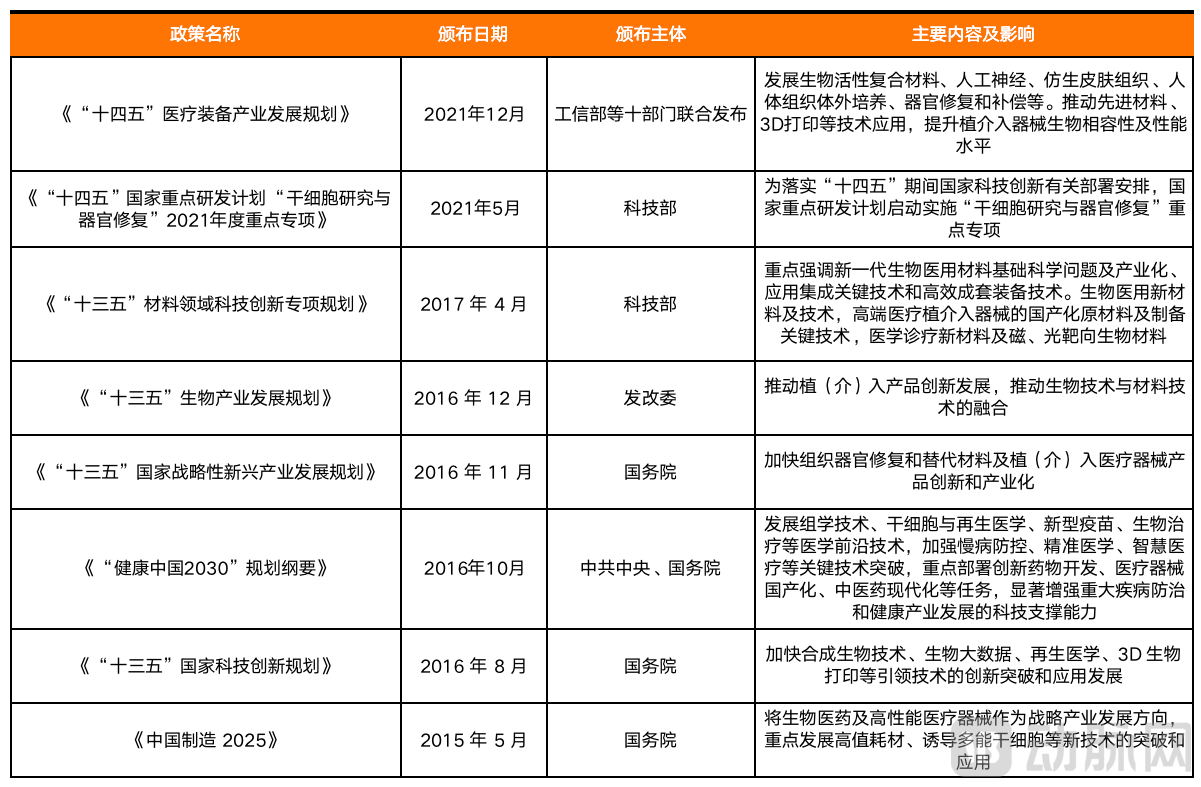
Policies Related to Some Innovative Implantable Devices
The market in China has also started to focus on this field. Huamai Medical is one of the fastest-growing companies in this area.The enterprise achieved rapid product iteration within five years and successfully advanced multiple product clinical enrollments/clinical trials, as well as the establishment of a bioactive matrix platform.
Reviewing the journey of Huamai Medical, the rapid development it has achieved can be attributed by its founder, Jiang Tao, to the deep collaboration between the team and clinical partners, as well as the team's accumulation of data and experience in scientific research and product development. He believes that only by achieving technological innovation with sufficient focus and professionalism can a company drive its growth through innovation.
It is reported that Huamai Medical initially chose to focus on the repair materials for segmental bone defects, an area with scarce clinical solutions and the most challenging demands, as their entry point.Based on years of innovative research and development, a bone regenerative medical material with excellent osteogenic performance has been successfully developed.
Its advanced bone regenerative medical materials are based on natural bioactive matrices, containing collagen molecules that preserve the natural triple-helix structure and various signaling factors required for cell behavior. These materials exhibit excellent osteoconductivity and bioactivity, enabling rapid repair of large-area bone defect tissues and addressing key challenges in the clinical field of bone regeneration.
After the high barrier problem was solved,Huamai Medical, building on the accumulation of research data and focusing on technological innovation, has developed a bioactive matrix material platform. It has launched a series of regenerative medicine products based on biomaterials for the regeneration of various soft tissues, hard tissues, and interface tissues in the human body, extending its core technology to multiple clinical application fields such as trauma, spine, joints, oral, sports medicine, and diabetic foot., committed to developing a series of best-in-class or first-in-class regenerative medicine products. By building a bioactive matrix platform, continuously securing a foothold at the entrance of the major acute and chronic disease diagnosis and treatment market, further achieving the industrialization and domestic production of core technologies and related products, and breaking through a series of "chokepoint" technologies.
Huamai Medical is precisely leveraging this strategic approach to grant the company flexibility in its development. With the capability to build a biomaterials platform, the company can continuously make strategic adjustments based on various unmet clinical needs, regulatory policies, and market changes. It can also design its product pipeline in a targeted manner to address challenges such as the normalization of centralized procurement, unmet clinical needs, and gaps in the market for essential products, achieving "innovation leadership."
Currently, the company continues to establish partnerships with medical institutions and, through clinical collaborations, gain an in-depth understanding of clinical needs to promote new product development. This also serves as a foundation for building long-term trust-based relationships with hospitals.
There are not many tracks with long slopes and deep snow, but regenerative medicine is one of them.
According to data from the market research firm Verified Market Research, the global regenerative medicine market size was only about $27.7 billion in 2020, but this figure is expected to reach $149.8 billion by 2028, with the growth rate continuing to increase.
From the definition, regenerative medicine refers to therapeutic approaches that replace, repair, or regenerate human cells, tissues, or organs to reconstruct or enhance physiological functions. Although stem cell-based regenerative medicine products have been widely applied in treatment areas such as bone marrow transplantation, age-related macular degeneration, neurodegenerative diseases, and type 1 diabetes.
But data from the U.S. Clinical Trials Registry shows that, as of March 24, 2022, there were 6,136 clinical trials related to stem cells in the United States, of which 2,624 had already been completed. Data from the Center for Drug Evaluation of the National Medical Products Administration shows that China currently has 19 stem cell therapies that have obtained clinical approval, including 18 types of mesenchymal stem cell therapies and one type of epithelial stem cell therapy.
Visible,Although the market for regenerative medicine in China is starting to gain momentum, the development of tissue engineering and regenerative medicine in China remains relatively lagging.
Jiang Tao believes that the industry needs both innovation and implementation. In the face of this situation, enterprises must remain focused and carry out fundamental clinical research work in the field of regenerative medicine. By closely integrating basic research with clinical practice, the transformation of scientific research achievements can be completed, continuously enriching their own product pipelines. This allows more innovative ideas, technologies, and achievements to be truly applied to clinical treatment, addressing critical clinical needs.
In the research and development of innovative technologies and the transformation of achievements, Jiang Tao has profound experience.It is reported that he graduated from Tsinghua University with a bachelor's and master's degree in polymer materials, and later studied in the United States, obtaining a Ph.D. in biomaterials from the University of Virginia and an MBA from the University of Chicago Booth School of Business. During his Ph.D., Jiang Tao worked under Professor Cato T. Laurencin, a member of the U.S. National Academy of Sciences, Engineering, and Medicine, as well as a foreign academician of the Chinese Academy of Engineering, focusing on bone biomaterials research. After graduation, Jiang Tao joined Zimmer Biomet, a global orthopedic giant, deeply engaging in the R&D and FDA approval of multiple orthopedic and sports medicine products related to tissue regeneration, such as bone, cartilage, and ligaments, successfully transitioning from academia to industry.
After leaving Zimmer Biomet, Jiang Tao focused on bone tissue engineering, advanced biomaterials, stem cells, and nanomedicine as his main research directions and served as an assistant professor at the University of Connecticut Medical Center. Based on the research platform provided by the institution and integrating his understanding of academia, industry, and clinical practice, Jiang Tao continued to conduct independent innovative research and development on the research platform, optimizing products to maintain their innovation while closely aligning with clinical applications. To date, Jiang Tao has published over 30 academic papers, with citations exceeding 2,200 times.
Speaking of the three experiences, Jiang Tao said"Innovative academic ideas are somewhat distant from actual products, and this gap may lead to difficulties in product development. The transition from academia to industry has given me a better grasp of this distance. During the actual product development process, I prioritize the feasibility of ideas. Meanwhile, my deep involvement in the FDA approval process at Zimmer Biomet has enhanced my understanding of the development direction and procedures for material-based regenerative medicine products, as well as how to manage the specific processes from idea conception to final product implementation."
Currently, with Jiang Tao's accumulation in innovative technology research and development, along with the core R&D team's expertise in regenerative medicine, biomaterials, and tissue engineering,The company's core material platform-related innovations have been granted 11 authorized invention patents and 5 authorized utility model patents. Several invention patents have also received patent authorization from countries and regions such as the United States, Japan, and the European Union, laying a solid foundation for the international expansion of future products.
For the regenerative medicine track or any other track, innovation is inevitably the key to the upgrading and transformation of the medical industry.
In recent years, the state has paid high attention to the innovative development in the medical field. Both the national innovation-driven development strategy and the Healthy China strategy clearly point towards innovation as the direction of development.
From the perspective of industrial development, China currently faces pain points such as uneven distribution of medical resources, a lack of medical resources in remote areas, and a large amount of unmet medical demand. Technological innovation can not only address challenges in disease screening, diagnosis, and treatment but also further improve the efficiency of disease diagnosis and treatment. Through technological innovation, these issues can be further resolved while seizing market opportunities.
Huamai Medical has rapidly developed by virtue of its dedication to innovative technologies and continuous innovation in the field of tissue repair and regenerative medicine materials.Established for just over five years, it has secured multiple rounds of financing.
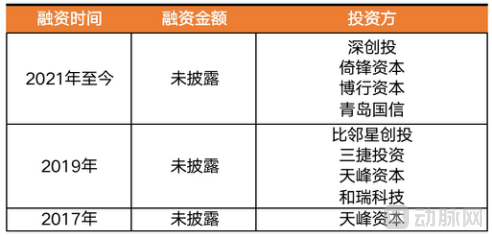
Huamai Medical Historical Financing Situation
In this regard, Shenzhen Capital Group, the Pre-B round investor of Huamai Medical, believes"Huamai Medical boasts a leading innovative team, solid technological content, and a robust product pipeline, with products closely aligned with unmet clinical needs. The technical barriers in the regenerative medicine sector are high, but Huamai Medical has a first-mover advantage and continues to steadily advance the development and clinical application of new products. Shenzhen Capital Group will continue to support the company’s long-term positive growth and contribute to the high-quality Chinese innovation in biomaterials."
It is reported that Huamai Medical has a financing plan recently. The funds will be mainly used for a new round of product development, clinical research, factory expansion, and commercialization promotion.
Reference Article:
Research Progress and Regulatory Status of Stem Cell-Based Regenerative Medicine Products
"Regenerative Medicine: The Ship Sailing Towards Immortality" — Guokr