

Nat Metab: GLP-1-Conjugated Tesaglitazar Shows Promise for More Effective Type 2 Diabetes Treatment

Novo Nordisk
Insulin Developer and Manufacturer
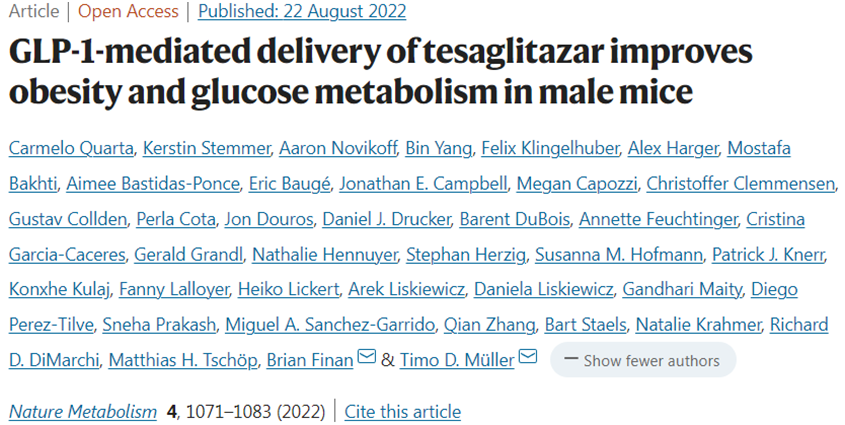
In a new study, from GermanyDiabetesResearchers from the German Center for Diabetes Research (DZD), Helmholtz Munich, and Novo Nordisk A/S have developed a new hormone combination for the future treatment of type 2 diabetes. They combined the glucose-lowering effects of tesaglitazar and glucagon-like peptide-1 (GLP-1) into a novel and highly effective drug. The advantage is that by combining tesaglitazar with GLP-1, tesaglitazar only enters tissues containing GLP-1 receptors. This reduces the side effects of tesaglitazar while enhancing its impact on glucose metabolism. This new drug has been successfully tested in animal studies. The relevant findings were published online in the journal Nature Metabolism on August 22, 2022, under the title “GLP-1-mediated delivery of tesaglitazar improves obesity and glucose metabolism in male mice.”
Tiglic acid improves glucose metabolism and lipid metabolism in patients with type 2 diabetes. It acts on two receptors within the cell nucleus, enhancing insulin sensitivity. This was confirmed in phase 3 clinical trials. However, tiglic acid also caused unwanted effects, such as signs of kidney damage. Nevertheless, to utilize this drug therapeutically, the authors employed a technique: they biochemically combined tiglic acid with GLP-1, a gastrointestinal hormone that has been successfully used to treat type 2 diabetes several years ago. This ensures that the drug combination only targets cells and tissues containing GLP-1 receptors.
Timo Müller, Ph.D., co-corresponding author of the paper, scientist at the German Diabetes Research Center, and director of the Institute for Diabetes and Obesity at Helmholtz Munich, explained, "This trick allows us to combine the glucose-lowering effects of GLP-1 and teglicar into a single highly effective molecule, while keeping teglicar away from tissues where it could be harmful."
This new drug improves glucose tolerance and glucose metabolism.
This new drug has been successfully tested in animal studies. "The improvement in glucose metabolism was much greater in obese and diabetic male mice treated with the combination of both drugs compared to treatment with either GLP-1 hormone or tirzepatide alone, and there were no detrimental adverse effects on the liver or kidneys," said Professor Kerstin Stemmer, co-first author of the paper.
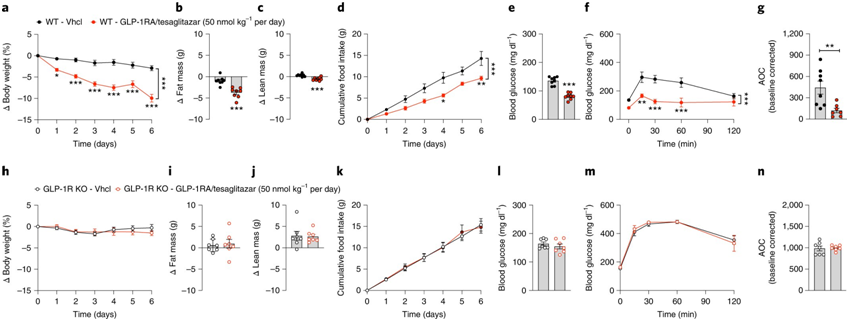
GLP-1RA/tesaglitazar in obese GLP-1R knockout mice, image from Nature Metabolism, 2022, doi:10.1038/s42255-022-00617-6.
This new drug is particularly effective in improving glucose tolerance levels. Only a minimal dose of this new medication is needed to achieve sustainable improvement in glucose metabolism. "This new drug has great potential for the acute treatment of elevated blood sugar levels associated with type 2 diabetes," said Aaron Novikoff, co-first author of the paper.
These authors now want to investigate whether this new drug might also have the potential to treat type 2 diabetes in humans, and whether the efficacy of this novel combination therapy can be further optimized through biochemical modifications.
These authors have long been dedicated to researching new candidate drugs for treating type 2 diabetes and obesity. Poly-agonists can simultaneously mimic the actions of multiple hormones. Clinical trials have shown that some poly-agonists hold excellent promise in treating obesity and type 2 diabetes and have entered phase 2 and phase 3 clinical trials. This year, in the United States, the first dual agonist drug for treating type 2 diabetes has been approved for marketing. This dual agonist drug combines GLP-1 and GIP (glucose-dependent insulinotropic polypeptide) receptor agonists, mimicking the actions of the intestinal hormones GLP-1 and GIP.BioValley Bioon.com)
References:
Carmelo Quarta et al. GLP-1-mediated delivery of tesaglitazar improves obesity and glucose metabolism in male mice. Nature Metabolism, 2022, doi:10.1038/s42255-022-00617-6.