

Ge Junbo's Team Completes First High-Risk PCI Supported by Domestic Percutaneous Ventricular Assist Device SynFlow3.0

ForQaly
Minimally Invasive Heart Ventricular Assist Device Developer
Recently, the team of Academician Ge Junbo from Zhongshan Hospital Affiliated to Fudan University successfully completed a high-risk and complex PCI (Percutaneous Coronary Intervention). During the procedure, the surgical team used the SynFlow3.0 percutaneous transvalvular ventricular assist device to aid the patient’s cardiac pumping, maintaining hemodynamic stability, preventing intraoperative circulatory collapse, and ultimately achieving successful coronary revascularization.
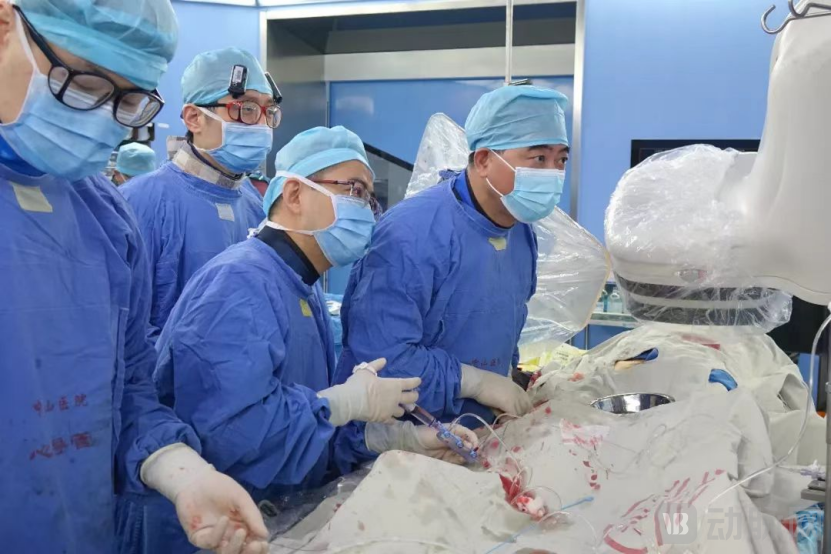 Surgical Scene Image
The successful implementation of this high-risk PCI surgery has preliminarily confirmed the safety and effectiveness of SynFlow3.0, a percutaneous transcatheter ventricular assist system developed by ForQaly Medical, in aiding high-risk PCI procedures. It also marks that ventricular assist devices produced in China will help clinicians overcome the challenges of high-risk and complex PCI surgeries, further improving the short- and long-term outcomes for patients with high-risk and complex coronary artery disease.
Regarding this surgery, Director Wang Xiangfei of the Cardiology Department at Zhongshan Hospital Affiliated with Fudan University frankly stated: "The patient's condition was extremely severe. The surgical procedure required repeatedly blocking the blood flow of the diseased coronary artery, causing the patient’s mean arterial pressure to temporarily drop below 50mmHg. Without the protection of a ventricular assist device, the patient’s blood pressure could have dropped even lower, and if circulation had collapsed, cardiopulmonary resuscitation would have been necessary."
The patient in this surgery is a 74-year-old male with a left ventricular ejection fraction (LVEF) of 30%, severe stenosis accompanied by calcified and tortuous lesions, and significant myocardial ischemia, representing a typical complex high-risk patient (CHIP). For such patients, there is a high possibility of hemodynamic instability or even circulatory collapse during PCI, and the risk of sudden death makes the PCI procedure extremely risky.
After thorough preoperative assessment, the team led by Academician Ge Junbo pre-inserted the SynFlow3.0 via the left femoral artery to provide ventricular assistance prior to the PCI procedure. During the operation, the SynFlow3.0 pumped blood from the patient’s left ventricle into the aorta through its flow channel, providing auxiliary pumping for the left ventricle. This increased the redundancy of circulatory support, ensured perfusion to vital organs throughout the body, and significantly enhanced the patient's safety during the perioperative period.
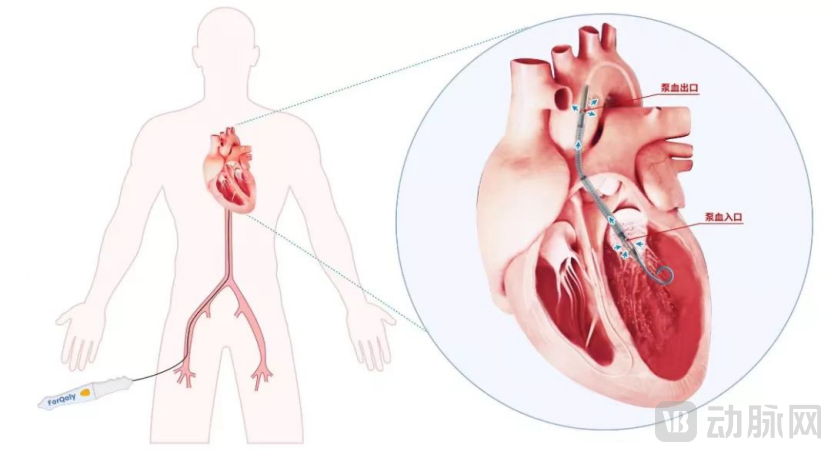 SynFlow3.0 Assisted Pumping
During the surgery, the patient's hemodynamics experienced fluctuations, but revascularization therapy was ultimately successfully achieved. The entire surgery lasted for 2 hours. Post-surgery, the patient recovered well and was discharged on August 29.
Director Wang Xiangfei commented: "The parameters of the SynFlow3.0 ventricular assist device directly match those of the mature foreign product Impella. The device offers good handling during operation and demonstrates strong performance in navigating through valves."
In recent years, the field of coronary intervention in China has gradually matured, with coronary stents mostly localized in production. The annual number of PCI procedures exceeds one million. However, there are approximately 11 million patients with coronary heart disease in China, indicating that the clinical treatment rate still needs improvement, especially for high-risk patients and those with complex lesions.In China, over 1 million PCI surgeries are performed annually, of which approximately 10% are high-risk PCI procedures. These surgeries are associated with greater risks and higher patient mortality rates, posing an urgent clinical challenge to be addressed.
Currently, there is no unified definition of high-risk PCI in clinical practice. Factors such as old age, left ventricular ejection fraction less than 35%, unprotected left main lesions, multi-vessel disease, and ST-segment elevation myocardial infarction are all considered high-risk PCI influencing factors. High-risk PCI procedures are more complex and take longer to perform.Ensuring the stability of patients' hemodynamics during surgery is the key to surgical success and affects prognosis.
With the increase in complex and high-risk patients, percutaneous mechanical circulatory support (MCS) has become the fastest-growing field in CHIP diagnosis and treatment. Currently, commonly used MCS devices in clinical practice include intra-aortic balloon pump (IABP), extracorporeal membrane oxygenation (ECMO), and percutaneous Impella. According to the "Chinese Expert Consensus on Clinical Application and Management of Percutaneous Mechanical Circulatory Support," in 2019, approximately 26,000 cases of IABP and 3,700 cases of ECMO were performed in China.
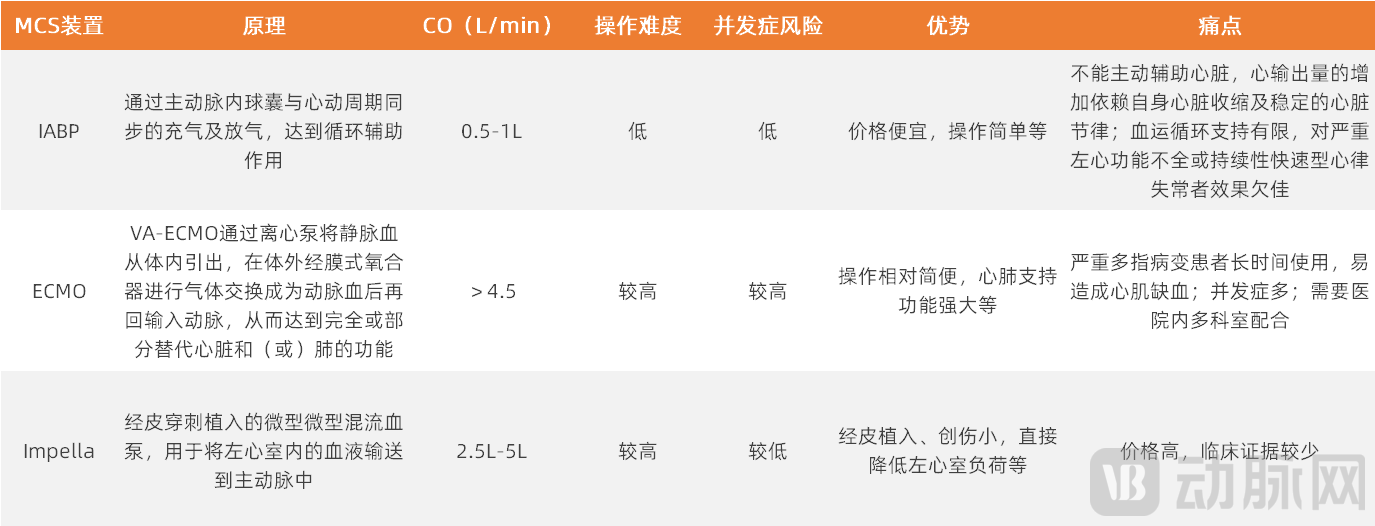
Comparison of MCS Devices Source: "Chinese Expert Consensus on Clinical Application and Management of Percutaneous Mechanical Circulatory Support"
IABP is the most widely used MCS device in clinical practice, with advantages such as low cost and simple operation. However, IABP cannot actively assist the heart and provides limited circulatory support. In contrast,Impella occupies a significant advantage in high-risk PCI assistance due to its minimally invasive nature, lower risk of complications, and ability to generate non-pulsatile continuous blood flow without relying on the patient's own cardiac rhythm.
Director Wang Xiangfei proposed: "Previous mechanical circulatory assist devices had shortcomings. The circulatory assist devices desired in clinical practice should, first, be relatively easy to use, and second, provide effective circulatory support within a short period of time. Ventricular assist devices like Impella are very suitable for us cardiologists, and for cardiac surgeons, Impella can also be used during heart bypass procedures. The product has very broad application prospects."
Moreover, short-term ventricular assist devices can also be used for short-term support in cardiogenic shock, improving patient survival rates. Results from a large U.S. cardiovascular study published in April 2021 showed that early use of the Impella percutaneous heart pump effectively improved hemodynamic status, increasing survival rates in cardiogenic shock patients from around 50% to 71%. In the fields of high-risk PCI procedure support and short-term cardiogenic shock assistance, ventricular assist devices have significant market potential.
As the most mature ventricular assist device product, Impella has cumulatively treated over 235,000 patients globally and has been recommended by multiple clinical guidelines and expert consensuses. With the increased adoption of Impella, the total market value of its parent company, AbioMed, once grew from $4.1 billion in 2015 to $14 billion. This demonstrates that both the clinical community and investors recognize the value of ventricular assist devices.
But China lacks effective ventricular assist device products, and currently, Impella has not been approved by the National Medical Products Administration. Compared with Europe and the United States, China is an even larger blue ocean market.In China, more than 110,000 high-risk PCI surgeries are performed annually, with over 300,000 patients experiencing cardiogenic shock. The significant gap in disease treatment urgently calls for the emergence of safe and effective ventricular assist devices.
Since 2015, ForQaly has entered the field of ventricular assist devices, a time when coronary intervention in China was in a period of rapid development.
According to Tang Zhirong, the founder of ForQaly, in 2015, Impella was used in 10,000 surgeries in the United States and Europe, but during the same period, there were fewer than 10 cases in China. The same product had different market performances, partly due to socio-economic and healthcare environment differences—U.S. insurance could cover the cost of Impella, while in China patients had to pay out of pocket. Another reason is the lack of cost-effective domestic brands in China, with imported products being more expensive and local companies not providing clinical education.
ForQaly was founded with the original intention of improving the quality of human life through high-quality and inclusive solutions.
In product design,ForQaly Medical's SynFlow3.0 Transvalvular Ventricular Assist Device operates the blood-pumping catheter through an external motor drive, converting a single-use motor into a reusable product, significantly reducing usage costs while also avoiding the issue of heat generation associated with in-body motor operation.
At the same time, the perfusion system of SynFlow3.0 has the functions of solution perfusion and waste liquid suction at the same time, which can reduce the perfusion solution and wear particles entering the human body, and avoid the deposition of non-absorbable particles in blood vessels.
Since the diameter of the femoral artery in Chinese patients is relatively thinner compared to Western patients, the clinical community pays close attention to the miniaturization of ventricular assist devices when implanted through the femoral artery. In this aspect, the external motor drive design of SynFlow3.0 offers certain inherent advantages. ForQaly also plans to further reduce the product size to accommodate more vascular conditions.
In the niche track of ventricular circulatory support, ForQaly has been deeply engaged for 7 years. The company dares to "tackle tough challenges" and is also adept at uncovering value. A strong multidisciplinary team, robust in-house R&D capabilities, and the right product direction are all foundational to the company’s sustainable growth.
ForQaly has a strong multidisciplinary team. In terms of expertise, the members' backgrounds cover disciplines such as materials science, mechanics, fluid mechanics, clinical medicine, and electronic software. In terms of industry experience, core members have many years of work experience and are highly experienced in product development, manufacturing, and commercialization.The company values R&D innovation and currently holds 35 invention patents.
In the future, ForQaly will continue to optimize the SynFlow3.0 ventricular assist device while expanding the company’s product line to comprehensively address clinical circulatory support needs. At the same time, the company will further strengthen cooperation with top-tier hospitals in China, ensuring that its products are "derived from clinical practice and applied back to clinical practice." Moreover, ForQaly remains committed to a global development strategy and will progressively initiate clinical studies of the SynFlow3.0 product overseas, bringing high-quality yet cost-effective domestically produced brands to the global market.
References:
"Chinese Expert Consensus on Clinical Application and Management of Percutaneous Mechanical Circulatory Support"
"Peking University First Hospital's Huo Yong: 1.16 Million! In 2021, the Number of Coronary Intervention Cases in China Increased by 20% Compared to the Previous Year" — Chinese Circulation Journal
"From the Brink of Bankruptcy to a Market Value of $14 Billion, How Did Abiomed Make a Comeback?" — VCBeat