

XTALPI Establishes Shanghai Headquarters in Pudong Zhangjiang, Unveils Automated Lab for the First Time
XtalPi
Computation-Driven Innovative Drug R&D Provider
ShanghaiSeptember 5, 2022PR Newswire -- The 2022 World Artificial Intelligence Conference (WAIC), themed "Intelligent Connectivity, Infinite Possibilities in the Metaverse," successfully concluded on September 3. At the closing ceremony, Ma Jian, co-founder and CEO of XtalPi, was invited to attend the signing ceremony for representative AI industry projects in Shanghai. Eight AI industry projects, including the "XtalPi Shanghai Headquarters," were signed on-site. Shanghai's municipal leaders attended and witnessed the signing ceremony. Meanwhile, XtalPi's self-developed intelligent and automated laboratory made its first public appearance, further showcasing new achievements in the integration of artificial intelligence and biopharmaceutical technologies for industrial applications.

At the closing ceremony of the World Artificial Intelligence Conference, XtalPi attended the signing ceremony for Shanghai's representative artificial intelligence industry projects.
New Infrastructure for Pharmaceutical R&D
New Industries of the Digital Economy
In June 2022, the General Office of the Shanghai Municipal People's Government issued the "14th Five-Year Plan for the Development of Shanghai's Digital Economy." In the plan, "expanding new digital industries" is mentioned as a key task, emphasizing the foundation of new infrastructure technologies such as 5G, artificial intelligence, and big data. The focus is on fields like pharmaceuticals, accelerating the layout of AI-driven drug development, and concentrating on protein structure prediction, drug target identification, and drug molecule design to improve the efficiency of drug research and development. This creates new growth opportunities in life sciences and achieves breakthroughs in the field of digital health.
As an intelligent and automation-driven drug research and development technology company, XtalPi has been widely integrating key new infrastructure technologies such as artificial intelligence and automation with the biopharmaceutical industry. It continuously empowers the source innovation of drug R&D with innovative technologies, pioneering a new model of drug R&D services that combines intelligent computing, automated experiments, and expert experience. XtalPi provides integrated solutions for drug discovery to biopharmaceutical companies worldwide, helping pharmaceutical companies shorten the drug R&D cycle, improve R&D efficiency, and increase success rates through professional services.
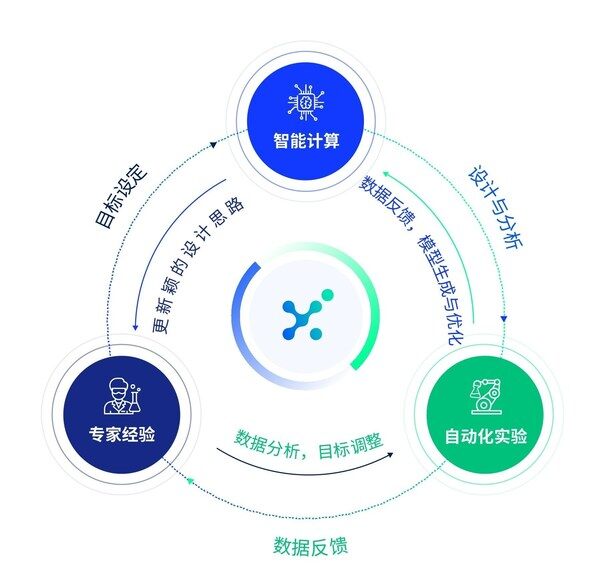
XtalPi's New Drug R&D Model Combining "Intelligent Computing, Automated Experiments, and Expert Experience"
Since its establishment in 2015, XtalPi's self-developed intelligent and automated drug research and development platform has continuously empowered the biopharmaceutical industry. Starting from its headquarters in Shenzhen, XtalPi has established experimental and computational R&D centers, innovative drug R&D centers, and artificial intelligence R&D centers in Shenzhen, Shanghai, Beijing, and other locations. Leveraging the industrial cluster advantages of the Yangtze River Delta, and focusing on strategic emerging industries such as biopharmaceuticals and artificial intelligence, XtalPi continues to expand its business layout. With the relocation of its Shanghai headquarters to Zhangjiang, Pudong, XtalPi will further utilize its technical advantages in AI-driven drug R&D and its extensive experience serving pharmaceutical companies both in China and internationally. It will continue to promote the deep integration of digital technology with the real economy and contribute to building a world-class digital industrial cluster.
Independently Developed, Industry-Leading
Full Acceleration of Automated Laboratories
At the World Artificial Intelligence Conference, XtalPi was invited to participate in the WAIC2022·Shanghai Bio-Computing Forum. Dr. Jian Ma, Co-founder and CEO of XtalPi, shared "From Automation to Intelligence -- The Upgrade Path of New Drug Development".
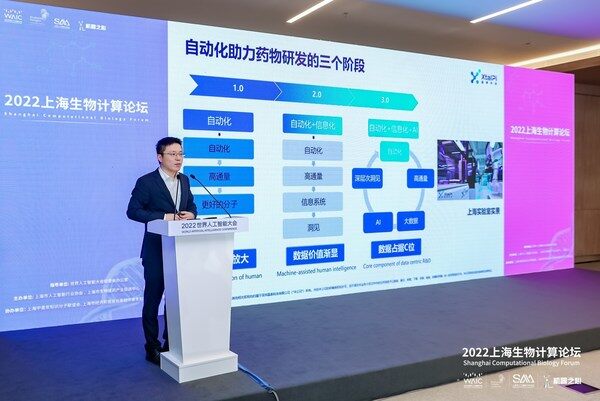
XtalPi Co-founder and CEO Dr. Jian Ma Delivers Keynote Speech
"With innovative technology as the link, clinical value as the guide, and market demand as the starting point, XtalPi has never stopped its steps of integrated innovation. From production tools to production relations, artificial intelligence is helping new drug research and development break through scientific bottlenecks, while automation is helping us overcome engineering bottlenecks. Innovative technologies not only help us tap more potential in new drug research and development, but their contributions in terms of cost reduction, efficiency enhancement, and resource optimization are also highly commendable."
Since 2019, XtalPi has been exploring the independent development of automated laboratories in the Shenzhen-Hong Kong Science and Technology Innovation Cooperation Zone at Futian River, with over 3,000 square meters of automated laboratory space. These labs have been successfully applied in scenarios such as automated chemical synthesis, providing related services to clients including Qingyu Pharmaceuticals, Hisun Pharmaceuticals, and Xilai Technology.
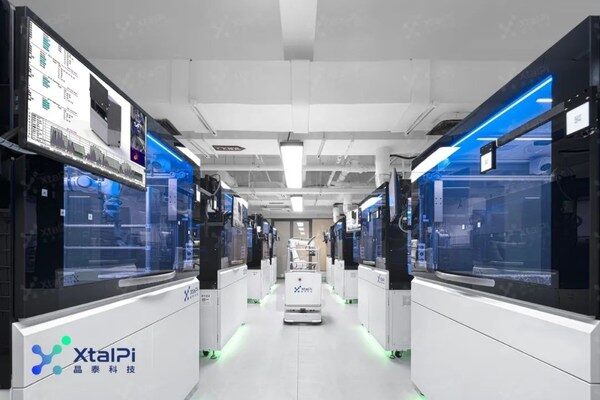
XtalPi's automated laboratories in Shenzhen and Shanghai have reached a considerable scale.
In the future, XtalPi will continue to expand the scale of its automated laboratories in Shanghai. At that time, a cluster of automated workstations comprising thousands of units will work together with an artificial intelligence computing platform and an experienced team of experts to achieve larger-scale resource scheduling and automatic control in more R&D scenarios, providing strong support for the research and development of more innovative drugs.
"By assigning a large amount of repetitive labor to robots, scientists will have more time and energy to focus on the key aspects of drug development. This not only significantly improves experimental output efficiency but also reduces errors caused by human operation, resulting in high experimental reproducibility and more competitive experimental productivity. Notably, automated experiments also have the potential to address the data shortage challenges in AI-driven drug discovery, helping to enhance the overall efficiency and success rate of the R&D process."
Break Through the Space-Time Bottleneck
Inject New Vitality
As is known to all, drug discovery is a process of continuous trial and error that requires multiple rounds of analysis iterations based on experimental data to screen out the optimal drug molecules. The speed at which experimental data is generated is one of the key factors determining the efficiency and success rate of drug development, while chemical synthesis represents the rate-limiting step in the entire DMTA (Design-Make-Test-Analyze) cycle, as well as the bottleneck that urgently needs breakthrough in drug discovery experiments. In June this year, at the closing ceremony of the 24th Annual Meeting of the China Association for Science and Technology, the "10 Frontier Scientific Questions" were released, among which was the question of "how to achieve automatic, intelligent, and precise chemical synthesis."
This is the original intention of XtalPi to accelerate drug research and development with the help of artificial intelligence, and it is precisely these initial driving forces that have pushed the scientist team of XtalPi to find solutions one by one and make significant progress.
In XtalPi's self-developed intelligent and automated drug discovery platform, the dry experimental data generated by physical models supports AI modeling. The human-machine collaboration in automated synthesis experiments not only enables 7*24 hours of uninterrupted work, reduces human error and dependence, and ensures high efficiency and parallel processing, but more importantly, it generates more standardized and high-quality wet experimental data. This data is fed back into the AI model for continuous iteration and optimization, further improving reaction efficiency and success rates.
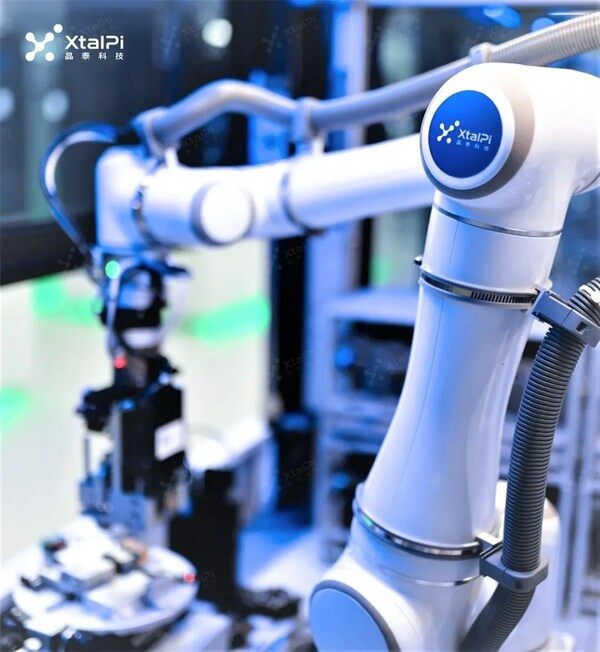
In the automated laboratory, robots are conducting experiments.
XtalPi's chemical synthesis team currently has nearly 300 synthetic researchers and hundreds of automated workstations, utilizing fully automatic or human-machine combined experimental models. The applications range covers high-throughput parallel reactions and multi-step automated synthesis, encompassing most commonly used reactions in chemical synthesis. It can control reaction temperature changes from 0 to 150 degrees Celsius, supports precise measurement of solids and liquids, achieves automatic LC-MS (Liquid Chromatography-Mass Spectrometry) monitoring of reactions, and enables anhydrous and anaerobic operations through automated glovebox workstations, among other capabilities. After repeated testing, XtalPi’s human-machine integrated experimental model has significantly improved experimental efficiency, achieving more efficient and consistently high-quality delivery.
Automation labs are helping us break through the efficiency and data bottlenecks in drug research and development, while also helping us overcome the limitations of distance in the post-pandemic era, realizing the concept of conducting experiments remotely from home.
"In the first half of this year, during the static management period in Shanghai, the experimental colleagues of XtalPi who worked from home remotely logged in from their homes in Shanghai to control the automated laboratory located in Shenzhen. With the assistance of a small number of on-site support staff, they completed the delivery of more than 70 target compounds that required 4-6 steps of synthesis, achieving over 90% of the project's delivery goals. Both the quality and efficiency of the delivery met the project's expectations, resulting in high customer satisfaction."
It has been proven that automated laboratories can not only extend the boundaries of human capabilities, expand our ability to handle complex problems, but also provide us with more confidence and composure in a changing world.
Automated laboratories provide an imaginative development path for innovative drug research and development in the post-epidemic era, and also inject new momentum into the continuous advancement of innovation at the source of drug discovery.