

Replay Files IPO Prospectus: Pioneering 'Big DNA' Genomic Medicine with $55M Seed Funding and Disruptive Hub-and-Spoke Business Model

Lansdowne Partners
Investment Management Institution

Kohlberg Kravis Roberts
Global Investment Firm

Replay
Next-Generation Genomic Medicine Technology Researcher

ARTIS Ventures
Venture Capital Firms

OMX Ventures
Early-Stage Venture Capital Firms

Axial
Early-Stage Life Sciences Investment Firms

SALT Fund
Investment Fund
In 1963, American biomolecular scientist and Nobel Prize winner in Medicine, Joshua Lederberg, proposed the concepts of "gene optimization" and "gene exchange." Since then, the prevention and treatment of diseases based on genes have become a major research focus in the medical field.
In the 1970s, Theodore Friedmann published a query in *Science* on the use of gene therapy for human diseases. In the 1990s, the FDA approved the first clinical trial of human gene therapy. In October 2003, China approved the gene therapy drug "Gendicine" for marketing, becoming the world's first nationally approved gene therapy drug. After decades of exploration, gene therapy has continuously improved in terms of its "scientific" nature and safety, driving its transition from laboratory to clinical application, with many biotechnology companies emerging that are represented by technologies such as gene writing and gene editing.
Replay, a next-generation genomic medicine technology researcher founded in California, USA in 2021, is currently dedicated to addressing key challenges that limit clinical progress. These include the need to increase payload capacity and develop off-the-shelf cell therapies to significantly reduce the cost of goods, enhance production speed, volume, and consistency, and expand the potential of genomic engineering.
On July 25, 2022, Replay announced the completion of a $55 million seed financing round, led by KKR & Co. Inc. and OMX Ventures, with participation from ARTIS Ventures, Lansdowne Partners, SALT, and Axial. Replay stated that the proceeds from this round will be used to build its platform technology toolkit for writing and delivering "large DNA" targeting complex diseases, including solid tumors and polygenic disorders.
What are Replay's competitive advantages? Let's find out.
"Genomics may completely颠覆 current clinical treatment methods in the future."
Replay was co-founded by Adrian Woolfson, Lachlan Mackinnon, David Knipe, and Ron Weiss.
Adrian Woolfson serves as President and Executive Chairman. He completed his undergraduate studies at King's College London, followed by clinical medical training at the John Radcliffe Hospital in Oxford, UK. He then finished his postgraduate medical training at Addenbrooke's Hospital in Cambridge. Under the guidance of Nobel laureate Professor César Milstein, he completed his doctoral thesis and conducted postdoctoral research in molecular immunology. He has since published over 140 books and papers. Currently, he is also a Fellow at Darwin College, Cambridge, a Welcome Trust Clinical Fellow, and a National Cancer Foundation Fellow at the MRC Laboratory of Molecular Biology in Cambridge, UK.
Adrian Woolfson's brilliance is not only reflected in his educational background, but also in his rich work experience. Before founding Replay, Adrian served as the Executive Vice President and Head of R&D at Sangamo Therapeutics, a biotechnology company specializing in gene therapy, where he led multiple gene editing and gene therapy R&D projects. He also served as the Chief Medical Officer at Nouscom, a cancer neoantigen vaccine company supported by 5AM, LSP, Abingworth, and Versant, located in Basel, Switzerland, and Rome, Italy, leading the development of a melanoma antigen vaccine product from research to IND submission.
At the same time, Adrian also served as the Global Clinical Leader for early and late-stage immuno-oncology and hematology at Pfizer in New York, establishing Pfizer's I-O hematological malignancy portfolio. In addition, he also worked at Bristol-Myers Squibb, leading a team to develop Sprycel, a Bcr-Abl inhibitor for the treatment of leukemia.
Adrian Woolfson's entrepreneurial idea emerged while he was serving as the head of R&D at Sangamo Therapeutics, aiming to address various challenges in genomics encountered during the R&D process. Later, he met biotechnology investor Lachlan Mackinnon in London.
Lachlan Mackinnon serves as the CEO of Replay, holding a master's degree in Chemistry from the University of Oxford. Previously, he was the founding director of Oxford Science Enterprises (formerly OSI), where he made seed investments in companies at the intersection of technology and biology, including the first funding rounds for ONI, OMass Therapeutics, Nucleome Therapeutics, Spybiotech, and Base Genomics. Base Genomics was acquired for $410 million just four months after raising $11 million in seed funding, marking one of the highest internal rates of return in life science deals.
 Co-founder and CEO Lachlan Mackinnon (left)
Co-founder, President, and Executive Chairman Adrian Woolfson (right)
Adrian Woolfson and Lachlan Mackinnon, one with years of experience in the gene therapy field and the other with extensive entrepreneurial and investment experience in the bioscience sector, have also teamed up with two other senior experts in the biotechnology field, Professor David Knipe and Professor Ron Weiss.
Professor David Knipe, Ph.D., graduated from the Massachusetts Institute of Technology and is currently a professor of Microbiology & Molecular Genetics, Microbiology, and Immunobiology at Harvard Medical School. He is a leading expert in the study of herpesviruses, particularly Herpes Simplex Virus (HSV). Professor David has co-edited the virology reference book "Fields Virology" and has served as the Program Director for the Mechanisms of Methamphetamine Action Training Program since 1986.
Professor Ron Weiss is one of the pioneers in synthetic biology, having started research in this field while pursuing his graduate studies at the Massachusetts Institute of Technology (MIT). After earning his Ph.D. from MIT in 2001, he taught at Princeton University until 2009, before returning to MIT as a tenured professor in both the Department of Biological Engineering and the Department of Electrical Engineering and Computer Science. He is also the director of MIT’s Synthetic Biology Center. In 2021, the center published a paper introducing a synthetic biological circuit composed entirely of protein components without any genetic elements.
"Genomics may completely颠覆当前的临床治疗方式 in the future. Based on my over 30 years of experience in clinical medicine, academia, and the biopharmaceutical industry, I believe we need more powerful and comprehensive molecular genetics platform technologies to address today's medical challenges and benefit patients. At Replay, we are fortunate to bring together world-class entrepreneurs, genomicists, and synthetic biologists to take on the biggest challenges in clinical medicine today," said Adrian Woolfson, co-founder, executive chairman, and president of Replay.
Gene Writing Platform, Vector Platform, Cell Platform, and Algorithm Platform
Currently, the technological breakthroughs in gene therapy mainly include AAV vector delivery technology, CRISPR gene editing technology, single/double base editing technology, and oncolytic virus genetic modification technology. Among them, CRISPR gene editing technology has become the most popular technology in the field of biomedicine.
CRISPR gene editing technology mainly relies on the host cell's DNA damage repair pathways to modify the genome. The issue is that the evolution of these DNA damage pathways restricts genomic changes, reducing efficiency when altering the genome and potentially causing DNA double-strand breaks during gene editing. Therefore, while CRISPR is powerful in changing a small number of bases or cutting DNA double strands, it is not an ideal tool for inserting exogenous genes into the genome.
Unlike CRISPR, gene writing technology can accurately insert large DNA sequences into the genome without cutting the DNA double strand or editing individual DNA bases, achieving a broader range of gene editing tasks.
Focusing on gene writing, gene editing, and large-fragment gene delivery, Replay has currently built four platforms: the gene writing platform (DropSynth™), vector platform (SynHSV™), cell platform (uCell™), and algorithm platform (LASR™).
Gene Writing Platform (DropSynth™)
This is a gene-writing platform capable of efficiently, rapidly, and cost-effectively synthesizing large DNA fragments, enabling the exploration of protein sequence space in a more effective, cost-efficient, and comprehensive manner than directed evolution.
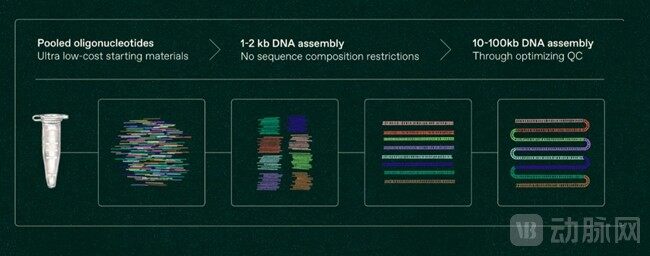 Gene Writing Platform Source: Replay Official Website
 Writing Large DNA Source: Replay Official Website
Vector Platform (synHSV™)
Generally speaking, the capacity of AAV vectors is 4.7kb, while SynHSV™ can provide up to 30 times the AAV payload, reaching a maximum of 150kb. This effectively addresses the delivery challenges of large gene fragments, multiple genes, and various transcriptional activators and repressors. It enables gene writing and delivery both in vivo and in vitro, expanding the scope of genomics and the prospects of multi-gene medicine.
Of course, Adrian Woolfson also acknowledged that although the evolved HSV can effectively evade the immune system, similar to AAV, the human body has neutralizing antibodies against HSV. Therefore, it is still difficult to determine which is safer: gene therapy based on HSV vectors or gene therapy based on AAV vectors.
 AAV vs. HSV Capacity Comparison Source: Replay Official Website
Cell Platform (uCell™)
uCell™ is an immune-silencing technology that enables iPSCs to serve as a renewable resource for cell therapy, reducing the cost of goods associated with patient or pooled donor-derived cells, enhancing product consistency and scalability, and enabling extensive genomic engineering.
Algorithm Platform (LASR™)
LASR™ is an evolutionary inference machine learning algorithm used to rewrite proteins for functional optimization, capable of converting developmental tree space into DNA sequence space to identify fitness peaks within the evolutionary landscape. Replay claims that combining this technology with DropSynth™ offers a differentiated approach for effectively navigating the protein sequence space.
 Sequence Conversion Source: Replay Official Website
Innovative "Hub-and-Spoke" Business Model Has Spun Off Five Product Companies
Replay, founded in California, has two executive headquarters. Currently, San Diego is home to administrative, R&D, and other functional departments, with President and Executive Chairman Adrian Woolfson and most employees working in San Diego. The other headquarters is located in London, where CEO Lachlan Mackinnon continues to leverage the UK's biotech talent pool to conduct business.
Generally speaking, a company will determine a specific main business direction, whether it’s a particular drug, a specific disease, or a certain type of technology platform. Unlike traditional companies, Replay adopts a "hub-and-spoke" business model.
Under its business model, Replay separates its platform technology from specific product development efforts. The parent company is responsible for developing the platform technology, while product development targeting specific diseases is distributed to product companies. Each product company is co-led by entrepreneurs and technical experts in the relevant disease area.
So far, Replay has established five product companies, four of which are gene therapy companies targeting monogenic diseases, covering areas such as ocular, brain, skin, and muscle genomic treatments. Ocular treatments focus on retinitis pigmentosa, Stargardt disease, and Usher syndrome type 1B. Brain treatments include Parkinson's disease and Friedreich's ataxia. Skin treatments mainly target dystrophic epidermolysis bullosa, while muscle-related gene therapy primarily addresses Duchenne muscular dystrophy.
In addition, set up a product company focused on "enzyme writing," utilizing Replay's gene-writing platform (DropSynth™) and algorithm platform (LASR™) to design synthetic proteins, and further optimize enzyme functions through three methods: TET, Anhydrase, and Catalase.
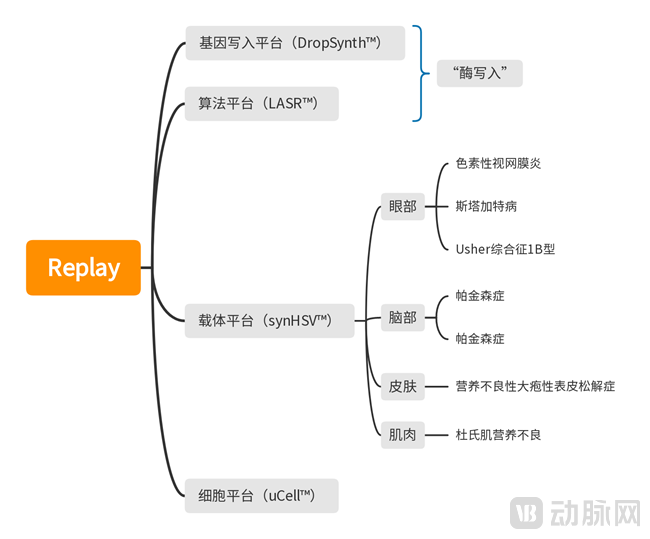 Replay Technology and Architecture Source: VCBeat
"Technology and product development have different talent needs, timelines, and cost controls," Lachlan Mackinno noted in a statement. "We have innovated in our corporate structure by adopting a new model to meet these differentiated requirements, separating 'technology development' from 'product development.' With a strong team, the right corporate structure, a portfolio of technology platforms, and financial backing, we believe that in the future we can build a biotechnology company that shapes the industry's future and stands the test of time."
KKR Managing Director and Replay Board Member Kugan Sathiyanandarajah stated, "Replay's mission is to create a world-leading company by writing and delivering 'large DNA' to develop and own the tools for reprogramming biology; we believe these capabilities will unlock the largest untapped opportunities in the field of medicine. Replay has extensive entrepreneurial experience within the company and a team of seasoned industry participants guiding the development of platform technologies and product companies to bring new treatments to patients."