

ACTBio: Chinese Research Team Unveils Safe and Efficient Method to Accelerate Neural Differentiation of Human Embryonic Stem Cells Using Surface Acoustic Waves

iRegene Therapeutics
Cell Therapy Product Developer
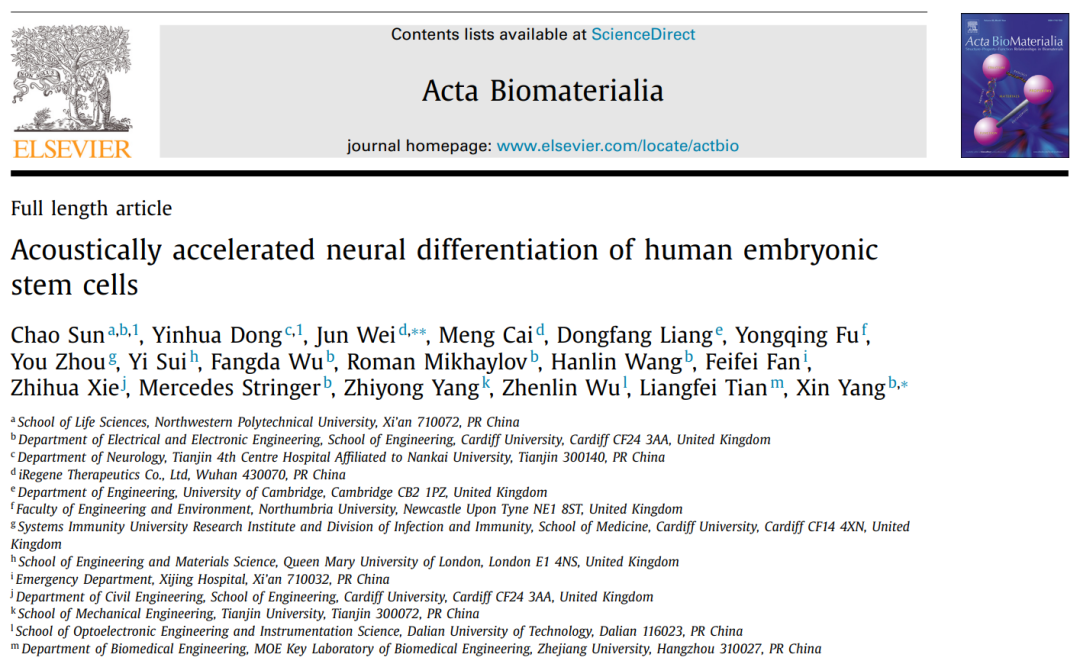
Recently, the team of Xin Yang from Cardiff University in the UK and the team from Wuhan iRegene published a research paper titled: Acoustically accelerated neural differentiation of human embryonic stem cells in the journal Acta Biomaterialia.
In the paper, the research team presented a groundbreaking method and principle for accelerating neural cell differentiation using Surface Acoustic Waves (SAW), revealing a novel approach where SAW accelerates neuronal differentiation by regulating changes in the extracellular matrix (ECM), plasma membrane, and actin cytoskeleton.
In this way, it can be achieved in pluripotentStem CellsFurther avoid deviations caused by methods such as genomic modification during application. At the same time, manipulating cells through entirely new physical means provides new insights for disease treatment.
It is reported that this research achievement originated from the "EPSRC Industrial Strategy Innovation" plan jointly applied for by the School of Medicine at Cardiff University in the UK and iRegene in February 2019. This research initiative mainly focuses on developing novel medical sensors forPrecisionIdentification of Specific Biomarkers Aims for Early Detection of Multiple Malignant DiseasesDiagnosisand the development of new therapies. Previously, the program had received the highest scientificManagementInstitution —— Approved and funded by the British Research Council.
Currently, with the development of disciplines such as medicine and biotechnology, regenerative medicine has become a research platform for exploring the potential cures for various diseases. This includes tissues and organs damaged due to age, disease, or trauma, as well as congenital defects, all of which may potentially be "cured" through regenerative medicine. In addition, the regenerative medicine platform also provides a new system for drug screening and toxicology evaluation, offering innovative approaches for extensive pharmaceutical development.
The work done by the research team this time also aims to further expand the application of new technologies in regenerative medicine.
According to Professor Xin Yang from the Department of Biomedical Engineering at Cardiff University and Dr. Jun Wei, co-founder and CEO of iRegene, their team used the neural differentiation of pluripotent stem cells as an entry point. By directly sandwiching a flexible printed circuit board (FPCB) between piezoelectric substrates, they developed a cell stimulator that generates surface acoustic waves (SAW), referred to as FSCS, and investigated its impact on the differentiation of human embryonic stem cells (hESCs) into neurons.
FPCB is made of flexible materials, which have good mechanical properties and can be used in harsh working conditions such as high temperature and high pressure. The cell stimulator processed thereby can be placed in the incubator for a long time while maintaining stable operation.
After the flexible FPCB and piezoelectric materials are tightly bonded through physical methods, they can effectively generate SAW. The so-called SAW is a type of ultrasonic wave with energy concentrated on the surface, making it particularly suitable for interacting with surface-adhered cells. By optimizing control parameters, the SAW generated extremely high-speed liquid flow in the stem cell culture medium, greatly enhancing the rate of material transfer between soluble substances and cells in the culture system.
It is worth mentioning that currently, SAW devices are typically manufactured through photolithography processes, such as patterning interdigital transducers (IDT) on piezoelectric substrates like lithium niobate (LiNbO3).
And in order to minimize the heavy reliance on cleanroom facilities for the preparation of SAW devices in future regenerative medicine applications, the research team also explored a novel technology this time — FPCB SAW-based cell stimulation (FSCS) devices.
The research results show that the use of FSCS devices can reduce stimulation time and are more adaptable to the special environment of cell culture. The energy and frequency precision of SAW are also more controllable, with wavelengths close to the size of cells, allowing for direct manipulation of the cells.
In addition, during the research process, the relevant research team also customized the working parameters of SAW entirely according to the energy required for stem cell differentiation. This created microwave vibrations on the cells at tens of millions of times per second to stimulate stem cell activity. Meanwhile, by optimizing control parameters, SAW generated extremely high-speed liquid flow in the stem cell culture medium, greatly enhancing the rate of material transfer between biochemical factors and cells.
Among them, the interaction between SAW and the medium in the device can be explained through numerical and analytical models, and the parameters of edge waves and plane waves from the PDMS-LiNbO3-fluid contact point are determined by the following model:θR=sin-1(C1/C2); The SAW boundary condition is determined by the following equation: ν=-