

Arctic Vision Accelerates Commercialization of Ophthalmic Innovations Under Dual-Engine Strategy: An Interview with CCO York Chen

Arctic Vison
Ophthalmic New Drug Developer
The ophthalmology industry is undoubtedly one of the hottest细分 tracks in recent years.
The extent of the boom can be glimpsed from the data. According to data from the VCBeat database, nearly 20 companies in China's ophthalmology industry have secured financing this year, with a total financing amount exceeding 1.8 billion yuan, placing it at a high point in recent years.
Behind this lies the unmet needs of 400 million ophthalmic patients in China. With the deepening of social aging and changes in modern lifestyles, the burden of ophthalmic diseases in China will become increasingly prominent, indicating a huge growth potential in market space.
Facing the vast blue ocean, numerous companies have made efforts to bring better and more optimal medical experiences to patients with eye diseases.In this field, the upstream of ophthalmology is becoming a focal point for capital investment, including Arctic Vision, an ophthalmic biotechnology company (referred to as "Arctic Vision" hereafter). The company focuses on the clinical development of cutting-edge technologies and innovative solutions that cater to a broader consumer base, making it one of the most notable players in today’s ophthalmic market.
Since its establishment in 2019, Arctic Vision has continued to be favored by capital., including well-known investment institutions such as Nan Fung Life Sciences, Ding Feng Life Sciences, Morningside Venture Capital, Loyal Valley Capital, Tencent Investment, New World Group, Octagon Capital, etc.
Not only that, but in the past year or so, Arctic Vision has added multiple new drug pipelines, encompassing more than ten innovative ophthalmic therapies ranging from early research, preclinical stages to late clinical stages and even commercialization phases.
In just three years, how did Arctic Vison grow so rapidly? How far has its commercialization progressed? What is its judgment on the industry? To address these questions, VCBeat conducted an in-depth interview with Chen Yi, Chief Commercial Officer of Arctic Vison.
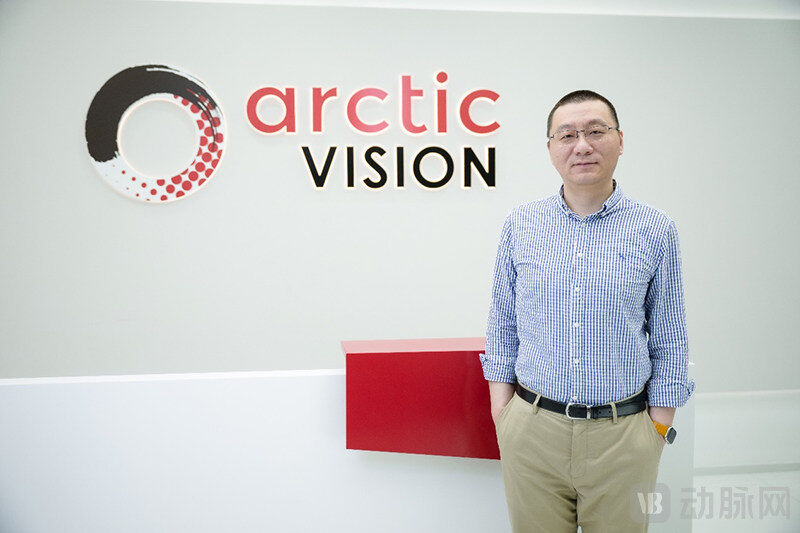 (Illustration: York Chen, Co-founder and Chief Commercial Officer of Arctic Vison)
Since its establishment, Arctic Vison has always focused on cutting-edge innovative therapies in the ophthalmology industry.
"Over the years, China's biopharmaceutical market has developed rapidly and gradually aligned with international standards. In this process, how the management concepts of international pharmaceutical giants can be integrated with the domestic market environment is a topic worth exploring in the industry." When talking about the original intention of joining the Arctic Vision startup project, Chen Yi told VCBeat,From the outset, the founders decided to focus on innovative therapies and technologies in ophthalmology to benefit more patients with eye diseases and the general public, helping them address eye health challenges more effectively and enjoy a visually pleasing life."As the CCO (Chief Commercial Officer), my main responsibility is to provide the company with maximized, stable, and long-term profit sources to achieve the maximization of commercial value."
Before joining Arctic Vison, Chen Yi worked at Merck and Boehringer Ingelheim, and served as the national sales head of Alcon and the head of Allergan's ophthalmology division in China, with 22 years of experience in marketing, sales, and team management in the ophthalmology industry.
"Different from other ophthalmic companies in the market,Arctic Vison adopts a dual-engine strategy: one end focuses on breakthrough frontier technologies for innovative therapies related to ophthalmic diseases, and the other end is consumer-oriented technology, addressing broader eye health challenges."Chen Yi said that this has achieved full-cycle coverage from eye care to the treatment of eye diseases."
How to understand? Simply put, Arctic Vision mainly addresses two major needs of patients with eye diseases. First, it tackles the previously unmet treatment demands for ophthalmic conditions, such as retinal degeneration caused by glaucoma, by providing several cutting-edge innovative therapies that fill therapeutic gaps (e.g., gene therapy, cell therapy, suprachoroidal injection, etc.). Second, it offers technological products aimed at improving eye health and elevating the level of ophthalmic consumption for the general public, including solutions for myopia, presbyopia, and dry eye syndrome.
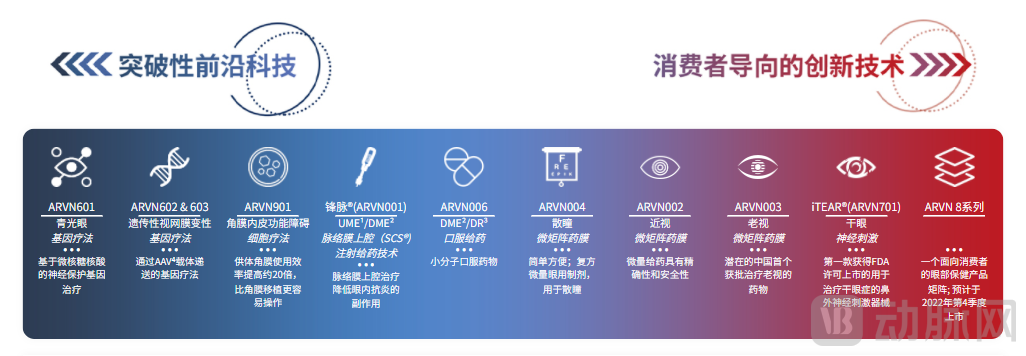
Centered on its dual-engine strategy, Arctic Vision has adopted a "licensing-in, co-development, and in-house R&D" triad-driven approach. The company currently possesses more than ten innovative ophthalmic therapies spanning from early research, preclinical stages to late clinical stages and even commercialization phases, with multiple projects achieving significant progress.
For example, in terms of clinical development, the domestic Phase III clinical trial of ARVN003—one of Arctic Vision's core products, a microdose ophthalmic solution of pilocarpine hydrochloride developed based on the Optejet® microdosing device—completed the enrollment of its first patient in July. This product is mainly used for the temporary improvement of near vision in patients with presbyopia.Notably, this is also the first patient enrollment in a Phase III clinical trial for presbyopia drugs in China, and ARVN003 is expected to become the first approved drug therapy for presbyopia in China.
Prior to this, Arctic Vision's Pulse®/ARCATUS® (ARVN001) also completed the first dosing in an Asian DME patient in a clinical trial for Diabetic Macular Edema (DME), offering a new treatment option for patients with uveitic macular edema. The latest authoritative data shows that the number of people aged 20-79 with diabetes in China exceeds 140 million, ranking first globally. Based on epidemiological surveys across various regions of China, the incidence of DME in diabetic patients can be as high as 7.9% and continues to rise annually.
Looking at the early R&D aspect, Arctic Vision has basically established comprehensive drug discovery and preclinical development capabilities, ranging from target identification, concept validation to in vivo and in vitro efficacy, pharmacology, and toxicology studies. It has already initiated independent research and development in three disease areas: hereditary retinal degeneration, diabetic retinopathy (DR), and diabetic macular edema (DME).
"The ultimate goal of the three-pronged strategy is to find products that meet the dual-engine criteria," said Chen Yi.All product selections and developments by Arctic Vison can be positioned on the spectrum anchored by breakthrough frontier technologies at one end and consumer-oriented innovative technologies at the other, addressing unmet needs in the ophthalmic treatment field while further enhancing public eye health.。
It can be seen that, adhering to the original intention of benefiting a wide range of ophthalmic patients and improving the diagnostic standards of the eye health industry, Arctic Vision has gradually emerged in the field of ophthalmic innovation.
In addition to its deep cultivation in innovative therapies, another reason for Arctic Vision's rapid development lies in its understanding and practice of commercialization.
"Previously, when talking about commercialization, people might understand it as recruiting sales teams to expand the market, but it's not just that."Commercialization is a major test of a company's cross-departmental collaboration capabilities."Marketing and sales are just the final push that everyone can see. In fact, every link from R&D to production, supply chain to sales reflects the overall strength of an innovative enterprise," Chen Yi told VCBeat. Arctic Vision has built a team with extensive industry experience. "They are a group of highly responsible and innovative people. Most members have participated in clinical development, market access, and commercialization of advanced ophthalmic treatment products recognized by the market. They also have comprehensive understanding and operational experience in consumer-oriented ophthalmic healthcare product projects."
"We will start commercial research at the stage of looking for products."Product characteristics largely determine future marketing channels and business models, and even the future market competition landscape."Chen Yi stated that Arctic Vision established a commercialization team at a very early stage and participated in the process of product development and introduction, continuously evaluating the commercial potential of products in the evolving market."
The advantage of this approach is that, by getting involved and making arrangements in advance, it can greatly enhance the synergy between Arctic Vision's product pipeline and commercialization.
"Based on the dual-engine strategy, we have adopted two core approaches.Breakthrough frontier technologies aimed at filling the gaps in the treatment of ophthalmic diseases are mainly concentrated in the top 200 core hospitals. Meanwhile, innovative technologies oriented towards consumers primarily cover the top 200 core hospitals as well as online e-commerce platforms."Chen Yi stated that this is a more advantageous differentiated business strategy based on the current industry environment. Some people may think that we have too many categories, such as drugs, medical devices, gene therapy, cell therapy, etc., and that it is difficult to build a commercial closed loop. However, as long as you grasp the core logic of the dual-engine strategy, you can easily understand Arctic Vision's business model."
In the field of breakthrough frontier technologies, the strategy for high-end specialty drugs only needs to cover top-tier core hospitals to tap into most of the commercial potential. On the other hand, consumer-oriented innovative technologies primarily rely on building an online e-commerce ecosystem, focusing on the consumer sector, which directly reaches target customers and forms an efficient online business loop. Ultimately, both engines can leverage innovative technologies and diverse collaborations to better provide medical and health products and services to patients with eye diseases and consumers.
From this perspective, Arctic Vison’s adoption of a model that prioritizes precision over breadth has not only contributed to the sustainable growth of the company's profits but also continuously expanded its future market potential.
The development history of the ophthalmology industry, to a certain extent, is built on the foundation of continuous breakthroughs in a series of innovative therapies.
As a result,Under this round of significant development in the upstream of the ophthalmology sector, China's ophthalmology industry is bound to enter a period of explosive growth.Thus, it can be seen that since last year, top investment institutions such as Hillhouse Ventures, Sequoia China, Legend Capital, Northern Light Venture Capital, and Vivo Capital, as well as the strategic investment departments or industrial capital of giants like Tencent, Xiaohongshu, and Aier Eye Hospital, have all been making moves in the ophthalmology sector.
In addition to the capital end, the policy end is also constantly issuing supportive documents.Whether it is the release of the "13th Five-Year Plan" for National Eye Health or the issuance of the "14th Five-Year Plan" for National Eye Health (2021-2025) by the National Health Commission this year, attention has been drawn to the eye health of two major groups: the elderly and adolescents. The diagnosis and treatment of fundus diseases and low vision rehabilitation have become hot topics. All these indicate that the industry will increase its emphasis on and procurement of ophthalmic-related pharmaceuticals and devices.
"We have caught a good point in time; this is both an opportunity and a responsibility." Chen Yi stated that, in the face of the development wave in the ophthalmology industry, Arctic Vision will remain true to its original aspiration and continue to bring more and better solutions to patients with eye diseases. "I believeThe greatest significance of innovation is that it allows for a clear differentiation from competitors, grants high autonomy in pricing, provides sufficient profits to help the company survive, and supports the better development of subsequent new products. Ultimately, this enables the company to operate positively and sustainably, benefiting the entire society.”
In summary, Arctic Vison has done a lot of work in the layout of innovative ophthalmic therapies and the construction of commercialization, and will continue to deepen its efforts.
Based on this, we have reason to believe that with the continuous efforts and breakthroughs of innovative ophthalmic forces represented by Arctic Vision, the ophthalmology industry will surely embrace more rapid development.
References:
1. International Diabetes Federation. IDF Diabetes Atlas, 10th edn. Brussels, Belgium: 2021. Available at: https://www.diabetesatlas.org
2. Retina Group of Chinese Ophthalmological Society, Chinese Medical Association. Clinical Guidelines for the Diagnosis and Treatment of Diabetic Retinopathy in China (2014) [J]. Chinese Journal of Ophthalmology, 2014, 50(11): 851-865.