

BonYak Bio's BRL-201, the World’s First Non-Viral PD-1 Locus-Targeted Anti-CD19 CAR-T Therapy, Receives IND Acceptance in China

BRL Medicine
Cell and Gene Therapy Drug Developer
ShanghaiSeptember 19, 2022PR Newswire -- September 16, 2022, BRL Medicine Inc., a Shanghai-based biotechnology company focusing on gene and cell therapy (hereinafter referred to as "BRL Medicine"), announced that it has utilized its proprietary Quikin CART technology.®The platform developed is named"TargetedCD19 Non-Viral PD1 Targeted Integration CAR-T Cell Injection (Pipeline Code: BRL-201) Investigational New Drug Application (IND)On September 16Officially obtained the approval from the Center for Drug Evaluation of the National Medical Products Administration of China (CDE) acceptance (Acceptance No.: CXSL2200465 in China).The preliminary research results of BRL-201 were officially published on August 31 this year in the top international academic journalNaturePublished on.
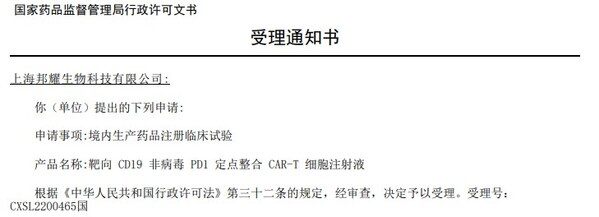
NMPA Acceptance Notice
AboutBRL-201
BRL-201BRL Medicine Utilizes Quikin CART®The CAR-T product targeting CD19 developed by the platform is indicated for relapsed/refractory B-cell non-Hodgkin lymphoma (r/r B-NHL). Notably,This is the worldThe FirstTargetedCD19 Non-viral PD1 Site-specific Integration CAR-T Product,CAR-T cell products with precise genomic integration can be prepared in a single step without the use of viral vectors, offering advantages such as low cost, short preparation time, simple process, and high safety and efficacy. Traditional CAR-T product manufacturing primarily relies on viral vectors, which introduces several significant issues: complex production processes, high costs, long preparation cycles, and potential tumorigenic risks. In comparison, BRL Medicine’s BRL-201 effectively addresses the major challenges associated with viral vector use, demonstrating substantial advantages and potential. Precise integration ensures that each CAR sequence is accurately inserted into a specific site in the genome, avoiding the risk of tumorigenesis caused by random insertion, thus maximizing the safety and efficacy of the CAR-T product. With just one step in the preparation process, it achieves both sustained CAR expression and regulation of endogenous genes in T cells, significantly reducing the overall preparation time for CAR-T products. Additionally, the non-viral production process offers potential cost advantages, benefiting more patients.
About Non-Hodgkin's Lymphoma
NonHodgkin's Lymphoma(non-Hodgkin lymphoma, NHL) It is a malignant tumor of the hematological system that originates in lymphoid tissue, accounting for 80%-90% of all lymphomas. It can occur in patients of all ages, races, and socioeconomic statuses, with incidence increasing with age (median age, 50 years). Even within the same NHL subtype, clinical manifestations can vary significantly among different patients. These can be roughly divided into aggressive or highly aggressive lymphomas, such as Diffuse Large B-Cell Lymphoma (DLBCL, the most common type, accounting for 31%-40% of all NHL) and indolent lymphomas, such as Follicular Lymphoma (FL), which fall into two categories. Data from GLOBOCAN 2020 shows that there were 259,793 global deaths from NHL in 2020, ranking 12th in global cancer mortality. In China, there were 54,351 NHL-related deaths in 2020, including 29,721 men and 24,630 women. NHL treatment typically includes chemoimmunotherapy, combining immunotherapy (e.g., monoclonal antibodies) with chemotherapy, occasionally supplemented by radiotherapy. There is currently no unified standard treatment regimen for R/R DLBCL, and clinical outcomes are generally poor. A multicohort, international retrospective study, SCHOLAR-1, confirmed the poor prognosis of refractory DLBCL patients. This meta-analysis included over 636 patients with relapsed or refractory DLBCL and showed that the overall response rate (ORR) to subsequent treatments was 20%-30%, with complete remission (CR) ≤15%, and a median overall survival (OS) of 6 months.Although the patient's disease was relieved after the initial treatment, recurrence often occurs afterwards. Despite the existingCAR-T products have been approved for clinical treatment of relapsed or refractory non-Hodgkin lymphoma, but the overall efficacy remains limited, with an urgent unmet clinical need.
BRL-201: Safe and Effective, IIT Study Shows Tumor Response Rate Exceeds 87%
In the investigator-initiated clinical trial (IIT) of BRL-201 for the treatment of relapsed or refractory non-Hodgkin lymphoma, which has been conducted in collaboration between BRL Medicine and the First Affiliated Hospital of Zhejiang University School of Medicine,After 8 patients received treatment, no CAR-T-related neurotoxicity or cytokine release syndrome above grade 2 was observed, demonstrating the excellent clinical safety of BRL-201.According to the test results, CAR-T cells can rapidly expand and persist for a relatively long period after infusion into patients.After receiving treatment87.5% of patients achieved complete remission (CR), and all patients responded to the treatment, with an objective response rate (ORR) of 100%.To date, the patients receiving this CAR-T therapyThe longest cancer-free survival period of the patient has exceeded2 years, and is still in a state of complete disease remission. Whether in the treatment of patients with PD-L1 high-expression tumors or under conditions of low CAR-T cell infusion doses and positivity rates, BRL-201 has demonstrated significant efficacy, proving its powerful tumor-killing ability. This research achievement was officially published on August 31, 2022, in the top international academic journal Nature, marking the first CAR-T research result from China to be published in the prestigious journal Nature. This not only represents a major breakthrough by BRL Medicine in the CAR-T field but also signifies that BRL Medicine has successfully stepped into the international first-tier team in gene and cell therapy.
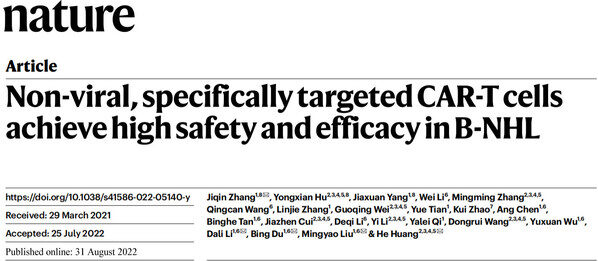
Nature article link: https://www.nature.com/articles/s41586-022-05140-y
BRL Medicine's Next-Generation Quikin CAR-T Product Accepted by CDEBRL MedicineCEO Dr. Zheng Biao stated:"Very pleased that the BRL-201 clinical trial application has been recognized by the CDE, another product from BRL Medicine achieves a milestone progress, which means BRL Medicine has successfully stepped into the international first-tier team in gene and cell therapy. In the future, BRL Medicine will continue to promote the transformation and implementation of innovative drugs for the benefit of patients worldwide."
In response,Professor Mingyao Liu, founder and chairman of BRL Medicine, also stated:"Very pleased that the BRL-201 clinical trial has been accepted by the CDE. This is another rapid breakthrough for BRL Medicine following the IND approval of 'BRL-101 Autologous Hematopoietic Stem and Progenitor Cell Injection' for treating transfusion-dependent thalassemia. BRL-201, without using a virus, can achieve targeted integration of CAR components into the genome and regulate endogenous genes in T cells in one step. This greatly reduces the production cost of CAR-T cells, shortens preparation time, and significantly improves the safety and efficacy of CAR-T cell therapy, benefiting more patients. The related results have recently been published in top international journals."NatureAbove all, I think this provides a milestone concept validation for the safety, efficiency, and feasibility of non-viral targeted integration CAR-T technology; coupled with the smooth acceptance of this IND, it has also greatly increased the momentum and possibilities for us to promote CAR-T therapy from traditional virus-based vectors to non-viral vectors, as well as the implementation of CAR-T integration with other immune function points. As a company committed to becoming a global leader in cell and gene therapy, BRL Medicine will always remain 'patient-centered' in the future, actively promoting the rapid updating and iteration of its R&D products, bringing good news to more patients suffering from cancer.