

Zelixir Launches ZCloud: A Full-Stack Protein Computational Design Platform Aiming to Become the 'EDA' of Biotechnology

Zelixir
Protein Structure Prediction and Design Service Platform Provider

Large Molecule Structure Prediction and Computation Welcomes a New "Powerful Tool".
On September 20, Zelixir (Shanghai Zhiyu Biotechnology Co., Ltd.) announced the official launch of its high-throughput, high-precision, full-ecosystem, end-to-end bio-computing platform "ZCloud" to address computational challenges in large molecule structure prediction, molecular dynamics simulation, drug design, enzyme engineering, and large molecule design (including proteins, nucleic acids, and their complexes).
Previously, Zelixir had launched multiple service modules, including FastAF2, PointSite, Docking, and Virtual Screening, serving over 50 biotech companies and academic institutions. The launch of Zelixir Cloud (ZCloud) this time represents a one-stop ecosystem integration of the company’s various service modules, achieving an industrial-level leap in both computational accuracy and speed.
Regarding the release of Yuyun ZCloud this time, Dr. Wang Sheng, CEO of Zelixir, stated, "Zelixir possesses expertise and innovation in large molecule structure computation and design. We are committed to building an intelligent synthetic biology design system, providing customers with low-cost, high-efficiency one-stop solutions for complex and challenging drug development projects. Ultimately, AI-based high-precision computing services can not only assist in the discovery of new drug molecules but also partially replace preclinical trials, allowing artificial intelligence to truly move from research experiments to industrial applications and production."
"At present, China and foreign countries are basically at the same starting line in the fields of AI-assisted pharmaceuticals and synthetic biology. Zelixir hopes to build ZCloud into the 'EDA (Electronic Design Automation)' of biotechnology, independently developing core technologies to ensure that the 'bottleneck' risks currently faced in the semiconductor field do not reappear in the biotech industry!" said Wang Sheng.
According to Anfinsen's rule, the amino acid sequence of a protein determines its three-dimensional structure, and this three-dimensional structure is the basis for the protein to perform its biological function, directly relating to the exploration of disease causes and treatment methods by humans. However, due to the multi-level structure of proteins and their complex interactions, accurately predicting the three-dimensional structure is highly challenging.
In 2020, AlphaFold2, developed by DeepMind, emerged and achieved an accuracy close to experimental error in the prediction of most protein monomer structures for the first time, profoundly impacting protein structure prediction and related fields. However, since AlphaFold2 did not release its training code, and the code is based on the JAX framework and TPU hardware implementation, heavily relying on Google's internal ecosystem, this presents significant usage limitations for the vast majority of biotech companies and researchers. On the other hand, the large and complex model of AlphaFold2 results in high costs for data processing and training, which are difficult for most researchers to bear.
Zelixir has chosen to further iterate and upgrade on the basis of AlphaFold2. While ensuring prediction accuracy, it has made substantial industrial-level improvements in the computational efficiency of each module, while integrating a new ecological paradigm to achieve full-process automation for protein development and synthetic biology.
Starting with structural modeling does not mean ending with structural modeling.
Currently, in addition to protein structure computation, the Zelixir ZCloud platform offers several cutting-edge algorithms in the field of bio-computation. These cover a wide range of areas including macromolecular design, molecular simulation, free energy calculation, drug molecule discovery, sequence and structure retrieval, and more. This is to meet various application scenarios in the drug development or synthetic biology component design process, such as sequence optimization, high-throughput structure prediction, binding site prediction, virtual screening, and free energy perturbation.
All of this is not a simple accumulation. In the process of building the ZCloud platform, Zelixir has focused more on breaking down usage barriers between different algorithms, linking various sub-modules into a complete, mutually supportive ecosystem to achieve a result where 1+1 is greater than 2. For different problems, each module can be creatively combined in any way, greatly enriching applicable scenarios.
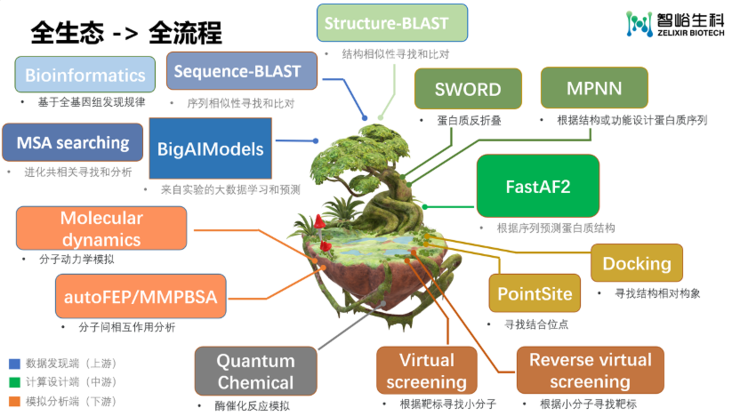
ZCloud Full Ecosystem Platform, Source: Zelixir
While becoming the "Swiss Army Knife" in the biotech field, the high precision of Zelixir's ZCloud platform computing is also guaranteed.
From the highly efficient and precise protein structure modeling tool fastAF2, to the independently developed, distinctive high-precision macromolecule (including proteins and nucleic acids) design algorithm SWORD, to advanced technologies such as high-precision absolute free energy calculation (autoFEP), high-accuracy binding pocket detection (PointSite), and high-precision molecular docking and screening (autoLigand), multiple self-developed algorithms from ZCloud have already demonstrated outstanding performance in collaborative projects with academic institutions and pharmaceutical companies.
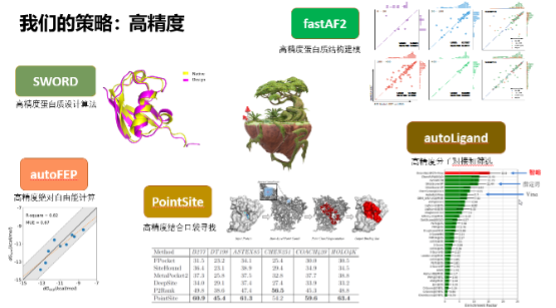
High-Precision Strategy, Source: Zelixir
More aligned with the needs of developers, the Zelixir ZCloud platform has also focused on optimizing the operational usage level, providing an easy-to-operate interface and visual graphic tools for user convenience. Additionally, by leveraging a "private cloud + public cloud" model, the Zelixir ZCloud platform has built a full industrial chain from structure-based approaches, high-throughput screening, lead optimization, molecular evaluation and recommendation, to synthetic biology-related modules, offering the capability to provide secure, private, large-scale, and high-throughput computing services.
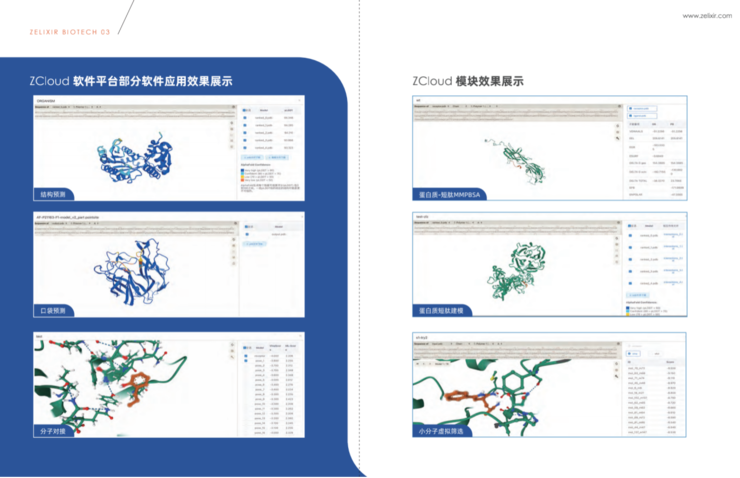
Zelixir ZCloud Application Effects and Module Effect Display
"Full ecosystem, full process, and fully useful—these were the key goals we aimed to achieve when designing Zelixir ZCloud. Based on the outcomes of current collaborative projects related to drug discovery, these objectives have been largely realized," pointed out Dr. Wang Sheng. As a more fundamental general platform, Zelixir ZCloud now covers every aspect of the drug discovery process, empowering biopharmaceutical companies to complete pre-research for new drug development at the touch of a button. "Pharmaceutical companies can subsequently refer to the computational results to smoothly carry out drug discovery tasks."
It is worth mentioning that when used in conjunction with Zelixir's self-developed ZPod integrated "mini" data center, the performance of ZCloud can be further enhanced to an even higher level.
Users can achieve linear expansion by purchasing multiple ZPods to obtain more powerful computing capabilities, and the elastic expansion of storage and computing power across multiple ZPods ensures a seamless acceleration experience. In addition to software and hardware co-optimized biochemical computing, the ZPod itself is also a professional HPC heterogeneous cluster. By utilizing the latest CPUs, GPUs, networking, and storage hardware, it ensures that the cluster's aggregate IO, computing, communication, and linear scalability are maximized.
In the view of Dr. Wang Sheng, CEO of Zelixir, after the launch of ZCloud, the new generation molecular design technology that combines "AI + macromolecular modeling + high-performance computing" enables Zelixir to significantly optimize the accuracy, efficiency, and cost of drug molecular design. This lays a solid foundation for advancing macromolecules (including proteins and nucleic acids) and synthetic biology from academic research to industrial implementation.
Based on its excellent performance, the Zelixir ZCloud platform has become an important tool for biotech companies and researchers to achieve one-stop compound molecule discovery and design.
Currently, various modules of the ZCloud platform by Zelixir have been widely adopted. Within 12 months of its launch, over 50 biotech companies and academic institutions have utilized Zelixir's ZCloud modules to predict more than 500,000 protein and nucleic acid structures, discovering previously unknown novel enzymes. This progress has significantly advanced research on real-world issues such as human health, candidate vaccines for monkeypox, animal immunity, and biosynthetic products.
According to publicly available information, based on protein structure prediction, in the first half of the year, Zelixir collaborated with a well-known biotechnology company, mainly focusing on the development and production of high-end difficult protein raw materials and auxiliary reagents. It also cooperated with a well-known CRO company in the direction of high-throughput assisted drug design and new drug molecule discovery. Previously, Dr. Wang Sheng also stated that he hoped to bring “AI + molecular design” into actual projects through various collaborations with industry players and academic institutions, based on Zelixir's expertise and innovation in macromolecular structure calculation and design.
"Studying key targets of a certain microorganism and potential drug molecules for treating infections caused by it; finding the most suitable short peptide linker for ADC drugs; providing mechanism explanations and molecular optimization designs for drug discovery platforms...” In fact, the potential of Zelixir's ZCloud goes beyond just this.
In June this year, the World Health Organization assessed the global public health risk of monkeypox as moderate. Just a few days later, Zelixir, based on its ZCloud platform, released full protein structure predictions for more than 600 monkeypox proteomes, along with detailed and clear protein function annotations, assisting scientists worldwide in vaccine and drug design for monkeypox virus based on protein structures. The research results were subsequently cited by Li Lanjuan, an academician of the Chinese Academy of Engineering and an expert in infectious diseases.
Notably, based on the protein structure prediction results provided by ZCloud, Zelixir has formed a complete industrial value chain closed-loop service that integrates large molecule structure prediction, design, and production, and has begun to continuously explore and broaden the boundaries of synthetic biology.
Generally speaking, synthetic biology often adopts the "bottom-up" concept of engineering, characterizing biological macromolecules with catalytic regulation and other functions in nature systematically to transform them into standardized "components." It then proceeds to create entirely new biological parts such as "modules," "circuits," and cellular "chassis," ultimately constructing artificial life systems for various applications.
From a fundamental perspective, synthetic biology requires the design and implementation of various foundational components, such as catalytic elements, regulatory elements, sensory elements, and structural elements. In this regard, Zelixir has never ceased exploring. Besides achieving significant breakthroughs in the design and modification of core catalytic elements (e.g., enzymes), a series of algorithms on the ZCloud platform have enabled structural calculations for single nucleic acids (e.g., RNA) as well as protein-nucleic acid complexes, facilitating the precise design of regulatory elements. Based on the important functional characteristics of RNA-based regulatory elements, extensive exploration is being conducted in the field of synthetic biology. Additionally, through its standardized and automated design, the ZCloud platform has, to a certain extent, realized the engineering design principles promised by synthetic biology.
According to Zelixir's vision, at the upstream end, by relying on strong macromolecular structure prediction and design capabilities, the company can address key challenges in the drug development process based on customer needs, while also creating a precise "blueprint" for its own synthetic biology products. At the downstream end, the company has mastered various production processes, including scaling up, process development, strain design, and metabolic engineering, and is advancing its layout in the synthetic biology field based on the prediction and design results generated upstream.
"These concepts can all be realized based on the powerful protein structure prediction capabilities of Zelixir's ZCloud. Reviewing the full ecological cycle acceleration model of the ZCloud platform, we see that it has already brought AI into an era of industrial-scale implementation." According to Wang Sheng, predicting a protein with a length of 655 would take the AlphaFold model 11 hours. Now, the fastAF2 model under the ZCloud platform can screen the target protein in just 6 minutes, achieving an acceleration of 110 times.
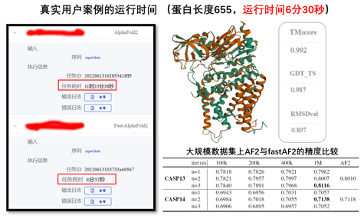
Source: Zelixir ZCloud platform fastAF2 online prediction (https://cloud.zelixir.com/fastaf2/#/fast-af2)
"This is the dawn of the AI-driven biological industrial era, an exciting breakthrough in large molecule industrialization. In the future, I believe Zelixir can utilize the ZCloud system to improve medicine, energy, environment, and other related fields through drug discovery and synthetic biology, bringing a visible revolution to biotechnology, especially synthetic biology!" said Wang Sheng.Leifeng.com(Official Account: Lei Feng Network)Leifeng.com
Original article by Leifeng.com, reprint prohibited without authorization. For details, seeReprint Notice。