

Amgen's Oral PDE4 Inhibitor Otezla Achieves Success in Phase 3 Trial for Pediatric Plaque Psoriasis

Amgen
Developer of Treatment Drugs for Serious Diseases

Image Source: Shutterstock
News on September 22, 2022 / BIOON / -- Amgen recently announced significant results for the oral anti-inflammatory drug Otezla (apremilast)Phase 3 Clinical Study Results Confirm the Efficacy of Otezla in Pediatric Patients with Moderate to Severe Plaque PsoriasisSpecifically, data from the Phase 3 SPROUT (PPS0-003) study showed that in children aged 6-17 with moderate to severe plaque psoriasis,At Week 16 of treatment, Otezla demonstrated significant improvements in efficacy assessment measures compared to placebo.In the study, adverse events were consistent with the known safety profile of Otezla. These results are highly encouraging, indicating that Otezla has the potential to offer a valuable new treatment option for the pediatric patient population, who currently have limited therapeutic options.
Otezla is an oral, selective phosphodiesterase 4 (PDE4) small molecule inhibitor approved for three adult treatment indications (mild, moderate, and severe plaque psoriasis, active psoriatic arthritis, and Behçet's disease-related oral ulcers).It is worth mentioning that,Otezla is the first and only oral therapy approved for adult patients with plaque psoriasis across all disease severities, including mild, moderate, and severe. Otezla can be used to treat all adult patients with plaque psoriasis, regardless of disease severity.
SPROUT (PPS0-003) is a multicenter, randomized, double-blind, placebo-controlled, Phase 3 study investigating the efficacy and safety of Otezla in pediatric patients aged 6-17 with moderate to severe plaque psoriasis. The enrolled patients had inadequate disease control or were intolerant to topical therapies. Moderate to severe plaque psoriasis was defined as: body surface area (BSA) involvement ≥10%, Psoriasis Area and Severity Index (PASI) score ≥12, and static Physician Global Assessment (sPGA) score ≥3.
In the study, a total of 245 patients were randomly assigned in a 2:1 ratio to receive either Otezla 20mg (body weight 20-50kg) or Otezla 30mg (body weight ≥50kg) orally twice daily, or placebo, for 16 weeks. Thereafter, all patients received Otezla during an open-label extension period up to Week 52. The primary endpoint was the percentage of patients achieving an sPGA response at Week 16 (sPGA response defined as an sPGA score of 0 [completely clear skin] or 1 [almost completely clear skin], and a reduction of at least 2 points from baseline).
The results showed,The study met its primary endpoint: at week 16 of treatment, 33.1% of patients in the Otezla group achieved sPGA response, compared to 11.5% in the placebo group (p<0.0001).. In addition,The study also met the key secondary endpoint: a higher proportion of patients achieved PASI 75 response (a 75% or greater reduction in PASI score), with 45.4% in the Otezla group compared to 16.1% in the placebo group (p<0.0001).
In the study, adverse events were consistent with the known safety profile of Otezla. The most common adverse events (incidence ≥5%) were diarrhea (20.2%), nausea (19.6%), abdominal pain (19.7%), vomiting (17.8%), headache (10.4%), fever (6.7%), nasopharyngitis (6.1%), and upper abdominal pain (5.5%).
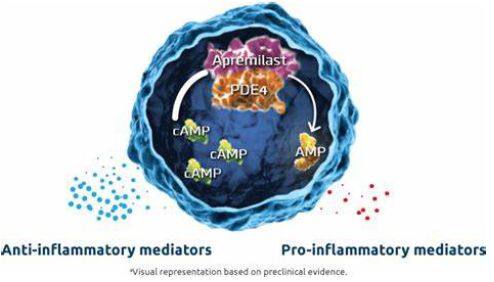
Mechanism of Action of Apremilast (Image Source: otezlapro.com)
Psoriasis is a serious chronic inflammatory disease that can cause raised, red, scaly patches on the skin, commonly affecting the outer sides of elbows, knees, or the scalp, but can also appear on any part of the body. Approximately 125 million people worldwide suffer from psoriasis, including around 14 million in Europe and over 8 million in the United States. About 80% of these patients have plaque psoriasis.
Otezla (apremilast) is an oral, selective phosphodiesterase 4 (PDE4) small molecule inhibitor that regulates a network of pro-inflammatory and anti-inflammatory mediators within cells. PDE4 is a cyclic adenosine monophosphate (cAMP)-specific PDE and is the predominant PDE in inflammatory cells. Inhibition of PDE4 leads to elevated intracellular cAMP levels, which is believed to indirectly modulate the production of inflammatory mediators.The specific mechanism by which Otezla exerts its therapeutic effects in patients is not yet clear.
Currently, Otezla has been approved for three therapeutic indications: (1) the treatment of adult patients with mild, moderate, or severe plaque psoriasis who are candidates for phototherapy or systemic therapy; (2) the treatment of adult patients with active psoriatic arthritis; (3) the treatment of adult patients with oral ulcers associated with Behçet's disease. Since its first approval by the U.S. FDA in 2014, more than 700,000 patients worldwide have been treated with Otezla. (Bioon.com)
Source: AMGEN ANNOUNCES POSITIVE NEW DATA AT EADV 2022 FOR OTEZLA® (APREMILAST)