

EU Approves First-in-Class TSLP-Targeting Monoclonal Antibody Tezspire for Severe Asthma Without Phenotypic or Biomarker Restrictions

AstraZeneca
Biopharmaceutical Manufacturer

Amgen
Developer of Treatment Drugs for Serious Diseases

European Commission
The European Commission, abbreviated as the EU Commission, is a supranational body under the European Union. Within the EU political system, the European Commission primarily undertakes executive tasks, thus being roughly equivalent to the government in a national system. However, the European Commission has other functions as well. In particular, except for the few circumstances specified in the treaties, the European Commission is the only institution with legislative power in the EU legislative process.

Image Source: Shutterstock
News / BIOON / -- AstraZeneca and Amgen recently announced jointly that the European Commission (EC) has approved Tezspire (tezepelumab): as an add-on maintenance therapy for patients with severe asthma aged ≥12 years who are inadequately controlled despite receiving high-dose inhaled corticosteroids (ICS) and other medications.
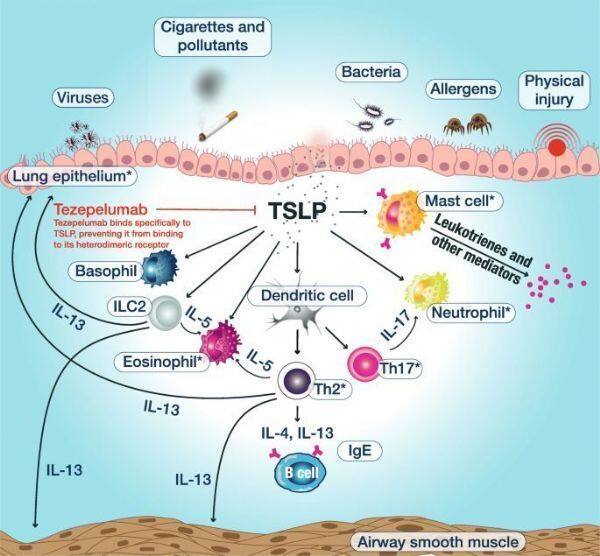
Tezspire is a first-in-class biologic that works at the top of the inflammatory cascade by blocking thymic stromal lymphopoietin (TSLP). TSLP is an epithelial cytokine that plays a key role in asthma inflammation.
Severe asthma is a complex disease, with approximately 60% of patients having multiple inflammatory drivers. Despite some progress in recent years, many patients still experience frequent exacerbations, increased risk of hospitalization, and significantly reduced quality of life.
Particularly worth mentioning is,In the treatment of severe asthma, Tezspire is the only biologic without phenotypic (such as eosinophilic or allergic) or biomarker restrictions. For the first time, many patients with severe asthma have the opportunity to receive treatment regardless of the inflammatory cause of their disease.
Clinical data shows,Across a broad population of severe asthma patients, regardless of key biomarkers (including: eosinophil count, allergic status, fractional exhaled nitric oxide [FeNO]), Tezspire consistently and significantly reduces asthma exacerbations, with the potential to transform treatment for a wide range of severe asthma patients.
This EU approval was based on the results of the PATHFINDER clinical program, which included the pivotal Phase 3 NAVIGATOR trial. The trial demonstrated that, in a broad population of patients with severe uncontrolled asthma, tezepelumab showed superiority across all primary and key secondary endpoints when added to standard therapy, compared to placebo.
The NAVIGATOR trial is the first Phase 3 trial to demonstrate therapeutic benefits in severe asthma by targeting TSLP. The results of this trial were published in May 2021 in the prestigious international medical journal, The New England Journal of Medicine (NEJM). For more details, see: Tezepelumab in Adults and Adolescents with Severe, Uncontrolled Asthma.
The results showed,In the entire patient population, compared with placebo + standard of care (SoC), tezepelumab + SoC treatment significantly reduced the annual asthma exacerbation rate (AAER) by 56% over 52 weeks., with statistically significant and clinically meaningful differences (AAER: 0.93 vs 2.10; RR=0.44; p<0.001).Regardless of blood eosinophil count, allergic status, or FeNO level, patients receiving tezepelumab treatment showed a significant reduction in AAER compared to placebo.In the trial, SoC was medium- or high-dose inhaled corticosteroids (ICS) plus an additional controller medication, with or without oral corticosteroids (OCS).
Moreover, in the subgroup of patients with baseline eosinophil count <300 cells/microliter, the trial also met the primary endpoint: compared with placebo + SoC, tezepelumab + SoC treatment resulted in a statistically significant and clinically meaningful reduction in AAER. A similar reduction in AAER was observed in the subgroup of patients with baseline eosinophil count <150 cells/microliter. In this study, tezepelumab showed good tolerability in patients with severe asthma, and there was no clinically meaningful difference in safety outcomes between the tezepelumab group and the placebo group.
Treating severe asthma is a significant challenge due to the complexity of the disease often driven by multiple inflammatory pathways. These results highlight the transformative potential of tezepelumab in treating a broad population of severe asthma patients, regardless of their inflammatory phenotype.
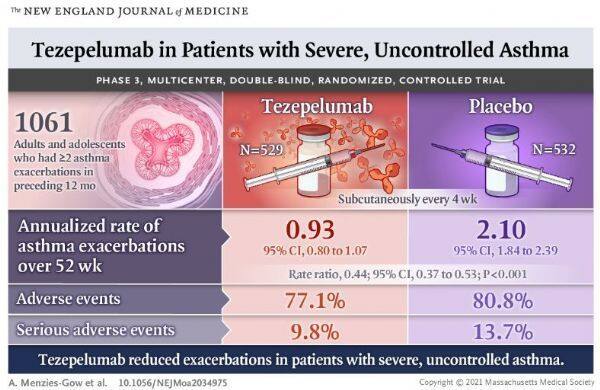
NAVIGATOR Clinical Trial Data (Image source: Literature DOI:10.1056/NEJMoa2034975)
TSLP is an epithelial cell factor produced in response to pro-inflammatory stimuli, such as allergens, viruses, and other pathogens in the lungs, playing a key role in the onset and persistence of airway inflammation.TSLP drives the release of downstream T2 cytokines, including IL-4, IL-5, and IL-13, leading to inflammation and asthma symptoms.TSLP can also activate various types of cells involved in non-T2-driven inflammation. Therefore, TSLP's early upstream activity in the inflammatory cascade has been identified as a potential target in a broad population of asthma patients. Blocking TSLP can prevent immune cells from releasing pro-inflammatory cytokines, thereby preventing asthma exacerbations and improving asthma control.
The active pharmaceutical ingredient in TezspireTezepelumab is a first-in-class anti-TSLP monoclonal antibody drug that specifically binds to human TSLP and blocks its interaction with the receptor complex, thereby preventing the release of pro-inflammatory cytokines by TSLP-targeted immune cells, preventing asthma attacks, and improving asthma control.By acting on the early upstream of the inflammatory cascade, tezepelumab may be suitable for a wide range of patients with severe uncontrolled asthma, regardless of patient phenotype or T2 biomarker status.
Severe asthma is a debilitating disease that affects approximately 34 million people worldwide. Due to the complexity of severe asthma, many patients continue to experience symptoms and frequent exacerbations despite receiving standard-of-care inhaled medications, currently available biologic therapies, and oral corticosteroids (OCS).
Tezspire works differently from any other asthma biologic, targeting multiple inflammatory pathways that contribute to asthma symptoms and exacerbations. Tezspire has the potential to transform care for a broad population of severely asthmatic patients who are currently underserved, including those without an eosinophilic phenotype.
Currently, Tezspire is being co-developed by AstraZeneca and Amgen. The industry believes that the approval and market launch of Tezspire will create intense competition in the asthma treatment field. Its target patient population will be much larger than the biologic therapies currently on the market, including GSK's Nucala (mepolizumab, targeting IL-5), Teva's Cinqair (reslizumab, targeting IL-5), as well as biologic therapies currently under development for asthma treatment, such as AstraZeneca’s own benralizumab (targeting the IL-5 receptor alpha subunit [IL-5Rα]) and Sanofi’s Dupixent (targeting IL-4/IL-13). All four of these therapies only target specific inflammatory molecules driving asthma inflammation and are only suitable for certain types of severe asthma patients, namely subgroup patients, such as those with eosinophilic asthma. (Bioon.com)
Source: Tezspire approved in the EU for the treatment of severe asthma