

Once-Weekly Insulin Icodec Reduces Injection Burden from 365 to 52 Annually and Demonstrates Superior Glycemic Control vs. Once-Daily Degludec in Type 2 Diabetes
Novo Nordisk
Insulin Developer and Manufacturer

Image Source: Shutterstock
News on September 27, 2022 / BIOON / -- Novo Nordisk recently presented new data from the ONWARDS 2 trial at the 58th Annual Meeting of the European Association for the Study of Diabetes (EASD) in 2022. This was a 26-week Phase 3a treat-to-target trial that enrolled 526 patients with type 2 diabetes who were previously using once-daily insulin injections, comparing switching toWeekly injection of insulin icodec versus daily injection of insulin degludecThe efficacy and safety. The primary endpoint of the trial was the change in glycated hemoglobin (HbA1c) at week 26 of treatment in the two treatment groups.
Icodec insulin is a novel ultra-long-acting basal insulin injected once weekly, designed to meet the weekly basal insulin requirement through a single subcutaneous injection.。Currently, the longest-lasting basal insulin product requires once-daily injection.Novo Nordisk is currently conducting Phase 3 clinical development of icodec insulin, which has the potentialSignificantly reduce the injection burden for diabetes patients, from 365 times per year to 52 times per year.
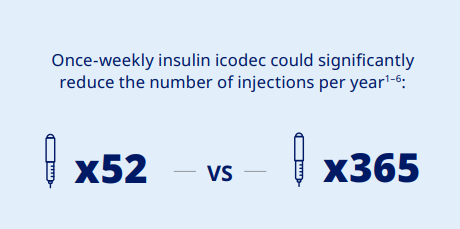
Image Source: Novo Nordisk
New data presented at the EASD Annual Meeting showed,During the 26-week treatment period, 37% of patients in the icodec insulin treatment group did not experience severe or clinically significantHypoglycemia, while the proportion in the degludec insulin treatment group was 27%.
The trial met the primary endpoint:At Week 26 of treatment, once-weekly injection of icodec insulin was non-inferior to once-daily injection of degludec insulin in reducing HbA1c.。In fact, icodec insulin is superior to degludec insulin in lowering HbA1c.: Compared with the average baseline HbA1c levels of 8.17% (icodec insulin group) and 8.10% (degludec insulin group),Once-weekly icodec insulin achieved an estimated HbA1c reduction of -0.93%, compared to a -0.71% reduction with degludec insulin (estimated treatment difference: -0.22%).
According to the Diabetes Treatment Satisfaction Questionnaire (DTSQ) assessment: during the 26-week treatment period in the ONWARDS 2 trialPatients with diabetes reported significantly higher satisfaction with once-weekly injections of icodec insulin compared to once-daily injections of degludec insulin.
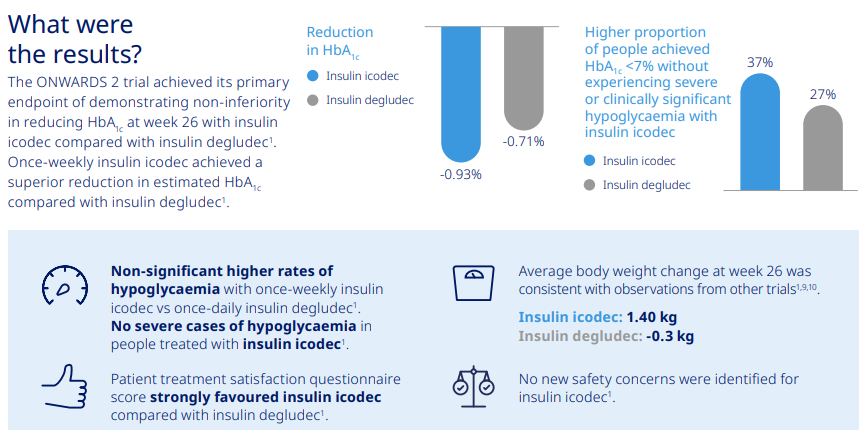
Image Source: Novo Nordisk
The average weekly insulin dose for icodec insulin was 268 U/week, compared to 244 U/week for degludec insulin. From baseline to Week 26, the estimated mean change in body weight for patients in the icodec insulin group was +1.40 kg, while for the degludec insulin group, it was -0.30 kg.
In the trial, once-weekly injection of icodec insulin demonstrated safe and well-tolerated properties. The incidence of hypoglycemic events was less than 1 event per patient-year in both treatment groups (0.73 events per patient-year for icodec insulin and 0.27 events per patient-year for degludec insulin, with no statistically significant difference between the two groups). As previously mentioned, no severe hypoglycemic events were observed in patients treated with icodec insulin. (Bioon.com)
Source: More people with type 2 diabetes achieved blood sugar target with once-weekly insulin icodec compared with once-daily insulin degludec