

LambdaVision Advances Protein-Based Artificial Retina with Microgravity Manufacturing: Files for IPO

Lambda vision
Artificial Retina Developer
Vision is an important source for humans and most animals to perceive external information. The realization of visual function relies on a complete visual circuit and a healthy periocular environment. When retinal cells undergo progressive apoptosis, the integrity of the retina is disrupted until visual function is completely lost, leading to the occurrence of retinal degenerative diseases.
Retinal degenerative diseases are chronic ophthalmic conditions, primarily divided into two major categories: hereditary retinal degenerative diseases and retinal degenerative diseases caused by complex retinal degeneration. The former mainly includes retinitis pigmentosa (RP), while the latter includes age-related macular degeneration (AMD), among others.
According to a 2020 survey, there are as many as 30 million patients with retinal degenerative diseases worldwide.In China, visual impairment is the second leading cause of disability after hearing impairment, affecting more than 3.3% of the Chinese population to varying degrees.With the extension of average life span and the development of social aging, the global blindness rate caused by retinal degenerative diseases continues to increase, seriously affecting the quality of individual life.
Currently, the main treatment methods for this disease include drug therapy, gene replacement therapy, stem cell therapy, and retinal prosthesis transplantation. The efficacy of each therapy varies depending on the type of cause and stage of the retinal degenerative disease. AndIn the field of vision restoration, retinal prosthesis transplantation is one of the more ideal therapies.
Many startups are conducting their own research projects on retinal prosthesis transplantation. LambdaVision, Inc. is one of them.
In 2009, LambdaVision was co-founded by Robert R. Birge, Nicole L. Wagner, and Kirk Dornbush, with its headquarters located in Connecticut, USA. Unlike traditional retinal prosthetics that utilize rigid materials, LambdaVision adopts aProtein-Based Retinal Prosthesis, providing a method to restore vision for blindness or late-stage retinal degenerative diseases (including RP and AMD).
Currently, LambdaVision has received over $8 million in funding from local and national research funds in the United States. In April 2020, the company secured an additional $5 million in NASA funding and signed a long-term contract with NASA and long-term partner Space Tango. This contract covers all flight missions to the International Space Station over three years, aiming to refine and produce its core product—a protein-based artificial retina.
Why Did Lambda Vision Win Multiple U.S. National Research Grants? What Sets Protein-Based Artificial Retinas Apart from Other Mediums? Could the Microgravity Environment in Space Bring Breakthroughs and Changes to the Production of Protein Retinal Prosthetics?
Pioneer in Light-Sensitive Protein Research Leads Entrepreneurship
The founder of LambdaVision, Inc. is Robert R. Birge.Pioneer in the Field of Photosensitive Proteins, and has successively held teaching and research positions at the University of California, Riverside, the Department of Chemistry at Carnegie Mellon University, the University of Connecticut, and other institutions, publishing over 250 research papers.Owning five patents related to the use of proteins for creating holographic associative memory, three-dimensional paging memory, and hybrid protein-semiconductor devices.U.S. and international patents.
LambdaVision, Inc. President and CEO Nicole L. Wagner studied under Professor Robert, during which she obtained her Ph.D. in Molecular and Cellular Biology from the University of Connecticut. Since 2007, Nicole has been dedicated to the application of retinal proteins. During her doctoral studies, she collaborated with the technical team to make discoveries.Natural bacterial rhodopsin can be used to manufacture retinal prostheses.。
The other founder, Kirk Dornbush, hasMore than 15 years of experience in the biotechnology fieldIn 2003, Kirk co-founded Iconic Therapeutics – the company’s lead product candidate, ICON-1, is a recombinant protein based on FVIIa, used for treating various diseases, including wet age-related macular degeneration (wet AMD) and cancer.
Lambda vision originated from the campus entrepreneurship program of Robert and Nicole, a teacher-student duo at the University of Connecticut (UConn), as part of UConn's technology incubator initiative. After receiving funding support from local and national sources, Lambda vision leveraged this groundbreaking technological discovery to establish new collaborations with organizations such as NASA and Space Tango.
Treatment of Retinal Degenerative Diseases: Retinal Prosthesis Transplantation is More Ideal
The main treatment methods for retinal degenerative diseases include drug and neuroprotective factor therapy, gene replacement therapy, stem cell therapy, cell regeneration, and retinal prosthesis transplantation.
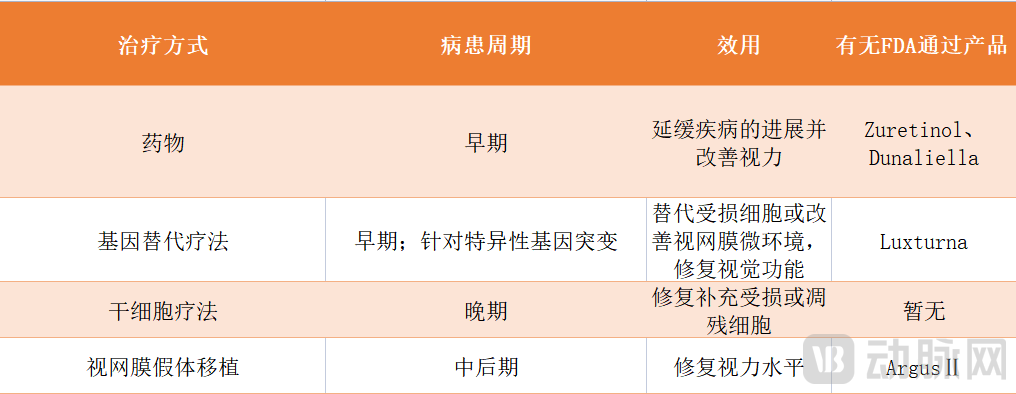
Drug therapy is a conservative adjunctive treatment method that can delay the progression of the disease and improve vision to a certain extent, but its therapeutic effect is very limited. As a supplement to drug therapy, a series of neuroprotective agents are also being developed in clinical practice.
Gene replacement therapy has experienced rapid development in recent decades, but the therapy mainly faces two issues: one is the small capacity of viral vectors, and the other is that the method of administration can easily lead to retinal detachment or macular holes.
Due to the small number of retinal cells and their immune-privileged characteristics, stem cell transplantation has become an ideal approach for repairing and replenishing damaged or degenerated cells. In recent decades, there have been up to 69 clinical applications related to stem cell therapy, but only two projects have advanced to Phase III clinical trials.
The principle of retinal prosthesis transplantation is to convert visual signals into electrical signals to directly stimulate the inner layer cells of the retina, thereby helping blind patients restore light perception. In 2013, Argus II, developed by Second Sight, received FDA approval, but after five years of implantation, 40% of patients experienced serious adverse events.
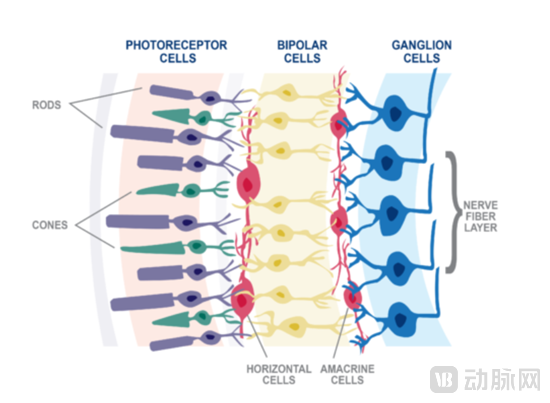
Diagram of Ocular Cells Source: Lambda Vision Official Website
Human efforts to restore vision have never ceased, and methods for visual repair have emerged one after another, but so far, there is no therapy that can fully restore vision.
Drug treatment can only alleviate the progression of visual degeneration to a certain extent, but cannot reverse it; gene therapy is only effective in treating early-stage retinal degenerative diseases caused by specific genetic mutations; although stem cell therapy can be used for late-stage retinal degenerative diseases, it has significant clinical side effects, and no related products have been approved for clinical treatment yet.Relatively speaking, retinal prosthesis transplantation is one of the ideal therapies in the field of vision restoration., the best vision patients can achieve after implantation of the prosthesis is 20/546, but it still cannot help patients obtain fine visual information at present.
Biomaterial-based Artificial Retinas Gain More Clinical Favor
There are two forms of retinal prosthesis transplantation: epiretinal transplantation, which resembles a pair of glasses and perceives external information through electronic signal stimulation captured by external devices; and subretinal transplantation, which operates on the same principle of electronic signal capture but involves implanting the prosthesis beneath the retina. Epiretinal transplantation requires various external hardware components, such as lenses and surgically implanted external devices. Therefore, clinically, there is a pursuit for a...Less invasive and with fewer adverse reactionsRetinal implants to restore partial vision in patients.
So far, traditional retinal prosthetic materials are mostly rigid materials, which have the advantages of resisting deformation and stability. However, these materials are all exogenous and not naturally present in living organisms.
Unlike existing retinal implants, LambdaVision uses proteins cultured from cells.All-natural, biodegradable, free of exogenous foreign substances or other living components. And precisely because of this, this implantLess invasive than mechanical devices, and the body is less likely to have an adverse reaction to it.

The human eye is highly sensitive, so implants like metal retinas can be highly disruptive, causing inflammation and even rejection reactions.The biosynthetic implant is relatively soft, composed of hydrogel and bioproteins, and exhibits excellent affinity.。
Supported by NASA, protein-based retina trials have commenced in space
The purple light-activating molecule relied on by LambdaVision — bacteriorhodopsin — is the sole protein found in the purple membrane of Halobacterium halobium, a microorganism discovered in highly saline marshes. Halobacterium halobium belongs to the archaea domain and represents one of the oldest life forms on Earth.
This protein was isolated from a high-salt environment, grown and purified in the laboratory, and is similar to the photopigments found in cone cells.Able to react with light, using pigments like a camera to detect external scenes, generating electrical signals to stimulate the cerebral cortex.`, establish a grayscale-based image to mimic and implement the function of the retina.`
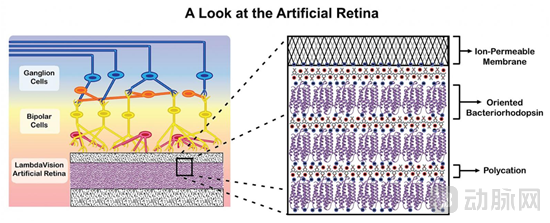
Working Principle of Protein-Based Retinal Prostheses Source: LambdaVision Official Website
The retinal prosthesis studied by LambdaVision is primarily fabricated through a layer-by-layer deposition process — immersing the substrate in various solutions and building multiple layers. This involves a piece of gauze being moved hundreds of times across multiple beakers.In a natural gravity environment, repeated sedimentation, evaporation, convection, and other factors may potentially affect the uniformity and stability of this film formation.Under NASA's Low Earth Orbit Space Economy Program, moving the production and improvement of proteins to the microgravity environment of the space station has become a new way to reduce the impact of gravity.
2016Lambda visionWon the CASIS-Boeing Technology Award at the Massachusetts Challenge and conducted the first experiment on the space station two years later.In a microgravity environment, when protein structures are in a state of free fall, they can form better layers of retinal proteins, improving the manufacturing process on Earth. Conducting medical experiments in a microgravity environment has great potential to help humanity overcome diseases.
In June 2019, NASA opened the International Space Station to industry partners who wish to manufacture, market, and promote commercial products and services in microgravity. In addition to Lambda Vision, NASA is providing seed funding to six other companies to explore product manufacturing on the International Space Station.
In April 2020, NASALambda visionAllocate $5 million to explore the production and evaluation of bacteriorhodopsin protein in near-Earth orbit space stations.As a long-term partner of Lambda Vision, Space Tango focuses on creating a low-Earth orbit market 250 miles away from Earth. It has built a mini-laboratory called CubeLabs, where one of the laboratories is conducting Lambda Vision's experiment.
In 2021, NASA launched four astronauts to the space station through SpaceX's 24th commercial resupply mission. The rocket carried LambdaVision's mini-laboratory, and this ongoing experiment is also part of NASA's efforts to develop a multi-billion-dollar low Earth orbit (LEO) space economy.
In May this year, NASA once again brought the Lambda vision experiment to the space station, with an expected six-month observation period. Nicole L. Wagner, CEO of Lambda vision, said, "Even if experiments are conducted on the space station, it will take approximately three years before true clinical trials can begin.。”