AstraZeneca to Acquire LogicBio Therapeutics for $68 Million to Strengthen Rare Disease Portfolio

AstraZeneca
Biopharmaceutical Manufacturer

Alexion
Developer of New Drugs for Rare Disease Treatment

LogicBio Therapeutics
Gene Therapy Drug Developer
01
Double Down on Rare Disease Layout
Recently, AstraZeneca and its subsidiary Alexion Pharmaceuticals agreed to acquire LogicBio Therapeutics at a price of $2.07 per share, for approximately $68 million (about 484 million RMB).
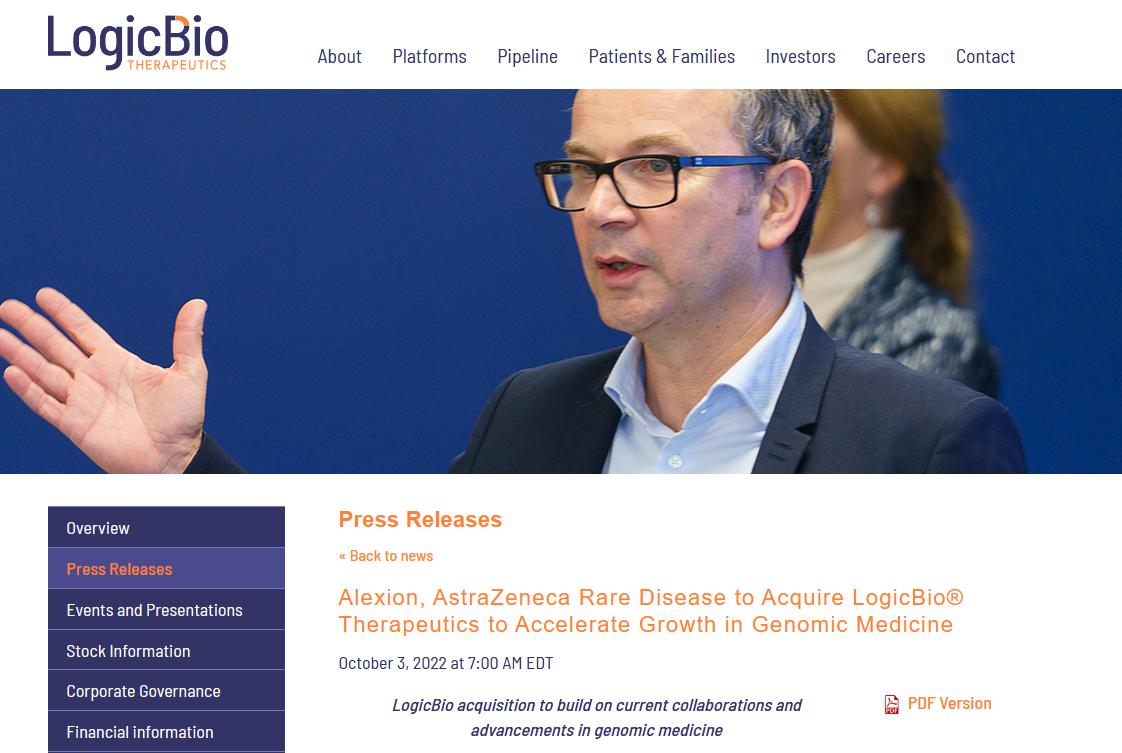
Source: LogicBio official website
LogicBio Therapeutics, Inc., founded in 2014, is a clinical-stage genomic medicine company based in Lexington, Massachusetts, focused on treating various genetic disorders, including rare diseases. The company is currently primarily dedicated to developing novel gene therapies for pediatric patients with rare diseases.
LogicBio Therapeutics has two technology platforms: GeneRide and sAAVy. GeneRide is a gene editing platform that utilizes the cell's natural DNA repair process, enabling the insertion of corrective genes into the human genome while avoiding risks associated with other gene therapy and gene editing technologies.
Currently, Alexion has leading complement inhibition technology for treating various rare diseases caused by the uncontrolled activation of the complement system, an important part of the immune system. Among its well-known treatments is Soliris, a drug for atypical hemolytic uremic syndrome and paroxysmal nocturnal hemoglobinuria.
It is reported that this proposed acquisition will bring LogicBio’s unique technology, an experienced rare disease team, and expertise in preclinical development to support Alexion's growth in genomic medicines.
Notably, LogicBio Therapeutics' closing price last Friday was only 27.3 cents, and the current acquisition price is more than seven times that.
LogicBio President and CEO Fred Chereau stated that both companies are equally committed to discovering treatments for rare diseases and improving patients' lives. Through this acquisition, the development of the two technology platforms — gene editing and AAV capsid — will be accelerated, jointly advancing the field of genomic medicine.
Marc Dunoyer, CEO of Alexion, AstraZeneca Rare Disease, also stated that the acquisition of LogicBio Therapeutics will bring significant advancements to Alexion's genomic medicine research.
Recently, AstraZeneca has been accelerating its layout in the rare disease field.
In July 2021, AstraZeneca China officially acquired Alexion Pharmaceuticals. AstraZeneca stated on its official website that the completion of this acquisition marked its entry into the rare disease drug field, opening a new chapter for AstraZeneca; In September of the same year, AstraZeneca China's Rare Disease Business Unit was officially established; On September 29, 2021, AstraZeneca announced that it would fully acquire Caelum Biosciences (a clinical-stage biotechnology company), etc.
This acquisition of LogicBio may indicate that AstraZeneca is making greater efforts to enter the rare disease market.
02
Rare Diseases: Hotspot for M&A Among Multiple Well-Known Pharmaceutical Companies
In recent years, judging from the moves of major pharmaceutical companies, rare diseases have gradually become a hot spot for mergers and acquisitions in the pharmaceutical sector of the capital market.
In December 2021, Novartis announced that it would acquire Cadent Therapeutics, a developer of therapies for cognitive and mood disorders, for $770 million. Novartis stated that this transaction, built on the company’s expertise in neuroscience, will help advance its development of potential neurological drugs.
In November 2021, Merck announced the completion of its $11.5 billion acquisition of Acceleron Pharma. Acceleron is a clinical-stage biopharmaceutical company focused on the development of cancer therapies and rare disease treatments.
In February 2019, Roche announced the acquisition of Spark Therapeutics, a pioneer in gene therapy, for $4.3 billion, expanding its presence in the rare disease field.
In April 2018, Takeda Pharmaceutical spent $65 billion to acquire Shire, a rare disease giant, which became the largest M&A in the pharmaceutical field in 2018.
Boston Consulting Group (BCG) research indicates that the global orphan drug market is expected to reach $194 billion by 2030. In China, accounting for 5%-7% of the global market share, this will create a market worth 60-90 billion yuan by 2030. Driven by policy incentives and market demand, major pharmaceutical companies are accelerating their expansion into the rare disease market.
In addition to foreign pharmaceutical companies, Chinese pharmaceutical companies are paying increasing attention to the rare disease sector. Data from MiNe Network shows that China's national health insurance has included 53 rare disease drugs, among which are major varieties with sales exceeding 1 billion yuan in Chinese public medical institutions in 2021, such as human immunoglobulin, rosuvastatin, and ezetimibe. Currently, well-known pharmaceutical companies including Canbridge Pharma, Contimed Biopharma, and Deyang Sunshine have all entered the market.
03
Driving Performance Growth Through M&A
In the pharmaceutical market, actions such as mergers and acquisitions often occur. Most pharmaceutical companies drive performance growth through mergers, acquisitions, or sales.
Take AstraZeneca as an example. From its recent moves in the rare disease field, it first sold its subsidiary Viea to Horizon Therapeutics for $3.05 billion, thereby recovering funds to better invest in its oncology pipeline. Later, it acquired Alexion. According to AstraZeneca's projections, during the first three years after merging with Alexion, it is expected to achieve an average annual revenue growth at a double-digit percentage.
AstraZeneca's 2022 half-year report shows that its revenue reached $22.161 billion, increasing by 48% year-on-year. Notably, the rare disease sector experienced rapid growth, generating approximately $3.5 billion in revenue.
From the reasons for pharmaceutical companies to initiate mergers and acquisitions or sales, some pharmaceutical companies aim to expand their business scope and intensity, some seek to enrich their drug pipelines and technologies, and others aim to boost corporate performance and move towards internationalization, etc.
For example, recently, Huadong Medicine announced the acquisition of 60% equity in Wuhu Huaren Technology through capital increase and equity transfer. The announcement stated that this transaction represents another significant step for Huadong Medicine in integrating into the global pharmaceutical innovation and R&D industry chain, highly aligning with its industrial microbiology development strategy. It aims to achieve international development by closely following the global trends in the industrial microbiology and synthetic biology industries, building an "industrialized, scaled, and internationalized" industrial cluster.
Under the background of healthcare reforms such as the normalization of centralized procurement, consistency evaluation, and medical insurance cost control, pharmaceutical companies are under significant pressure. Mergers, acquisitions, or asset sales have become a way for better development. In the long term, market concentration is also expected to increase.
However, pharmaceutical companies' mergers and acquisitions also face layers of challenges, with many uncertainties remaining in R&D and commercialization.
"News updates, in-depth commentary, consulting reports, live streaming, academic conferences... Access with one click!
Job search, talent recruitment, data lookup, supplier search, bounty trading, information release, clickPharmcube, all in one fell swoop~"

Editor: Dada Xiwa
Disclaimer: This article is a reprint from Pharma Intelligence Network. The images and text are the original works of the author, and the purpose of the reprint is to convey more information. It does not represent the views of this platform. If there are any issues related to the content, copyright, or other aspects, please leave a message on this platform, and we will delete it as soon as possible.