Meinuo Pharma Submits Prospectus Highlighting Advances in PROTAC Drug Development and Manufacturing Capabilities

Bristol-Myers Squibb
Biopharmaceutical and Nutritional Product R&D and Sales
Stay updated on the latest research breakthroughs in the field of protein degradation and keep track of the newest trends in the PROTAC market? All insights are available in the five-minute "Today's PROTAC Headlines" series brought to you by the MinoReThinking PROTAC Platform.
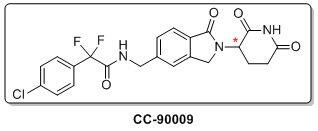
Organic Process Research & Development published an article online by Dr. Michael J. Zacuto on June 23, 2022, reporting the process synthesis of Bristol-Myers Squibb's CELMoD drug CC-90009. Notably, this literature is one of the few reported cases in the process development for preclinical/clinical PROTAC drugs, especially for the process synthesis involving CRBN pharmacophore derivatives.
1. Molecular Structure
2. Synthetic Pathway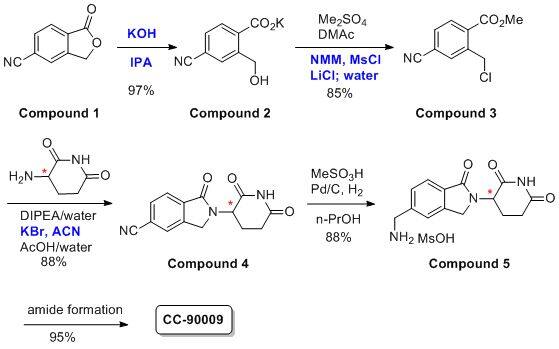
The improved process starts from compound 1, undergoes lactone ring-opening with KOH/IPA treatment, and isolates to obtain compound 2 (potassium salt). Subsequently, it is methylated and subjected to the Findelstein reaction to yield compound 3. Compound 3 undergoes a substitution reaction with 3-amino-2,6-piperidinedione, followed by intramolecular cyclization to produce compound 4. The hydrogenation of compound 4 has been optimized to significantly reduce the usage of Pd/C but still requires an equivalent amount of methanesulfonic acid. However, the acidic reaction environment causes palladium leaching, necessitating additional measures to reduce Pd residue (<50 ppm). In summary, this process basically resolves the scale-up synthesis of racemic CRBN derivatives, but this method is not suitable for producing chiral CRBN fragments like ARV-471, which Pfizer/Arvinas is currently testing in Phase II clinical trials. If another chiral center exists in the drug molecule, establishing the chiral center on 3-amino-2,6-piperidinedione becomes particularly important; otherwise, avoidable risk points may arise during quality research and later-stage filings.
About Meiluo
Suzhou Meino Pharmatech Co., Ltd. is a platform-based enterprise focusing on small molecule drug research and development. Established in 2008, it is one of the first CRO/CDMOs in China to deeply cultivate the field of protein degradation. After 14 years of development and growth, Meino now has eight technology platforms, including the protein degradation drug development platform ReThinking PROTAC, and has successfully developed dozens of core fragments (hundreds of kilograms level) capable of stable production.
Meno aims to provide integrated services for global biopharmaceutical companies, ranging from drug synthesis, structural optimization, process development, comprehensive quality research, pilot-scale production to cGMP manufacturing. It has established in-depth strategic partnerships with over 100 biopharmaceutical enterprises worldwide. For collaboration opportunities, please feel free to contact us!

Editor: Bai Ji